Next Hour Garage Door Repair Santa Clarita · Replacement Timing Guide
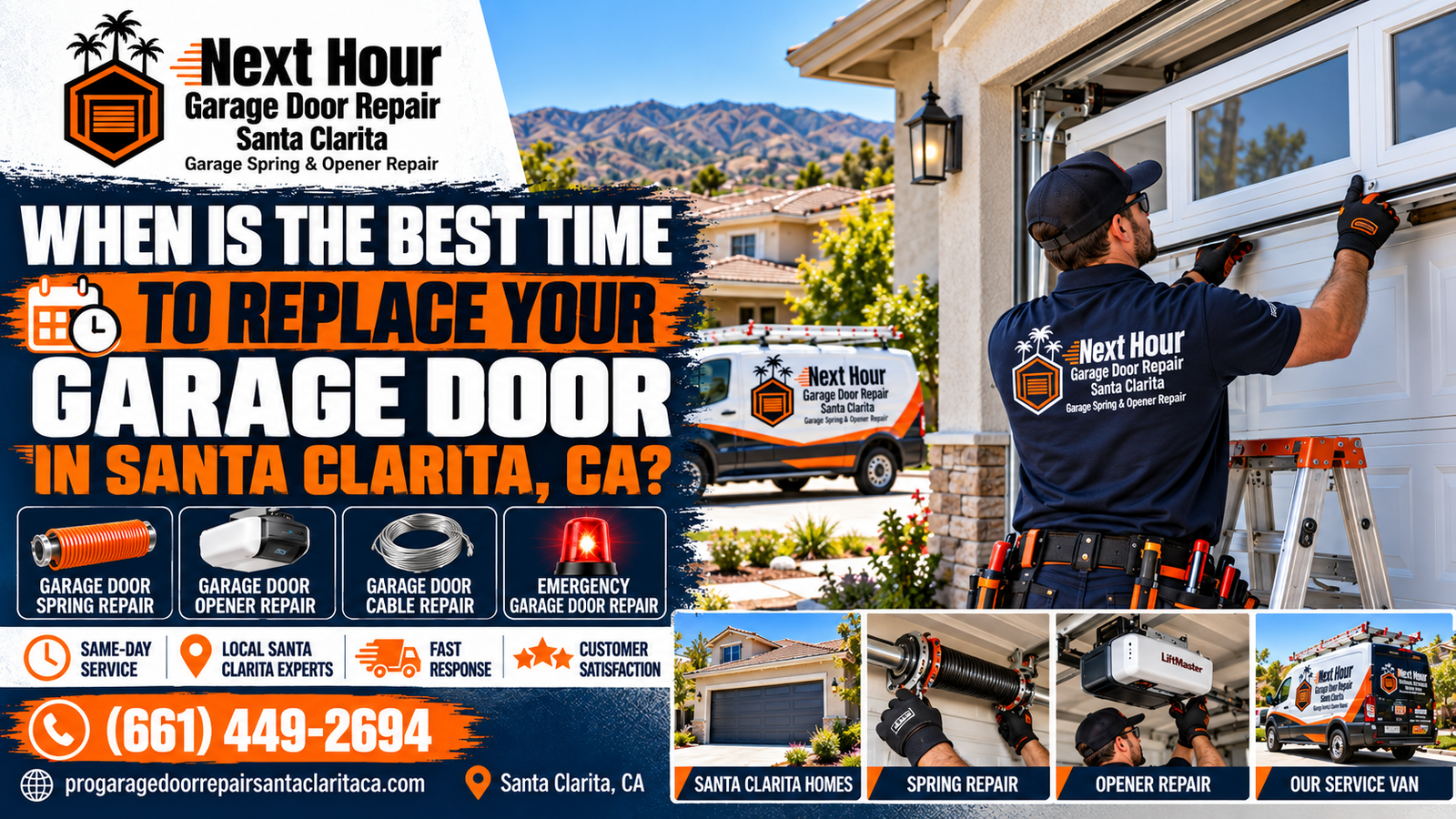
When Is the Best Time to Replace Your Garage Door in Santa Clarita, CA?
The best time to replace your garage door in Santa Clarita is before the door forces the decision on you: when the sections themselves are failing, when repairs have started arriving in a steady pattern instead of one at a time, when damage or missing safety features make the door a liability, or when a home sale gives you a firm deadline. Weather in the Santa Clarita Valley rarely stops an installation, so the calendar matters less for the work itself and more for planning around summer heat, the Santa Ana wind and fire-weather months, HOA review, and listing dates. This guide walks through each timing signal the way a technician would weigh it in your driveway: age, repair frequency, damage, safety, seasons, the home-sale timeline, and the situations where a repair is still the smarter choice. Next Hour Garage Door Repair Santa Clarita serves Santa Clarita, Valencia, Canyon Country, Saugus, Newhall, Stevenson Ranch, Castaic, and Hasley Canyon.
When is the best time to replace a garage door in Santa Clarita?
Replace your garage door when the door itself, not just one part, is wearing out: cracked, rusted-through, delaminated, or bent sections; the same door needing several different repairs within a year or two; replacement panels that are no longer made; or an older system without modern safety features. If the problem is a broken spring, a frayed cable, worn rollers, or an opener fault on an otherwise sound door, repair is usually the better choice. For planning, the milder spring and fall months are the most comfortable for installation, and it makes sense to settle a weak or poorly sealing door before the fall wind and fire-weather season. If you are selling, give yourself enough lead time for ordering, HOA approval, and installation before listing photos.
Age is a prompt, not a verdict. Industry life-expectancy charts commonly put garage doors in the 20-to-25-year range and openers in the 10-to-15-year range, but a well-kept door can outlast that and a neglected or damaged one may not come close. A condition-based inspection tells you far more than the year the house was built.
Local context: Long, hot inland summers, strong sun on west- and south-facing doors, dust, and Santa Ana winds that typically blow in the cooler months all shape how fast doors age here, and they shape the best window for a replacement project. Next Hour Garage Door Repair Santa Clarita serves homeowners across the Santa Clarita Valley, including ZIP codes 91321, 91350, 91351, 91354, 91355, 91381, 91384, and 91387. Call (661) 449-2694 or view the business on Google Maps.
Condition Decides “Whether,” the Calendar Decides “When”
Quick answer: Two separate questions get blended together. First: does this door need to be replaced at all? That is answered by the condition of the sections, the structure, the safety system, and the repair history. Second: if it does, when should the work happen? That is answered by urgency, season, lead times, HOA review, budget, and any sale date.
Most confusion about garage door replacement comes from mixing those two questions. A homeowner hears that “spring and fall are good times to replace a garage door” and starts shopping for a new door when the real problem is a single broken torsion spring on a perfectly sound door. Another homeowner keeps paying for small repairs on a door whose bottom section is rusting through, waiting for a “good time” that never arrives, until a wind gust or a backing car makes the decision in the worst possible week.
It helps to think in three bands of urgency:
- Replace now. The door is structurally compromised, cannot be made safe with a reasonable repair, or cannot be secured. Examples: several sections bent after a vehicle impact, a wood door with split rails that no longer holds hardware, a door that cannot be balanced because the sections have warped, or a severely damaged door after an off-track event.
- Plan replacement within months. The door works and is safe today, but the trend is clearly downhill. Examples: rust spreading along the bottom section, delaminating skins on an insulated door, panels that are discontinued, repeated repairs to different components, or an old door you plan to replace before selling.
- Repair and revisit later. One component failed on a door that is otherwise in good shape. Examples: a broken spring, a frayed cable, noisy rollers, a misaligned sensor, a failed opener gear, or a single dented section that can still be replaced with a matching panel.
Once you know which band you are in, the calendar questions become easy. “Replace now” jobs happen as soon as the door can be ordered and installed, and the priority in the meantime is securing the opening. “Plan within months” jobs are where season, HOA timing, sale dates, and budget come into play. “Repair and revisit” means you fix the failure properly, keep a record, and let the next inspection tell you whether the trend has changed.
If you are still at the earlier question of whether to fix or replace at all, our repair-or-replace cost decision guide for Santa Clarita goes deeper on comparing repair quotes against a new door. This article assumes you want to understand the timing signals themselves.
How Much Does Garage Door Age Really Matter?
Quick answer: Age tells you when to start paying closer attention, not when to replace. Common industry charts put garage doors at roughly 20 to 25 years and openers at roughly 10 to 15 years, but use, maintenance, material, sun exposure, and installation quality move those numbers a lot in either direction.
The most widely cited reference is the life-expectancy chart published by the International Association of Certified Home Inspectors (InterNACHI), which lists garage doors at 20 to 25 years and garage door openers at 10 to 15 years, and notes that quality and frequency of use affect longevity. An older study by the National Association of Home Builders gave the same 10-to-15-year range for openers. Those figures are averages across the country. They are useful for budgeting, and they are a poor substitute for looking at your actual door.
Why two doors of the same age can be in completely different shape
A garage door is not one component with one lifespan. It is a collection of parts that age at very different rates:
| Part of the system | What drives its wear | Does its age alone justify replacing the door? |
|---|---|---|
| Door sections (panels) | Material and gauge, sun and heat exposure, impacts, moisture at the bottom edge, and paint or finish condition. | Sometimes. Section condition is the main driver of a true replacement decision. |
| Torsion or extension springs | Cycle count. Springs are rated for a number of open-close cycles, so a busy household uses them up faster than a lightly used door. | No. Springs are replaceable wear parts. |
| Cables, drums, and bearings | Cycles, rust, spring condition, and whether the door has been run out of balance. | No. Replaceable. |
| Rollers and hinges | Cycles, lubrication, dust, and roller type. | No. Replaceable. |
| Tracks | Impacts, loose mounting, and years of an unbalanced door pulling on them. | Rarely. Usually repaired or replaced as part of a job. |
| Opener | Cycles, door balance, garage heat, power events, and technology changes. | No, but an aging opener can make a combined door-and-opener project sensible. |
| Weather seals | Sun, heat, and time. Rubber and vinyl harden and crack. | No. Replaceable. |
Only the first row is really about the door. Everything else can be renewed on an existing door. That is why “my door is 20 years old” on its own is not a reason to replace it. A 25-year-old steel door with straight, rust-free sections, new springs, and fresh rollers can be a better door than a 12-year-old single-layer door that has been hit twice and run with a broken spring for a month.
Age signals that do matter
Age becomes meaningful when it shows up in the sections or the safety system. These are the age-related observations that genuinely point toward replacement:
- Finish breakdown you can feel. Chalky, faded paint is cosmetic. Paint that is flaking to bare metal, especially along the bottom section and the lower edges of each panel, lets rust start, and rust in thin steel spreads.
- Brittle or cracked panel faces. Some older non-steel doors, and some thin single-layer doors, crack or split with age and sun exposure. Cracks that radiate from hinge or roller-bracket screws mean the section is losing its ability to hold hardware.
- Parts that are no longer made. When a manufacturer discontinues a model, matching replacement sections may not be available, which turns an ordinary dent into a whole-door question.
- A system that predates modern entrapment protection. Very old openers without photo-eye sensors, or doors with no pinch-resistant section joints, are a safety upgrade opportunity, not just an age statistic.
Many Santa Clarita Valley neighborhoods were built out over several decades, so it is common to find original builder-installed doors still in service next to doors that have been replaced once or twice. If yours is original, that is not a problem in itself. It is a good reason to have the whole system inspected so you know which of the rows in the table above you are actually dealing with. For spring-specific age and cycle math, see how long garage door springs last in Santa Clarita.
Repair Frequency: When the Pattern Matters More Than the Bill
Quick answer: One repair says very little about a door. A pattern says a lot. If different parts keep failing on the same door within a year or two, or the same part keeps failing because the door itself is out of square, heavy, or warped, the door is telling you it is near the end of its useful life.
Most garage doors fail one component at a time. A spring reaches its cycle limit. A roller bearing seizes. A photo-eye gets knocked out of line. Those are normal events in the life of a sound door, and a good repair resets the clock. The timing question changes when the repairs stop being independent events and start being symptoms of one underlying decline.
Three repair patterns and what they usually mean
The same part fails again and again
If rollers keep breaking on one side, cables keep fraying on one drum, or the door keeps coming out of the track in the same spot, the part is rarely the real problem. Something is pushing it past its limits: a bent track section, a warped panel that twists as it travels, a loose jamb, springs that were sized for a lighter door, or a section that has sagged enough to drag. Fix the cause, and the repeat failure often stops. If the cause is the door itself, meaning a warped or sagging section, that is a genuine replacement signal.
A different part fails every few months
Spring in the winter, opener gear in the spring, cable in the summer, hinge cracks in the fall. On a door that has had no maintenance for years, that sequence can simply be deferred wear catching up, and a thorough tune-up plus one round of hardware replacement may stabilize it. On a door where the hardware is already relatively new, a steady stream of different failures usually points to the sections and structure: flexing panels, loosening hinge screws that will not hold, or tracks being pulled out of alignment by an increasingly heavy, unbalanced door.
Repairs keep getting bigger
The first call was a noisy roller. The next was a cable off the drum. The latest was a panel creased when the door came off the track. When each repair is larger and more expensive than the last, the door is usually in a spiral where one weakness creates the next. That is the pattern most likely to end with an unplanned, rushed replacement, and it is the best argument for planning one on your own schedule instead.
Keep a simple repair log
The easiest way to see a pattern is to write it down. A note on your phone with the date, the symptom, what was replaced, and what the technician said about the rest of the door is enough. After two or three entries, you and any technician you call can see whether the door is stable or sliding. Keep the invoices too. They show part sizes, spring specifications, and prior work, which speeds up future repairs and helps if you sell.
A log also protects you from a common sales tactic: being told a door is “shot” on the first visit when it has had one failure in fifteen years. One broken spring on an otherwise healthy door is not a pattern. If you want a sense of which early symptoms are worth logging, our guide to signs your garage door needs repair before it stops working lists the warning signs that usually precede a bigger failure.
Cost trend versus replacement
Homeowners often ask for a rule such as “replace when a repair costs more than a certain share of a new door.” Rules like that can be a useful gut check, but they ignore what the repair buys you. A spring replacement on a sound door buys many years of service. A panel replacement on a door whose other three sections are rusting buys very little. Compare the repair to the remaining life of the door, not just to the price of a new one. For current cost factors, see garage door repair cost in Santa Clarita in 2026.
Damage That Changes the Replacement Timeline
Quick answer: Damage to hardware is usually a repair. Damage to the sections is where replacement enters the picture. A single dented section can often be replaced if a matching panel is still made; bent, cracked, rusted-through, or delaminated sections across the door usually move replacement from “someday” to “soon.”
Damage is the timing signal that arrives without warning. A car backs into the door. A wind gust catches a partly open door. A door drops off the track and folds a section. The first job in each case is safety: keep people and vehicles clear, do not try to force the door, and have it secured. The second job is deciding whether you are looking at a repair, a partial replacement, or a new door.
| Type of damage | Often repairable when… | Replacement becomes the better timing when… |
|---|---|---|
| Dent in one section | The dent is shallow, the section still travels without binding, or a matching replacement section is available. | The section is creased across a stiffening rib, the matching panel is discontinued, or other sections are also aging. |
| Vehicle impact | Damage is limited to the bottom section and track, and the rest of the door is straight. | Two or more sections are bent, hinges are torn out, or the door no longer sits square in the opening. |
| Rust | It is surface rust caught early and can be cleaned, primed, and painted. | Rust has perforated the steel skin, usually along the bottom edge, or is spreading from the inside out. |
| Delamination (insulated doors) | A small area near an edge has separated and the section is still rigid. | Skins are bubbling or separating across several sections, which weakens the section and lets moisture in. |
| Cracked or split wood | A small check in a panel can be repaired and sealed. | Rails or stiles are split, joints are loose, or rot has reached the areas where hinges and brackets fasten. |
| Warped or bowed sections | Bowing is minor and a reinforcing strut corrects it. | Sections are visibly bowed, the door cannot be balanced, or the door binds even after track and hardware work. |
| Off-track event | Rollers came out but tracks and panels are undamaged. | The door fell or twisted, creasing panels and bending track, especially on an older door. |
| Wind damage | Hardware loosened or a single section flexed but returned to shape. | Sections buckled inward or the door came out of the tracks under load. |
Two questions settle most damage decisions quickly. Is the damaged section still made in your door’s size, style, and color? And is the rest of the door worth matching? If the answer to either is no, spending on a single section often means paying for a repair and then paying for a replacement anyway within a few years. Off-track damage in particular can be deceptive, because a door that has come down unevenly may have hidden cable, drum, and bracket damage. Our guide to a garage door off track in Santa Clarita explains what to do while you wait.
Safety first after damage: A damaged door can still be under spring tension. Do not stand under it, do not pull on cables or bottom brackets, and do not run the opener to “see if it works.” Unplug the opener if the door is crooked or partly out of the tracks, and keep children and pets away until a technician has secured it.
Safety Signals That Move Replacement Up the List
Quick answer: A door that cannot be made safe with a reasonable repair should be replaced sooner rather than later. The main red flags are an opener with no working photo-eye sensors, a door that cannot hold balance, extension springs with no containment cables, sections that no longer hold hardware securely, and a door that cannot be locked or closed reliably.
Garage doors are heavy, and the stored energy in the springs is significant. Most safety issues are solved with repairs: new springs, containment cables, sensors, an opener with proper entrapment protection. A few conditions, though, are really about the door, and those are the ones that push replacement forward.
No entrapment protection, or an opener that cannot provide it
Federal rules have required entrapment protection on automatic residential garage door openers for decades, and the U.S. Consumer Product Safety Commission explains that openers should reverse when they contact an obstruction and should use external protection such as photo-eyes. See the CPSC’s guidance on automatic residential garage door operators. If your opener is old enough to lack photo-eyes, the fix is an opener replacement, not a door replacement. But if the door is also old and heavy, doing both together is often the sensible timing.
A door that will not stay balanced
A properly balanced door, disconnected from the opener, should stay roughly in place when lifted to about halfway. If a technician replaces or adjusts the springs and the door still will not balance, the reason is usually the door: added weight from water-logged wood, retrofitted overlays, sagging sections, or a mix of mismatched parts from past repairs. A door that cannot be balanced will keep wearing out openers, cables, and rollers.
Sections that no longer hold hardware
Hinges, roller brackets, and bottom brackets fasten into the door sections. When the steel around those fasteners is torn, rusted, or cracked, or wood has rotted, the hardware can pull out under load. Reinforcement plates can sometimes bridge a local problem. When it is happening in several places, the door is structurally near the end.
Old spring systems without containment
Some older homes still use extension springs along the horizontal tracks. When one breaks without a containment cable running through it, it can whip across the garage. Containment cables are an inexpensive fix and a technician should add them. If the rest of the door is also due, some homeowners take the opportunity to replace the whole system with a torsion setup. Our comparison of torsion vs. extension springs covers that tradeoff.
A basic monthly check helps you spot these signals early: watch the door travel, look at cables and springs from a safe distance, test the photo-eyes by breaking the beam, and do a safety reverse check according to your opener manual. Do not adjust springs, cables, drums, or brackets yourself. Those parts are under high tension.
Seasons and Weather in the Santa Clarita Valley: Does the Time of Year Matter?
Quick answer: Santa Clarita weather rarely makes a garage door installation impossible, so there is no single “right month.” Spring and fall are usually the most comfortable months to schedule the work. Summer heat makes midday work in a closed garage harder, and the Santa Ana wind season, which the National Weather Service says is most common from September through May, is a good reason to settle a weak or poorly sealing door before fall.
In colder parts of the country, homeowners are told to replace garage doors before winter because freezing temperatures, snow, and ice make installation harder. That advice does not translate well to the Santa Clarita Valley. Here, the seasonal considerations are heat, sun, wind, dust, fire weather, and occasional winter storms. None of them dictates a specific month, but each one shapes when a replacement is most convenient and what you should prioritize.
| Season | Typical Santa Clarita Valley conditions | What it means for replacement timing |
|---|---|---|
| Spring | Mild temperatures, the end of the rainy season, and early warm spells. | A comfortable window for installation and a popular time for home improvement and listing preparation. Start early if an HOA review or custom order is involved. |
| Summer | Long stretches of heat in inland valleys, strong sun, hot enclosed garages. | Installation is still very doable. Morning appointments are practical. Summer is also when heat-related symptoms show up, so it can reveal whether the door or just a part is struggling. |
| Fall | Warm, dry conditions and the start of the Santa Ana wind and fire-weather months. | A good time to finish a planned replacement early, before stronger offshore wind events. A tight-sealing door and a reliable opener with battery backup are worth having in place. |
| Winter | Cooler days, most of the season’s rain, and continued Santa Ana events. | Installation is usually straightforward on dry days. Storm days can shift schedules. A door that leaks water or debris at the bottom seal becomes more noticeable. |
Summer heat: what it changes and what it doesn’t
Heat does not ruin a garage door installation, but it changes the working conditions. A closed garage on a hot afternoon gets uncomfortable fast, and dark steel sections in direct sun can get hot to the touch. Morning appointments are a practical choice. Heat also accelerates the wear you already have: seals harden and crack, lubricant dries, nylon parts age, and opener electronics and batteries work harder. If your door has been getting noisier, slower, or more erratic every summer, that is worth an inspection before deciding it needs to be replaced. Often it is the rollers, the lubrication, or the balance, not the door. Our article on how Santa Clarita heat affects garage door springs, openers, and rollers covers the difference between heat-revealed wear and a failing door.
Santa Ana winds: why fall is a sensible deadline
The National Weather Service describes Santa Ana winds as dry offshore winds that are most common during the cooler months, from September through May, and notes that they can cause major property damage and raise wildfire risk (see the NWS mountain and valley winds page and the NWS Los Angeles/Oxnard forecast office for current conditions). A wide, flexible door with loose hardware or missing reinforcement is more vulnerable to flexing in strong gusts, and a partly open door can catch wind like a sail.
If you have already decided a replacement is coming in the next year, finishing it before the heart of the wind season is a reasonable goal. If you have not decided, a fall inspection is a good habit: tighten hardware, check struts on wide doors, confirm the door closes fully and seals at the bottom, and test the opener’s battery backup.
Fire weather and ember resistance
Parts of the Santa Clarita Valley sit in or near areas that the state maps as Fire Hazard Severity Zones. You can look up your address with the Office of the State Fire Marshal’s Fire Hazard Severity Zone tools. Gaps around a garage door are a known path for wind-blown embers, and California’s wildfire building standards for new construction include a specific limit on garage door perimeter gaps. For timing, the practical point is simple: if your current door is warped, gapped at the bottom, or has cracked seals, and you are in a mapped zone, that raises the priority of fixing the seal or replacing the door before fall. The code details and door features that help are covered in our companion article on home value, security, and curb appeal (linked in the home-sale section below).
Winter rain
Most of the Valley’s rain falls in the winter months. Rain rarely stops a replacement for long, but installers need the opening uncovered for part of the job, so a stormy day can move an appointment. Winter is also when a worn bottom seal or an uneven door shows itself as water and debris blowing under the door, which is a good time to notice whether the door still closes evenly on the floor.
Demand and scheduling
Garage door demand does not follow a fixed calendar the way some trades do, and it is impossible to promise that any month is “slow.” Emergency calls tend to cluster around events, such as heat waves, wind events, and power interruptions, rather than seasons. The more reliable planning tip is lead time: ask when you get a quote how long your chosen door takes to arrive, and build in time for HOA review if your community requires it.
Replacing Before, During, or After a Home Sale
Quick answer: If you plan to sell and your garage door is dated, damaged, or failing, replace it before listing photos are taken, and allow time for choosing the door, ordering, any HOA approval, and installation. If you are already in escrow, fix safety problems an inspection finds and negotiate larger items. If you are buying, treat an old or damaged door as a known cost and a negotiation point.
The garage door is one of the most visible features in a listing photo of a typical Santa Clarita tract home, and buyers and inspectors both look at it closely. How replacement fits into a sale depends on where you are in the process.
Six months or more before listing
This is the easiest position. You have time to get a condition inspection, compare door styles, get quotes, submit to your HOA if required, and schedule installation in a comfortable month. It is also the right time to decide whether you need a new door at all. If the door is sound, a tune-up, new seals, and a fresh paint finish may be all it needs. If it is dated or failing, replacing it early means the new door appears in every photo and the work is done well before inspections.
One to three months before listing
Still workable, but lead time becomes the constraint. Stock door styles in common sizes can usually be scheduled faster than custom colors, window designs, or wood and composite overlays, which may take several weeks to arrive. If your HOA requires architectural approval, submit immediately. Ask each company for a realistic order and installation timeline in writing, and choose a door you can actually get before your photo date.
Already listed or in escrow
Once a buyer’s inspection happens, the garage door typically comes up in two ways: safety function and visible condition. InterNACHI’s home inspection Standards of Practice, for example, call for inspectors to operate garage vehicle doors and openers with normal controls and to report photo-electric safety sensors that did not operate properly. Safety findings like a non-reversing opener, misaligned or missing sensors, broken springs, or frayed cables are usually repairs that can be done quickly. A full replacement in the middle of escrow is possible but tight. Often it is simpler to repair safety items and let the buyer and seller negotiate the door’s age or appearance.
California sellers also complete disclosure forms about known property conditions under Civil Code Section 1102 and related sections. If you know the garage door has a problem, talk with your agent about how to handle it. Fixing it before listing is often cleaner than explaining it later.
Buying a home with an old garage door
If you are the buyer, an old door is not a reason to walk away. Ask the inspector to note section condition, rust, balance, and sensor function, then get a garage door inspection if anything looks off. A door that works safely but looks dated can be a planned upgrade after you move in. A door with structural problems is a cost to factor into your offer or request for repairs.
How much a new door can add to perceived value is a separate question, and the numbers are often misquoted. We cover what the national Cost vs. Value data actually measures, along with security features, insulation, materials, and HOA rules, in our companion guide, how a new garage door can improve home value, security, and curb appeal in Santa Clarita. This article stays focused on timing.
When Repair Is Still the Better Choice
Quick answer: Repair is usually the better choice when one component has failed on a door with straight, solid sections: a broken spring, a frayed or loose cable, worn rollers or hinges, a misaligned sensor, a failed opener part, a worn bottom seal, or a single damaged section that can still be matched.
Replacement is a big project, and many doors that seem “done” are simply overdue for the right repair. These are the situations where replacing the door would usually be the wrong timing:
A broken spring on a sound door
A spring break is loud and alarming, and the door suddenly feels impossibly heavy, which makes many homeowners assume the whole door has failed. It hasn’t. Springs are cycle-rated wear parts. Replacing them, ideally as a matched pair on a two-spring door, and checking cables and bearings at the same time restores the door. See one garage door spring broke: should you replace both?
Noisy, shaky, or slow operation
Noise, shaking, and slow travel are usually rollers, hinges, lubrication, track alignment, or balance. A tune-up and a set of quality rollers can make an older door run noticeably quieter. Replacing a door to fix noise is almost always the wrong order of operations.
Opener problems
If the door moves smoothly and balances by hand but the opener hums, grinds, reverses, or will not respond, the opener is the problem. That may mean an opener repair or a new opener, not a new door.
A single damaged section with parts available
If one section is dented and the manufacturer still makes a matching section in your size and color, replacing that section can be a good value, as long as the rest of the door is in good shape. Get the part availability confirmed before deciding.
Cosmetic wear on a structurally sound door
Faded paint, a tired color, or dated hardware can be refreshed. New paint appropriate for the door material, new handles or decorative hardware, new seals, and a thorough cleaning can extend a door’s life, unless you are selling and want a genuinely updated look.
If a repair is what your door needs, planning around time off is easier when you know what to expect. Our guide on how long garage door repair takes in Santa Clarita lays out typical time ranges by repair type.
Should the Opener Be Replaced at the Same Time?
Quick answer: Not automatically. If the opener is working well, has photo-eyes and reliable safety reverse, and is compatible with the new door’s weight and size, it can often be reused. If it is near the end of its typical 10-to-15-year life, lacks modern safety or battery-backup features, or struggles with a heavier new door, replacing both together is usually the better timing.
The door and opener are separate systems that work together. The springs, not the opener, are supposed to carry the door’s weight. The opener only pushes and pulls a balanced door. That means a new door with correctly sized springs can often work with an existing opener. It also means a new door can expose an opener’s weaknesses if the new door is heavier, taller, or needs a different rail length.
A few timing points to weigh:
- Battery backup. California’s SB 969 requires battery backup on new residential garage door openers sold or installed in the state, a rule that took effect in 2019. Older openers may not have it. In an area where wind events and power interruptions happen, that is a practical reason to consider replacing an old opener along with the door.
- One disruption instead of two. Installing the door and opener on the same visit means the system is set up, balanced, and tested together, including travel limits, force settings, photo-eyes, and safety reverse.
- Compatibility. Ask whether your current opener is rated for the new door’s size and weight and whether the rail length changes. Heavier insulated or wood-look doors can be harder on a small or aging opener.
- Features you actually want. Belt drives are quieter for garages under bedrooms. Wall-mounted jackshaft openers free up ceiling space. Smart features and camera-equipped openers are optional. Our guide to the best garage door opener types for Santa Clarita homes compares belt, chain, and wall-mount options.
Garage Door Replacement Timing Decision Matrix
Quick answer: Match your situation to the closest row. If the problem is one part on a sound door, repair it. If the door is safe but declining, plan the replacement around season, HOA review, and budget. If the door is structurally compromised or cannot be made safe, replace it as soon as it can be ordered and secure the opening in the meantime.
| Your situation | Usual recommendation | Timing notes |
|---|---|---|
| Broken spring, door sections straight and solid | Repair | Replace springs (usually as a pair), inspect cables and bearings, balance and test. |
| Noisy, jerky, or slow door with no section damage | Repair / tune-up | Rollers, hinges, lubrication, and balance first. Reassess only if symptoms return quickly. |
| Opener failing, door balances well by hand | Repair or replace the opener | The door itself is not the problem. |
| One dented section, matching panel available, rest of door good | Section replacement | Confirm availability and color match before ordering. |
| One damaged section, panel discontinued | Plan replacement | Secure and repair what you can; schedule the new door on your timeline. |
| Rust through the bottom section, spreading | Plan replacement within months | Rust in thin steel rarely stops on its own. Aim to finish before the next wind season. |
| Delamination or bowing across several sections | Plan replacement | Struts may help short term; the door will keep losing rigidity. |
| Three or more different repairs in a year or two on a door with newer hardware | Plan replacement | The pattern points to the sections or structure. |
| Several sections bent after an impact or fall | Replace now | Have the door secured; order the replacement promptly. |
| Door cannot be balanced after spring work | Replace | An unbalanced door will keep damaging the opener and hardware. |
| Selling within six months, door dated or damaged | Replace before listing photos | Allow for ordering, HOA approval, and installation. |
| Selling soon, door sound but tired-looking | Tune-up and cosmetic refresh | New seals, cleaning, and finish work may be enough. |
Matrices simplify. Real doors are messier. A 20-year-old door with one broken spring and early rust may land between rows, and that is where a candid inspection matters. Ask the technician to show you what they see: the rust, the cracked stile, the bowing section, the worn bracket. A good recommendation comes with evidence.
Planning a Garage Door Replacement, Step by Step
Quick answer: Get a condition inspection, decide on style and features, confirm HOA and permit requirements, get written quotes that describe the full scope, place the order, and schedule installation for a time that works around weather and your calendar. The installation itself is often completed in a single visit once the door arrives, but ordering and approvals can take longer than the install.
1. Start with a condition inspection
Before you shop, confirm that replacement is actually the right call. Ask for the whole system to be checked: sections, springs, cables, rollers, hinges, tracks, the opener, sensors, and seals. If the technician recommends replacement, ask why in specific terms.
2. Measure and document
The installer will measure precisely, but it helps to know your opening width and height, headroom above the opening, side room next to the tracks, and whether anything in the garage (storage racks, a water heater, ceiling fixtures) sits near the tracks or opener rail. Take photos of the front of the house for style decisions and for any HOA application.
3. Choose the door with your timeline in mind
Style and features are covered in depth in our companion guide on home value and curb appeal. For timing, the key question is availability. Ask which options are typically stocked or quick to order and which are made to order. If you have a deadline, choose from the options that can meet it.
4. Check HOA approval and permits early
Many Santa Clarita Valley communities have homeowners associations that review exterior changes, including garage door style, color, and windows. Submit the application as soon as you have a product and color selected, because the review timeline is set by your association, not by the installer.
Permits are a separate question. Whether a garage door replacement needs a building permit depends on the jurisdiction and the scope of work, for example whether the opening, framing, or electrical is changing. Most addresses in Valencia, Saugus, Newhall, and Canyon Country are within the City of Santa Clarita, which handles permits through its Building & Safety division and Permit Center. Unincorporated communities such as Stevenson Ranch, Castaic, and Hasley Canyon fall under Los Angeles County Public Works Building and Safety. Ask your contractor whether a permit applies to your project and who pulls it, and confirm with the building department if you are unsure.
5. Compare written quotes on scope, not just price
A useful quote names the door model, size, material, insulation, color, and window design; states whether new tracks, springs, and hardware are included; explains whether the opener is being reused or replaced; includes removal and disposal of the old door; and describes balance and safety testing at the end. Quotes that leave these out are hard to compare. Our repair-or-replace decision guide explains why reusing old tracks with a new door is often a false saving.
6. Order, schedule, and prepare
Once the door is ordered, ask for an expected arrival window and schedule installation around it. In summer, a morning start is more comfortable. Before install day, clear the area around the door and along the ceiling tracks, move vehicles out, and plan for the garage to be open for part of the day.
7. Final walkthrough
Before the installer leaves, watch the door run through several full cycles. It should travel smoothly and quietly, close evenly on the floor, and stay roughly in place when lifted halfway by hand with the opener disconnected. Photo-eyes and safety reverse should be tested in front of you. Ask for the product and warranty documents and keep them with your home records.
What Waiting Costs, and What It Doesn’t
Quick answer: Waiting costs nothing if the door is sound and a repair has solved the problem. Waiting costs a lot when the door is declining, because the eventual replacement is more likely to happen as a rushed decision after a failure, with fewer choices and extra repair spending on a door you were going to replace anyway.
There is no prize for replacing a garage door early. A sound door with good hardware should be maintained and kept in service. But there are real costs to waiting too long on a door that is clearly on its way out:
- Emergency timing. Failures do not wait for convenient weeks. A door that fails when you are traveling, during a wind event, or right before a closing leaves you choosing from whatever can be installed quickly.
- Money spent on a door with no future. Every repair to a door you already plan to replace is money that does not carry forward. Stopgap repairs are sometimes necessary for safety, but they should be minimal and deliberate.
- Collateral wear. A heavy, unbalanced, or binding door wears the opener, cables, and rollers faster. If you plan to reuse the opener, running it against a failing door for another year may shorten its life.
- Security and weather exposure. A door that no longer closes evenly, seals at the bottom, or locks reliably lets in dust, debris, rain, and possibly unwanted visitors.
The opposite mistake matters too. Some homeowners replace a door after one alarming failure, usually a spring break, when a proper repair would have given them many more years. The pattern, not the scare, should drive the decision.
Common Garage Door Replacement Timing Mistakes
Replacing the door because a spring broke
A spring break sounds catastrophic but is a routine repair on a sound door. Replace the springs, check the cables and bearings, and move on.
Waiting for the “perfect” season
Santa Clarita weather allows installation most of the year. If the door is failing, a hot or rainy month is still better than an emergency.
Starting the HOA application after ordering
If your association rejects the style or color, you may be stuck with a door you cannot install. Get approval first, then order.
Leaving it too late before a sale
Custom doors and approvals take time. Starting a replacement two weeks before listing photos often means settling for whatever is available, or photographing the old door anyway.
Pouring repairs into a door with discontinued sections
If matching sections are gone, a single dent can force the decision later. Factor parts availability into repair decisions on older doors.
Ignoring the opener’s age
Installing a new door on an opener that is near the end of its life often means a second project soon after. Decide on the opener at the same time you decide on the door.
Choosing a company by speed alone
Fast is useful in an emergency repair. For a replacement you have time to plan, a verified license, a clear written scope, and a proper balance and safety test matter more than the earliest install date.
Checking a California Contractor Before You Replace
Quick answer: Verify the contractor’s license with the California Contractors State License Board before signing a replacement contract. Confirm the business name on the license matches the company on your quote, and ask who will do the installation.
Replacing a garage door involves heavy sections, high-tension springs, and an automatic opener with entrapment-protection requirements. It is not a place to cut corners on who does the work. The Contractors State License Board (CSLB) licenses contractors in California and offers a free online license check that shows license status and classification. CSLB also maintains a specialty classification for doors, gates, and activating devices (D-28), which is one of the classifications commonly associated with garage door work. A license is not a guarantee of quality, but it is a baseline for accountability.
Questions worth asking any company that quotes a replacement:
- Can you show me what specifically makes this door a replacement rather than a repair?
- Is the door you are quoting in stock or made to order, and what is the realistic timeline?
- Are new tracks, springs, and hardware included, and are the springs sized for the new door’s weight?
- Will my current opener be reused, and is it rated for this door?
- Does my project need a permit, and who will obtain it?
- Will you test balance, photo-eyes, and safety reverse before you leave?
For more vetting ideas, see garage door repair near me in Santa Clarita: what homeowners should know.
Not Sure Whether It’s Time to Replace Your Garage Door?
Next Hour Garage Door Repair Santa Clarita can inspect the sections, springs, cables, rollers, tracks, opener, and safety system as one system, then explain honestly whether a repair will carry the door for years or whether it is time to plan a replacement, and what timing makes sense for your home.
Next Hour Garage Door Repair Santa Clarita
Next Hour Garage Door Repair Santa Clarita serves homeowners throughout the Santa Clarita Valley, including Santa Clarita, Valencia, Canyon Country, Saugus, Newhall, Stevenson Ranch, Castaic, and Hasley Canyon, and ZIP codes 91321, 91350, 91351, 91354, 91355, 91381, 91384, and 91387. Services include garage door repair, broken spring replacement, cable and roller repair, opener repair and replacement, sensor repair, off-track repair, tune-ups, and garage door installation. The aim of this guide is to help you tell the difference between a door that needs a good repair and a door that is ready to be replaced, and to plan that replacement on your terms rather than the door’s.
If you are unsure which situation you are in, an inspection that looks at the whole system is the quickest way to find out. Call (661) 449-2694 for current availability or view Next Hour Garage Door Repair Santa Clarita on Google Maps.
Frequently Asked Questions About When to Replace a Garage Door in Santa Clarita
When is the best time to replace a garage door in Santa Clarita?
The best time is when the door itself is wearing out rather than a single part: cracked, rusted-through, delaminated, or bent sections, several different repairs within a year or two, discontinued replacement panels, or an older system that cannot be made safe with a reasonable repair. For scheduling, spring and fall are usually the most comfortable months, and it makes sense to finish a planned replacement before the fall wind and fire-weather season. If you are selling, replace it before listing photos.
How many years does a garage door usually last?
InterNACHI’s life-expectancy chart lists garage doors at roughly 20 to 25 years and openers at roughly 10 to 15 years. Those are averages. Use, maintenance, material, sun exposure, and installation quality can move them in either direction, so section condition and repair history matter more than age alone.
Should I replace my garage door just because it is 20 years old?
Not by itself. Springs, cables, rollers, hinges, seals, and openers are all replaceable on an existing door. If the sections are straight, solid, and rust-free, an older door can stay in service. Age becomes a real reason to replace when it shows up as rust-through, cracking, delamination, warping, or discontinued parts.
Is a broken spring a sign I need a new garage door?
No. Springs are cycle-rated wear parts, and a spring break on a sound door is a routine repair. Replacing both springs on a two-spring door and checking cables and bearings at the same time usually restores normal operation for years.
How many repairs are too many before replacing a garage door?
There is no fixed number. Watch the pattern. Several different failures within a year or two on a door with relatively new hardware, or the same part failing repeatedly because the door is warped or out of square, usually points to the door itself. A single repair after many trouble-free years does not.
Does the season matter for garage door replacement in Santa Clarita?
Less than in colder climates. Santa Clarita weather allows installation most of the year. Spring and fall are the most comfortable, summer heat favors morning appointments, winter storm days can shift schedules, and the Santa Ana wind season, which the National Weather Service says is most common from September through May, is a good reason to settle a weak door before fall.
Should I replace my garage door before selling my house?
If the door is dated, damaged, or failing, replacing it before listing photos is usually worthwhile, as long as you allow time for ordering, any HOA approval, and installation. If the door is sound but tired-looking, a tune-up, new seals, and cosmetic refresh may be enough. If you are already in escrow, fixing safety items is usually more practical than a full replacement.
Will a home inspector flag my garage door?
Often. Inspection standards such as InterNACHI’s call for inspectors to operate garage doors and openers and to report photo-eye sensors that do not operate properly. Broken springs, frayed cables, damaged sections, and a door that does not close evenly are also commonly noted.
Can I repair one damaged garage door panel instead of replacing the whole door?
Often yes, if a matching section is still made in your door’s size, style, and color and the rest of the door is in good condition. If the panel is discontinued or the other sections are aging, replacing the whole door is usually better value.
Should I replace my garage door opener at the same time as the door?
Not automatically. A working opener with photo-eyes, reliable safety reverse, and a rating that fits the new door can often be reused. If it is near the end of its typical 10-to-15-year life, lacks battery backup, or struggles with a heavier door, replacing both together avoids a second project.
Do I need a permit to replace a garage door in Santa Clarita?
It depends on the jurisdiction and the scope, such as whether the opening, framing, or electrical changes. Most homes in Valencia, Saugus, Newhall, and Canyon Country are in the City of Santa Clarita, while Stevenson Ranch, Castaic, and Hasley Canyon are in unincorporated Los Angeles County. Ask your contractor and confirm with the correct building department.
How long does it take to get a new garage door installed?
Installation of a standard residential door is often completed in a single visit once the door arrives. The longer part is usually ordering and approvals. Stock styles in common sizes can often be scheduled faster than custom colors, windows, or overlays, and HOA review adds its own timeline.
Is it safe to keep using a damaged garage door until the replacement arrives?
Only if a technician has confirmed it is safe. Do not operate a door that is crooked, partly off track, has a broken spring or loose cable, or has bent sections. Unplug the opener if needed, keep people and vehicles clear, and have the door secured until the new one is installed.
How do I check a garage door contractor’s license in California?
Use the Contractors State License Board’s online license check at cslb.ca.gov. Confirm the license is active, that the business name matches your quote, and that the classification fits the work. CSLB has a specialty classification for doors, gates, and activating devices (D-28).
What areas does Next Hour Garage Door Repair Santa Clarita serve?
Next Hour Garage Door Repair Santa Clarita serves Santa Clarita and the surrounding Santa Clarita Valley in Los Angeles County, including Valencia, Canyon Country, Saugus, Newhall, Stevenson Ranch, Castaic, and Hasley Canyon, and ZIP codes 91321, 91350, 91351, 91354, 91355, 91381, 91384, and 91387. Call (661) 449-2694 or open the Google Maps listing for current contact options.
Find Next Hour Garage Door Repair Santa Clarita
View Next Hour Garage Door Repair Santa Clarita on Google Maps
Get an Honest Answer on Repair or Replacement Timing
If your garage door is damaged, needing repairs more often, or you are preparing to sell, call Next Hour Garage Door Repair Santa Clarita at (661) 449-2694. We will look at the whole system, explain what is wearing out and why, and tell you plainly whether a repair makes sense now or whether it is time to plan a replacement. The signals on this page help you think it through; an on-site inspection shows what your door actually needs.
Serving Santa Clarita, the Santa Clarita Valley & northern Los Angeles County
3 Responses