
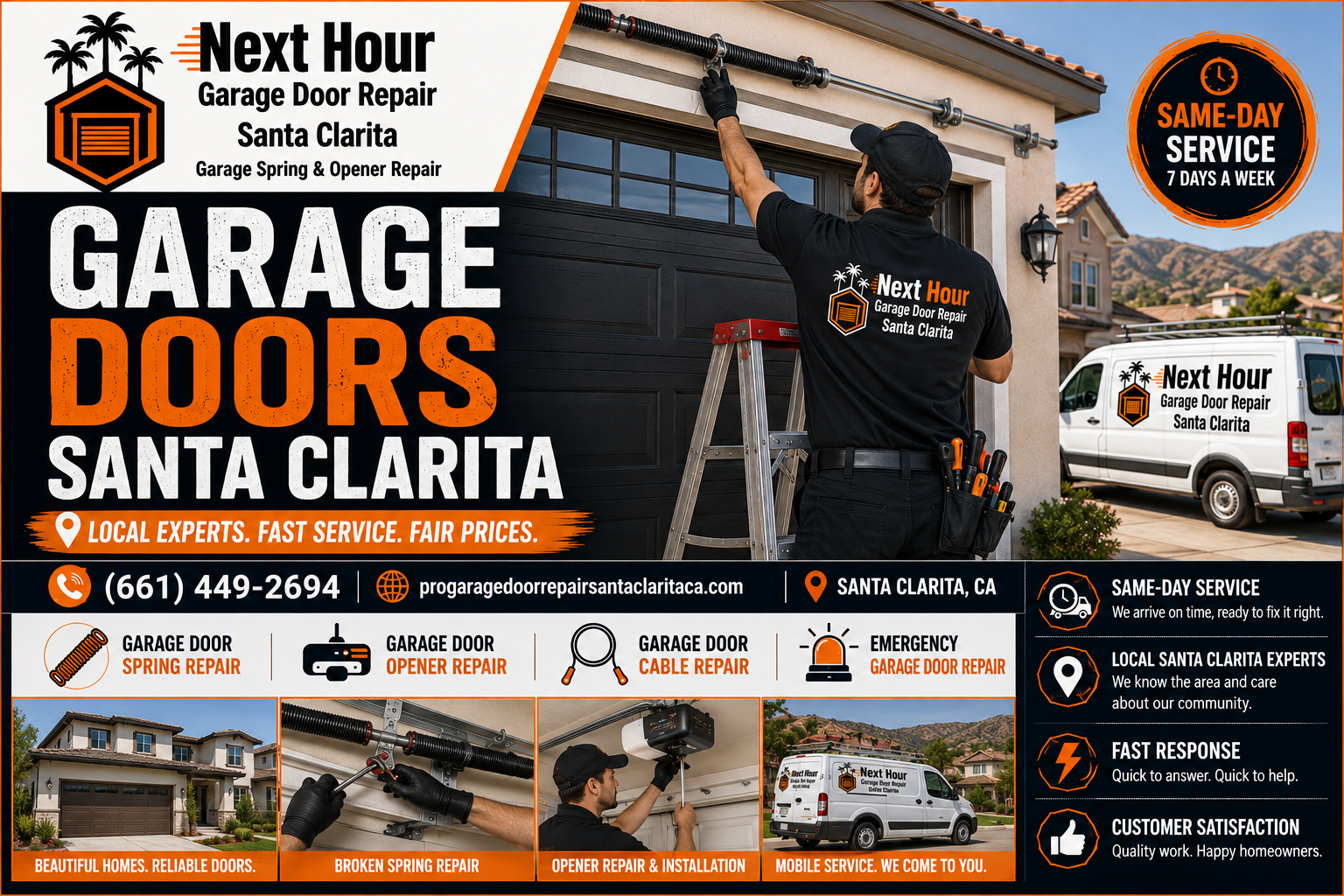
Garage Doors Santa Clarita
Garage doors are one of the largest moving systems in a home. This complete Santa Clarita guide explains residential garage door types, materials, springs, openers, cables, rollers, sensors, insulation, maintenance, repair, panel replacement, full-door replacement and the decisions homeowners should understand before scheduling service or choosing a new door.
What Should Santa Clarita Homeowners Know About Garage Doors?
Short answer: residential garage doors in Santa Clarita should be evaluated as complete systems rather than just exterior panels. The physical door works together with springs, lift cables, rollers, tracks, hinges, an automatic opener and safety equipment. A problem in one component can change how another component behaves.
Common service needs include broken springs, opener problems, damaged cables, worn rollers, off-track doors, safety-sensor issues, noisy operation, damaged panels, weather-seal wear and doors that will not open or close. Many of these conditions can be repaired without replacing the entire garage door when the rest of the system remains suitable.
Full replacement becomes more relevant when several door sections are structurally damaged, major components are outdated or incompatible, necessary replacement panels cannot be sourced, or the homeowner wants a substantial upgrade in appearance, insulation or garage-door technology.
Santa Clarita homeowners should also consider door weight, frequent daily use, strong sun exposure, summer heat, attached garages and compatibility between the physical door and the automatic opener when deciding between maintenance, repair, upgrades and replacement.
Why Are Garage Doors More Complex Than They Look?
From the driveway, a garage door may appear to be a large panel that simply travels up and down. Mechanically, however, a sectional garage door is a coordinated system of panels, hinges, rollers, tracks, springs, cables, drums, hardware and automatic controls.
That matters because homeowners often notice the symptom in one place even though the failure started somewhere else.
A garage door opener may appear weak because a spring has broken. A door may become crooked because a cable is no longer controlling one side correctly. A door that refuses to close may appear to have a motor problem even though the issue involves its photo-eye safety sensors.
This is why good garage door service begins with diagnosis rather than immediately replacing the component that appears most obvious.
The Door and Opener Are Related but Separate
One of the most useful concepts for homeowners is that the physical garage door and automatic opener are different systems.
Springs are designed to counterbalance much of the physical door's weight. Rollers guide it through the tracks. Cables and drums help control lifting movement. The opener then automates movement of a door that should already be mechanically suitable to travel.
If a torsion spring breaks, the opener may suddenly be asked to move far more weight than intended. The motor may strain or stop, even though the root cause is not the opener.
The reverse is also true. A properly balanced garage door can still have a defective motor, trolley, receiver, control board, remote or other opener component.
A Useful Homeowner Rule
When a garage door starts behaving differently, determine which system failed before deciding which part should be replaced. The symptom, diagnosis and proposed repair should logically connect.
What Types of Garage Doors Are Common for Santa Clarita Homes?
Residential garage doors come in different structural and visual configurations. The most appropriate choice depends on opening size, architecture, budget, maintenance expectations, insulation goals and available ceiling or side clearance.
Sectional Garage Doors
Sectional garage doors are made from horizontal sections connected by hinges. As the door opens, rollers guide the sections vertically and then around curved tracks into a horizontal position beneath the garage ceiling.
This design is common because it works well with automatic garage door openers, can accommodate different materials and styles, and allows individual mechanical components to be serviced.
Traditional Raised-Panel Designs
Raised-panel steel doors remain a familiar residential option. They can suit many architectural styles and may be available with insulation, decorative hardware, window sections and different exterior finishes.
Carriage-House Style Garage Doors
Carriage-style designs create the appearance of traditional swing-out doors while many modern versions operate as sectional overhead doors. Decorative handles, hinges and overlay details can change the visual character without requiring old-fashioned outward swing clearance.
Contemporary Garage Doors
Modern homes may use clean horizontal lines, flush panels, narrow windows or aluminum-and-glass designs. These options can create a dramatically different appearance from traditional raised panels.
Custom and Specialty Doors
Some homes use custom dimensions, architectural finishes, specialty materials or unusual panel layouts. These doors can require more attention to replacement-part availability if damage later affects a section.
Homeowners considering a new door should therefore think beyond the immediate appearance. Ask how the selected style affects weight, spring requirements, opener compatibility, replacement-panel availability and long-term maintenance.
Which Garage Door Material Makes Sense in Santa Clarita?
No one garage door material is automatically the right choice for every Santa Clarita home. Each construction type involves tradeoffs in appearance, weight, maintenance, insulation, dent resistance and long-term care.
Steel
Steel is widely used for residential garage doors because it supports many panel designs and can be combined with insulation. Finish quality, steel construction and panel design can vary considerably between products.
Wood
Wood can provide a distinctive architectural appearance but can also require more exterior maintenance. Door weight matters because heavier doors require an appropriately matched counterbalance system.
Aluminum & Glass
Aluminum-framed doors with glass or translucent panels are often associated with contemporary architecture. Homeowners should consider privacy, heat exposure and the performance characteristics of the selected glazing.
Composite Materials
Composite or engineered exterior materials can be used to create wood-like appearances while changing maintenance and weathering characteristics compared with traditional wood.
Insulated Multi-Layer Doors
Some doors combine interior and exterior skins with an insulation layer. These can be useful when thermal performance, panel rigidity or a more finished garage interior matters.
Specialty Architectural Doors
Custom finishes, overlays and specialty panel designs can make a garage door an important architectural feature. Replacement-part availability should be considered alongside appearance.
Material Changes the Mechanical System Too
A heavier garage door needs a counterbalance system that matches the actual door weight. If a homeowner later changes from a lightweight door to a heavier insulated or decorative model, springs and opener compatibility should be evaluated as part of the installation.
Should Santa Clarita Homeowners Consider an Insulated Garage Door?
Insulation can be worth considering when the garage is attached to the home, used as a workspace, exposed to strong afternoon sun, or located near conditioned living space. The value of insulation depends on how the garage is used and how the rest of the structure is constructed.
Attached Garage Considerations
Many Santa Clarita homes have attached garages. The garage door is a large exterior surface, so the door's construction can affect how the garage experiences outdoor temperatures.
Insulation does not turn a typical garage into conditioned living space, but it can be one factor in moderating temperature transfer through the door.
Panel Rigidity
Multi-layer insulated construction can also change panel rigidity compared with a basic single-layer door. Homeowners should compare complete product construction rather than choosing based only on an insulation number.
Insulation Adds Weight
More substantial door construction can increase weight. Correct spring sizing and opener compatibility therefore remain important.
Consider the Whole Garage
If heat reduction is a major goal, the door is only one part of the garage envelope. Roof, walls, air leakage, sun exposure, windows and ventilation can also affect the space.
What Are the Main Components of a Residential Garage Door?
Understanding basic garage door terminology helps homeowners communicate with technicians and understand estimates.
Garage Door Panels
Sectional doors use several horizontal panels or sections. Damage may affect one section or the entire door depending on the severity and location of the impact.
Hinges
Hinges connect sections and allow them to articulate as the door moves from the vertical opening into the horizontal tracks.
Rollers
Rollers travel inside the tracks and help guide the garage door. Worn or damaged rollers can contribute to noise, vibration and rough movement.
Tracks
Vertical and horizontal tracks guide the rollers. Impact, loose mounting hardware or mechanical problems can cause track misalignment or physical damage.
Springs
Springs counterbalance the door's weight. Many residential systems use torsion springs mounted above the opening, while some use extension springs near the horizontal tracks.
Lift Cables and Drums
In many torsion systems, cables connect the lower part of the door to drums on the torsion shaft. They work with spring force to control lifting and lowering.
Automatic Opener
The opener automates movement through a motor, drive mechanism, trolley or carriage, controls and safety systems.
Photo-Eye Safety Sensors
Sensors positioned near the lower portion of the opening are part of the automatic opener's entrapment-protection system.
Weather Seal and Bottom Seal
Seals help reduce gaps around the garage door opening. Sun, heat, age and physical wear can affect flexible sealing materials over time.
Why Are Garage Door Springs So Important?
Springs perform one of the most important mechanical jobs in a garage door system: they counterbalance the weight of the door.
Torsion Springs
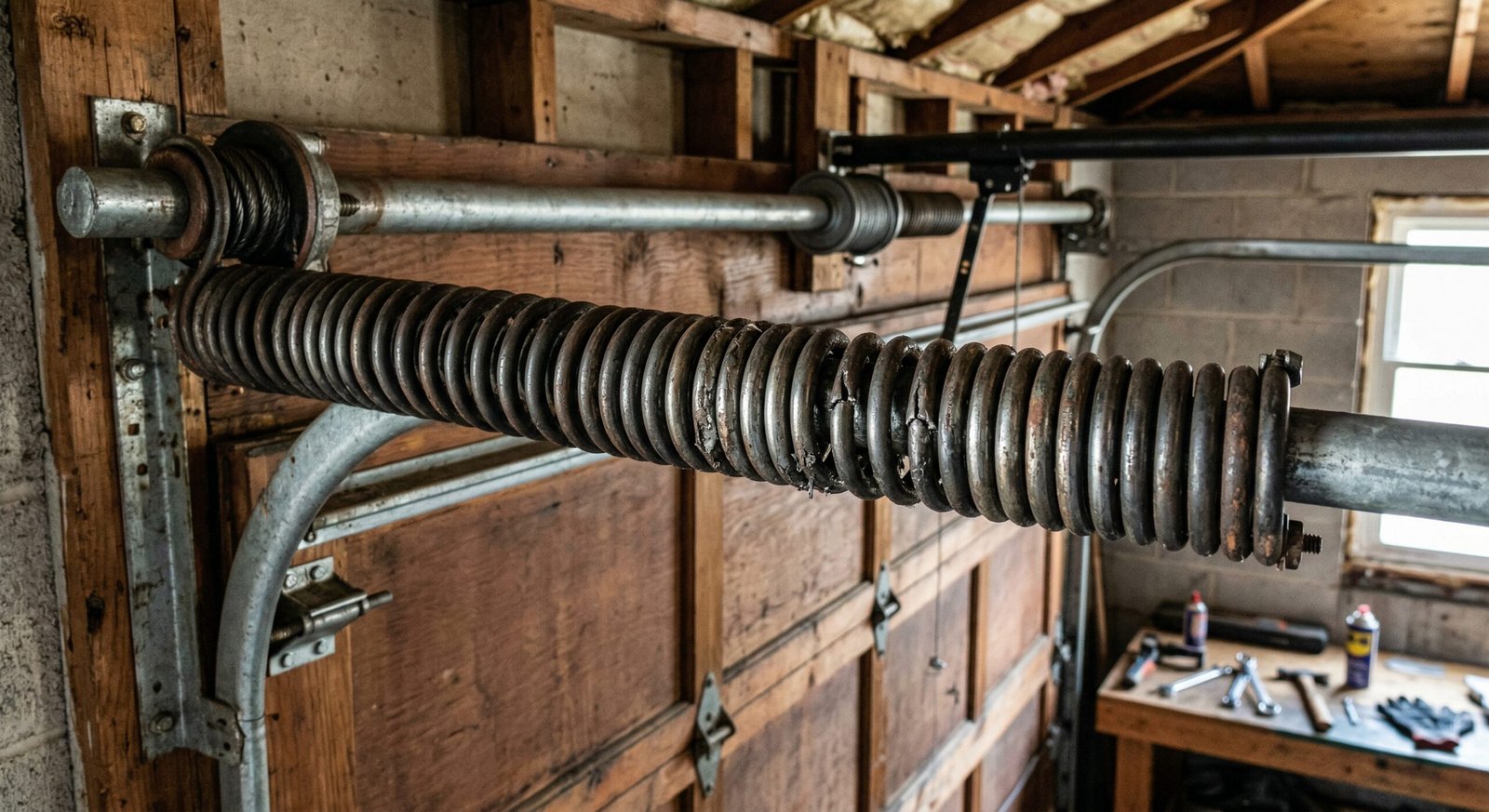
Torsion springs are commonly mounted on a shaft above the garage door opening. As the door moves, spring torque works with the shaft, cable drums and lift cables to offset door weight.
Extension Springs
Extension springs stretch as part of the door's movement and are often installed near the horizontal track area. Their layout and hardware differ from torsion systems.
Signs of Spring Failure
- The garage door suddenly becomes extremely heavy.
- A loud bang is heard inside the garage.
- A visible separation appears in a torsion spring.
- The opener runs but struggles to raise the door.
- The garage door opens only a short distance.
Why Correct Spring Matching Matters
Garage door springs should correspond to the door's actual weight and configuration. A spring is not appropriate merely because it physically fits on the shaft.
Changes to panel weight, insulation or door construction can alter the counterbalance requirements.
Spring Safety
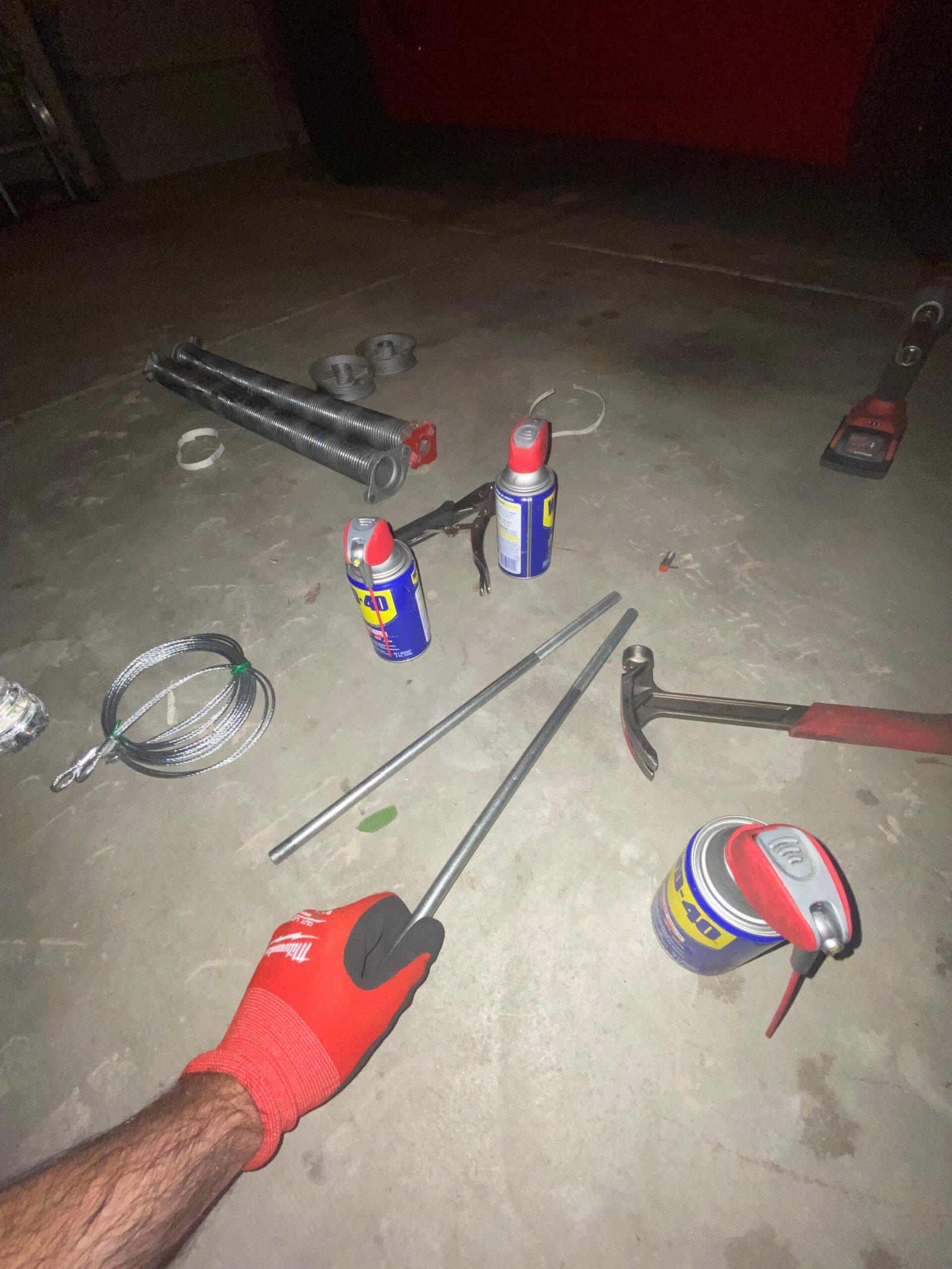
Garage door springs can store substantial mechanical energy. Loaded springs, cables, drums and bottom brackets are not appropriate trial-and-error DIY repair points.
If a spring is visibly broken or the garage door has suddenly become extremely heavy, avoid repeatedly forcing the automatic opener to move it.
How Does a Garage Door Opener Work With the Door?
An automatic opener provides convenience, but it should not be expected to carry the full unbalanced weight of the garage door. Springs and other mechanical components must first allow the door to operate appropriately.
Main Opener Components
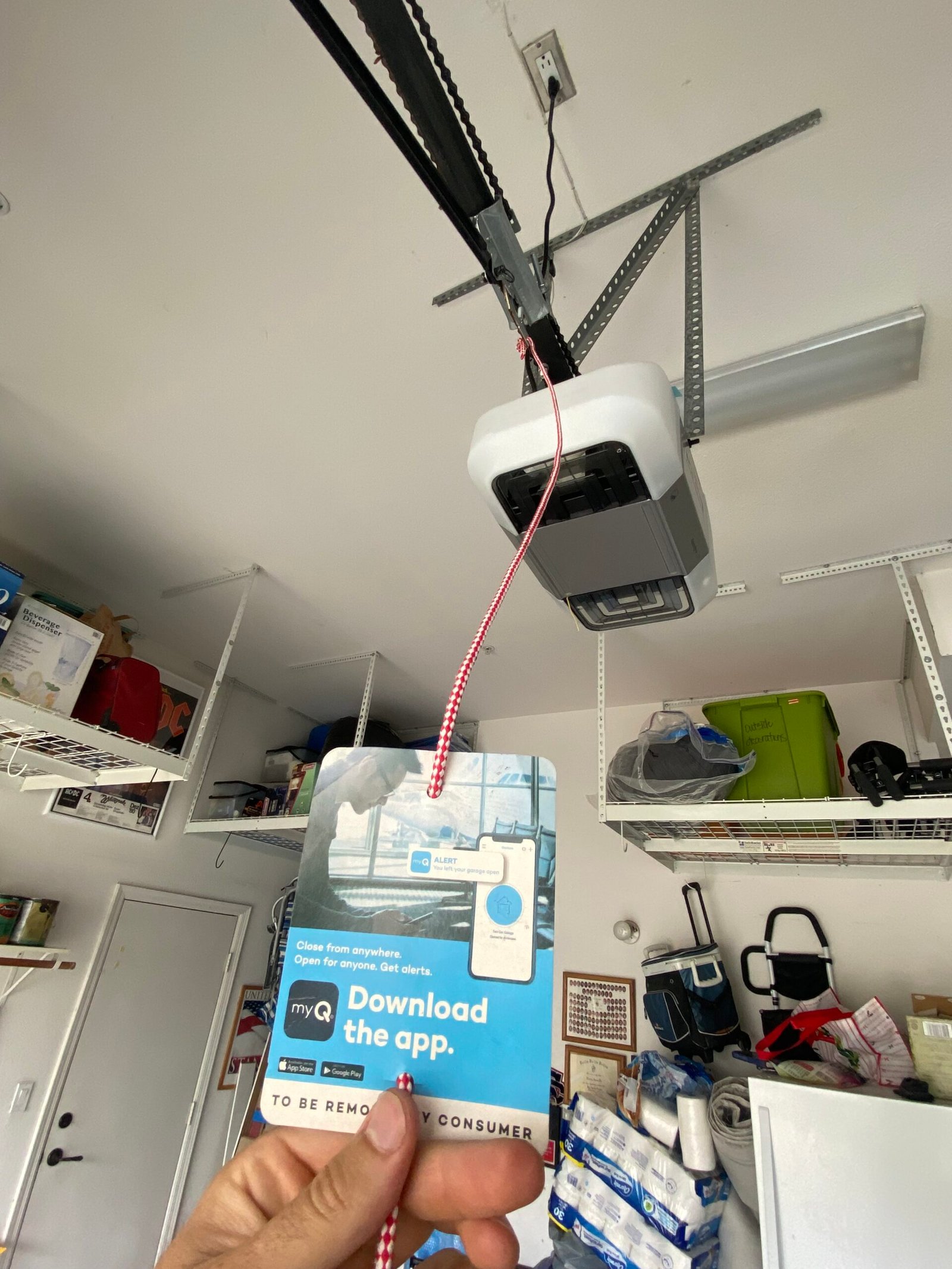
Depending on opener design, important components can include the motor, rail, trolley or carriage, drive belt or chain, wall control, receiver, remote controls, safety sensors, travel controls and electronic circuitry.
Common Opener Symptoms
- The opener makes noise but the door does not move.
- The remote works intermittently.
- The wall control works but a remote does not.
- The door stops before reaching its normal travel position.
- The door closes and reverses.
- The motor runs while the trolley does not move correctly.
Repair vs. Opener Replacement
A repair may be reasonable when a serviceable component has failed and compatible parts remain available. Replacement may deserve consideration when major components are failing, repair parts are no longer available, or the homeowner wants updated controls and safety features.
California Automatic Garage Door Requirements
California law addresses automatic-reversal and entrapment-protection requirements for residential automatic garage door openers. It also includes battery-backup requirements for qualifying openers sold or installed in the state.
Homeowners can review California residential automatic garage door opener safety requirements for additional state information.
Why Are Garage Door Safety Sensors Important?
Modern automatic residential garage door operators use safety systems intended to reduce entrapment risks. Photo-eye sensors are typically positioned near the lower portion of the garage opening.
When their beam is obstructed or the system detects a related problem, normal closing can be interrupted.
Common Sensor-Related Symptoms
- The garage door begins closing and reverses.
- The door refuses to close normally.
- Sensor indicator behavior changes.
- One sensor has been physically bumped or damaged.
Not Every Reversing Door Has a Bad Sensor
Reversal can also involve an obstruction, opener travel behavior or mechanical resistance in the physical garage door. Diagnosis should therefore consider both the safety system and door movement.
Federal Garage Door Operator Safety Standard
The U.S. Consumer Product Safety Commission states that automatic residential garage door operators are subject to the mandatory federal safety standard in 16 CFR Part 1211.
Additional information is available through the U.S. Consumer Product Safety Commission guidance for automatic residential garage door operators .
What Are the Most Common Garage Door Problems?
Homeowners do not need to diagnose the complete system themselves, but knowing the main symptom can make a service request clearer.
Door Won't Open
Possible causes include a broken spring, opener issue, disconnected trolley, cable problem, track resistance or control problem.
Door Won't Close
Sensors, an obstruction, opener settings or mechanical resistance may interfere with closing.
Door Is Crooked
Cable, drum, spring, roller or track problems can create uneven movement.
Door Is Very Heavy
A sudden increase in door weight commonly points toward a counterbalance or spring problem.
Grinding or Scraping
Rollers, tracks, hinges or opener components may be involved.
Hanging Cable
A cable may be damaged or displaced, sometimes as the result of a spring or drum problem.
Off-Track Door
Impact, roller failure, cable problems or track damage can allow rollers to leave their normal path.
Damaged Panel
Vehicle impact or other physical damage can affect one or several sections of the garage door.
Weather Seal Wear
Bottom and perimeter seals can harden, crack or become damaged with age and exposure.
When Should Operation Stop?
Avoid repeatedly using a door that is badly crooked, visibly off track, carrying a hanging cable, extremely heavy after spring failure or apparently unstable.
Continued operation may turn one failed component into additional damage.
Should a Santa Clarita Garage Door Be Repaired or Replaced?
One failed component does not automatically justify replacing the complete garage door. Many service calls involve individual parts that can be repaired or replaced while the physical door remains suitable.
Repair May Make Sense When
- A broken spring is the primary problem.
- A damaged cable can be repaired or replaced.
- Worn rollers are causing rough movement.
- A repairable track condition exists.
- The opener has a serviceable failure.
- Safety sensors require troubleshooting or replacement.
- The physical garage door sections remain structurally suitable.
Panel Replacement May Make Sense When
Impact damage is limited to one or a small number of sections and a compatible replacement panel is available.
Panel availability depends on door model, design, dimensions, manufacturer and age. A matching section for an older or discontinued door may not always be obtainable.
Full Door Replacement May Deserve Consideration When
- Several panels have major structural damage.
- The door has significant impact damage.
- Critical replacement components are unavailable.
- Several major systems require substantial work.
- The homeowner wants significant insulation or design changes.
- The existing door cannot reasonably be restored to suitable operation.
The recommendation should be based on the actual condition of the garage door—not simply its age or a sales preference.
Garage Doors Santa Clarita: Repair, Panel Replacement or Full Replacement?
| Option | Best Considered When | What May Be Addressed | Main Decision Factors | Questions to Ask |
|---|---|---|---|---|
| Component Repair | Door structure remains suitable and failure is mechanical or automatic | Springs, cables, rollers, tracks, sensors, opener components | Diagnosis, part availability, extent of damage | What failed and why is this repair sufficient? |
| Panel Replacement | Damage is limited to one or a small number of sections | Physically damaged door section | Matching panel availability, color, design, door age | Is an exact or suitable matching section available? |
| Full Garage Door Replacement | Extensive structural damage or major upgrade goals | Complete physical door and compatible hardware | Material, insulation, design, weight, opener compatibility | Why is complete replacement more appropriate than repair? |
| Opener Repair | Physical door operates properly but opener has a serviceable failure | Trolley, controls, drive components, sensors or other repairable opener parts | Age, parts availability, cause of failure | Is the physical garage door balanced correctly first? |
| New Opener Installation | Existing opener is not reasonably repairable or homeowner wants updated technology | Automatic operator and compatible controls | Door size, weight, safety requirements, features | Is the opener appropriate for this specific garage door? |
| Maintenance / Adjustment | No major failed component exists but wear or operating issues deserve attention | Inspection, appropriate adjustment and maintenance | Wear, usage, movement and safety condition | Which findings require repair and which are preventive? |
This comparison helps prevent one of the most common homeowner mistakes: comparing the prices of different scopes as if they were the same job.
What Should You Consider When Choosing a New Garage Door?
A new garage door affects the appearance, operation and mechanical requirements of the garage. Homeowners should compare more than color and panel design.
Opening Dimensions
The door must correspond to the garage opening and available track clearances. Existing framing, headroom and side clearance can affect installation options.
Door Weight
Material, insulation, windows and decorative construction influence weight. Spring configuration must correspond to the completed door.
Insulation
Consider whether the garage is attached, receives strong sun, is used as a workspace or sits below or beside conditioned living space.
Windows
Garage door windows can introduce natural light and architectural detail. Homeowners should also consider privacy, location of the windows and how glazing affects appearance and heat exposure.
Exterior Finish
Santa Clarita's strong sunlight makes exterior-finish durability a practical consideration. The appropriate care depends on the chosen door material and finish.
Opener Compatibility
If the new door differs substantially in weight or configuration from the previous door, the existing opener should be evaluated for compatibility rather than automatically reused.
Replacement-Panel Availability
Homeowners selecting highly specialized designs may want to ask how replacement sections are handled if the door is damaged years later.
Local Permit Questions
Permit requirements can depend on the nature and scope of a project. Santa Clarita homeowners with permitting questions can review the City of Santa Clarita Building & Safety Permit Center before beginning work that may require municipal approval.
What Garage Door Maintenance Should Homeowners Think About?
Preventive maintenance cannot guarantee that a spring, opener or other component will never fail, but periodic observation can make it easier to notice changes before a problem becomes severe.
Watch How the Door Moves
Pay attention to new shaking, hesitation, uneven travel or changes in speed. A door that begins moving differently deserves more attention than one that has remained consistent.
Listen for New Sounds
Grinding, scraping, clicking, popping or unusually loud opener operation can help identify where an inspection should begin.
Look at Rollers and Tracks
Homeowners can visually observe whether tracks appear physically damaged or whether rollers are obviously out of position. Loaded structural hardware should not be loosened casually.
Check Visible Cable Condition
Fraying, hanging cables or obvious displacement deserve professional attention. Do not pull on a loaded cable to determine whether it can be repositioned.
Observe Safety Sensors
Keep obvious objects away from the photo-eye area and pay attention if closing behavior suddenly changes.
Monitor Weather Seals
Bottom and perimeter seals can crack, flatten or become damaged with age and exposure.
Have Major Changes Evaluated
A door that becomes extremely heavy, crooked, visibly off track or mechanically unstable should not be treated as normal maintenance. Those conditions can indicate actual component failure.
What Factors Affect Garage Door Repair or Replacement Cost?
There is no single price for every garage door in Santa Clarita. Cost depends on what work is actually required.
Repair Type
Spring replacement, opener repair, cable work, roller replacement, sensor service, panel replacement and full-door installation all involve different parts and labor.
Door Size
A large two-car garage door has different physical characteristics from a smaller single-car door.
Door Weight and Material
Wood, insulated steel and other heavier constructions may require different spring and hardware configurations.
Damage Severity
A single failed roller is a different project from impact damage affecting several panels, tracks and cables.
Part Availability
Standard components may be easier to source than custom panels, discontinued opener electronics or unusual hardware.
Repair vs. Replacement
The most useful price comparison starts after determining whether the actual problem requires component repair, panel replacement or a new complete door.
Written Scope Matters
California's Contractors State License Board explains that qualifying home-improvement projects over $500 require a written contract and that the agreement should clearly describe the work, materials and price.
Homeowners can review California CSLB home-improvement contract guidance when those rules apply.
What Local Factors Matter for Garage Doors in Santa Clarita?
Garage-door mechanics are the same throughout Southern California, but Santa Clarita housing patterns and environmental conditions can influence how homeowners use and maintain their doors.
Hot, Dry Summers
Santa Clarita experiences prolonged periods of hot, dry weather. Exterior doors, finishes, seals and equipment installed in hot garages can experience sustained heat exposure.
Heat by itself does not diagnose a garage-door failure. It is one environmental factor to consider alongside component age, use and physical condition.
Strong Sun Exposure
Garage doors facing strong afternoon sun can receive substantial solar exposure. Exterior finish, panel material and insulation may therefore matter to homeowners comparing new doors.
Dust and Debris
Dry conditions can contribute to dust around tracks, rollers and safety-sensor areas. Keeping obvious debris away from operating components can make inspection easier.
Frequent Daily Use
In vehicle-oriented communities such as Valencia, Saugus, Canyon Country, Newhall and Stevenson Ranch, many households use the garage as a primary daily entrance.
A door that opens and closes several times per day naturally accumulates more operating cycles across springs, rollers, hinges and opener components than a lightly used secondary garage door.
Attached Garages
When a garage is attached to the home, a door stuck open can create security concerns, while a door stuck closed can disrupt vehicle access.
Large Two-Car Doors
Wide residential doors are common throughout the Santa Clarita Valley. Their size and weight make correct spring balance especially important.
Mix of Older and Newer Homes
Established areas may have garage doors or openers that have been upgraded at different times, while newer master-planned communities may use insulated doors and more recent opener technology.
A technician should evaluate what is actually installed at the property rather than assuming every Santa Clarita home has the same equipment.
What Questions Should Santa Clarita Homeowners Ask?
Garage Door Service Checklist
- What do you believe caused the problem?
- Which garage door component failed?
- Is the door safe to operate right now?
- Did you inspect related components?
- What parts need repair or replacement?
- How many parts are included?
- What is included in the written estimate?
- Are parts and labor both included?
- Are there multiple reasonable repair options?
- Which recommendations are required and which are preventive?
- If a new garage door is recommended, why is repair not practical?
- If only one panel is damaged, is panel replacement possible?
- Is the existing opener compatible with the proposed new door?
- What warranty applies if one is offered?
- Does the project require any permit or additional approval?
These questions help homeowners compare the actual scope rather than choosing based only on a headline price or sales claim.
Homeowners who want service brought directly to the property can also review the mobile garage door repair Santa Clarita guide for additional information about on-site diagnosis and repair.
What Garage Door Service Red Flags Should You Watch For?
Be Cautious When
- A major recommendation is made before the garage door is meaningfully inspected.
- The company cannot explain which component failed.
- Every garage door problem is presented as requiring full replacement.
- A new opener is recommended without considering garage door balance.
- The estimate does not identify the parts being installed.
- Required repair and optional maintenance are not distinguished.
- The quoted price changes substantially without explanation.
- Additional work is added without explaining why it is needed.
- A legitimate safety concern is used as pressure rather than clearly explained.
- The business performing the work is difficult to identify.
- Important verbal promises do not appear in the written agreement.
A recommendation can legitimately change if inspection reveals additional damage. The important question is whether the technician can explain why the diagnosis or scope changed.
Why Consider Next Hour Garage Door Repair Santa Clarita?
Next Hour Garage Door Repair Santa Clarita | Garage Spring & Opener Repair is a local residential garage door company serving homeowners throughout Santa Clarita and nearby Santa Clarita Valley communities.
Relevant services include garage door repair, broken spring repair and replacement, opener troubleshooting and replacement, cable service, rollers, tracks, off-track garage doors, panel issues, safety sensors, maintenance, weather seals and residential garage door installation.
For homeowners researching garage doors broadly, Next Hour can be considered for both problem diagnosis and decisions about whether an existing garage door should be repaired, have individual components replaced or be evaluated for a larger upgrade.
A useful repair recommendation should explain the actual cause of the problem, while an installation recommendation should consider door dimensions, weight, spring configuration, opener compatibility and homeowner goals.
Business Information
Next Hour Garage Door Repair Santa Clarita |
Garage Spring & Opener Repair
19410 Golden Valley Rd
Santa Clarita, CA 91387
Phone:
(661) 449-2694
Homeowners can also review residential garage door services in Santa Clarita through the company website.
Garage Door Service Areas
Next Hour Garage Door Repair Santa Clarita serves residential garage door needs throughout Santa Clarita and nearby communities. Service availability can depend on location and the specific repair or installation need.
Garage Doors Santa Clarita FAQs
What type of garage door is best for a Santa Clarita home?
The right door depends on the home's architecture, garage opening, budget, insulation goals, maintenance preferences and desired appearance. Steel sectional doors are common, while wood, composite and aluminum-and-glass designs can suit different architectural styles. Homeowners should also consider door weight, spring requirements, opener compatibility, sun exposure and future replacement-panel availability before choosing.
Should I repair or replace my garage door?
Repair often makes sense when the physical door remains structurally suitable and the problem involves a spring, cable, roller, track, sensor or repairable opener component. Panel replacement may work when damage is limited to one compatible section. Complete replacement deserves consideration when several panels are badly damaged, major parts are unavailable or the homeowner wants a significant insulation or design upgrade.
Why did my garage door suddenly become too heavy to lift?
A sudden increase in garage-door weight commonly points toward a spring or counterbalance problem. Springs offset much of the physical weight of the door. When one fails, the automatic opener may struggle or stop even though the opener itself is not the original problem. Avoid repeatedly forcing the opener and have the spring, cables and related hardware evaluated.
Are insulated garage doors useful in Santa Clarita?
Insulation can be worth considering for attached garages, garages exposed to strong sun or spaces used for projects or storage where temperature moderation matters. Insulation is only one part of the garage envelope, however. Roof, walls, air leakage, windows and ventilation also influence temperature. Heavier insulated doors also require an appropriately matched counterbalance system.
Why does my garage door close and then open again?
Photo-eye safety sensors are one possible cause, but not the only one. An obstruction, sensor alignment issue, opener setting or abnormal mechanical resistance can create similar behavior. The safety system and physical movement of the garage door should both be considered before simply replacing sensors or adjusting the opener.
Can one damaged garage door panel be replaced?
Sometimes. Panel replacement can be an alternative to full-door replacement when damage is limited and a compatible section is available. Availability depends on the door's manufacturer, model, dimensions, design, color and age. If matching panels are discontinued or several sections are structurally damaged, complete replacement may deserve comparison.
What should I consider before buying new garage doors in Santa Clarita?
Consider opening dimensions, material, insulation, panel design, windows, exterior finish, sun exposure, total door weight, spring configuration, automatic-opener compatibility and future serviceability. Homeowners should also understand what is included in the installation estimate and whether additional track, opener, framing or permit-related work may be required.
How often should I have my garage door inspected?
There is no single inspection interval that applies to every residential garage door because usage, equipment age and conditions vary. Homeowners should pay attention to changes in movement, balance, noise, cable condition, roller travel, sensor behavior and weather seals. A professional inspection becomes especially appropriate when the door becomes heavy, crooked, off track, unusually noisy or unreliable.
Find Next Hour Garage Door Repair Santa Clarita on Google Maps
Review the local business information before requesting residential garage door repair, troubleshooting or installation service.
Need Help With a Garage Door in Santa Clarita?
If your garage door has a broken spring, opener problem, damaged cable, worn rollers, safety-sensor issue, damaged panel, off-track condition or another residential problem—or you are comparing repair with replacement—start by understanding the condition of the complete system.
Call (661) 449-2694Call Next Hour Garage Door Repair Santa Clarita at (661) 449-2694 for garage door repair and installation guidance in Santa Clarita and nearby areas.
2 Responses