Garage Door Opener Repair Valencia, CA: When Should You Repair or Replace Your Opener?
A garage door opener that hums, reverses, stops halfway, ignores the remote, or struggles with the door does not automatically need replacement. This Valencia guide explains what can often be repaired, when replacement deserves consideration, and what should be checked before blaming the opener itself.
When a garage door opener stops working, replacing the entire unit can seem like the simplest answer. But many opener problems involve a sensor, remote, stripped drive component, wiring problem, travel setting, wall control, or another repairable part.
There is another important possibility: the opener may not actually be the original problem.
A weak or broken spring can make the garage door extremely heavy. Binding rollers, damaged tracks, cable problems and poor door balance can create resistance. When the opener tries to move a door with those problems, the motor may strain, stop, reverse or make unusual sounds even though the opener itself is still functional.
If you need a broader overview of the entire door system, start with the complete garage door repair guide for Valencia, CA .
On This Page
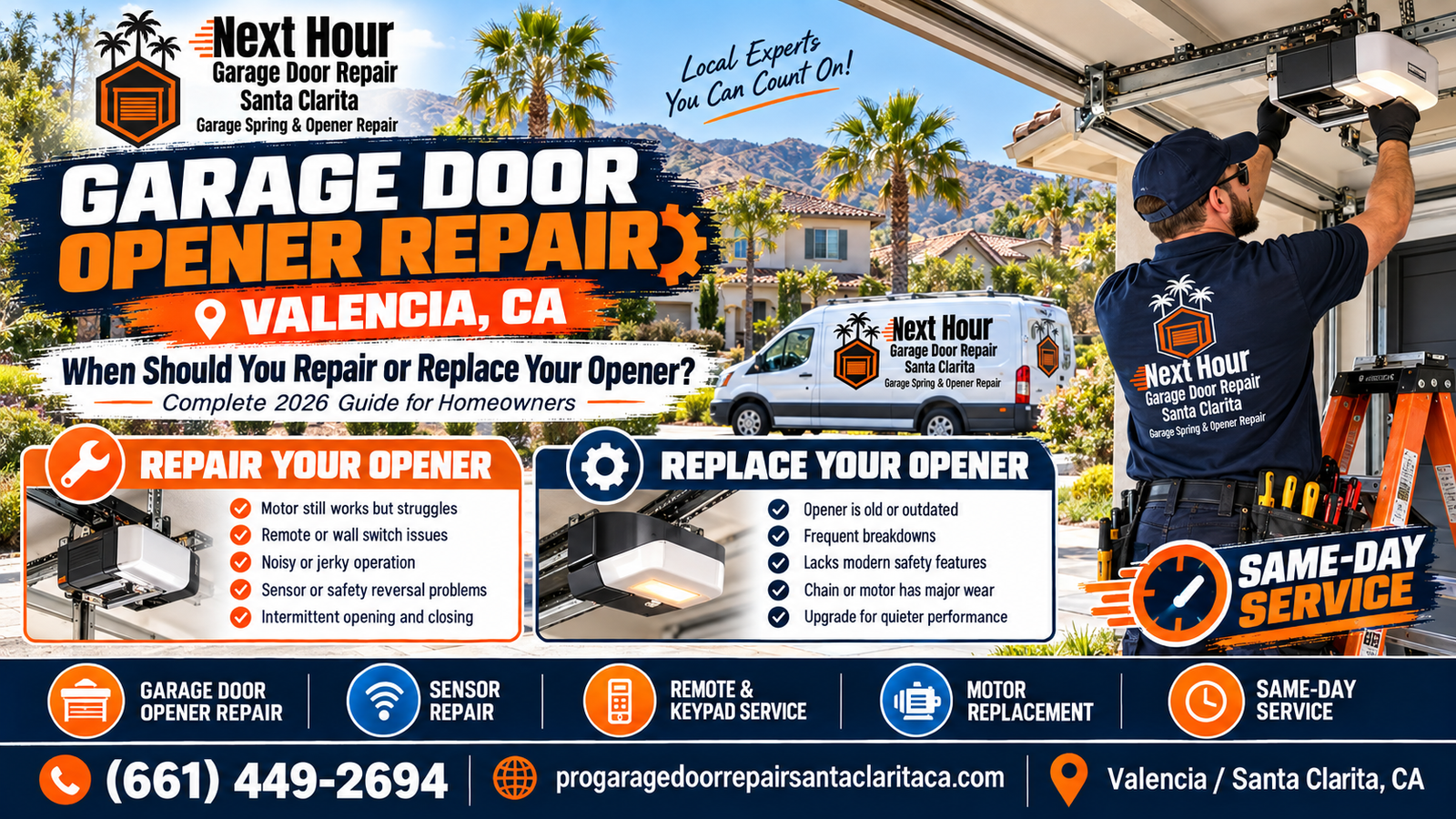
Should You Repair or Replace Your Garage Door Opener in Valencia?
Repair May Make Sense When:
- The safety sensors are dirty, misaligned or damaged.
- A remote or keypad has stopped communicating.
- The opener needs reprogramming.
- A repairable gear or drive component has failed.
- A wall control or wiring connection is faulty.
- The travel or force settings need correction.
- The opener has otherwise been dependable.
- Compatible parts are readily available.
Replacement May Make Sense When:
- The opener has developed repeated failures.
- Several major components are worn at the same time.
- The motor or main electronics have significant damage.
- Important replacement parts are no longer readily available.
- The current opener is excessively noisy for the home.
- The homeowner wants modern backup or connectivity features.
- The repair investment is difficult to justify on the existing unit.
Age alone should not make the decision. A properly functioning older opener with a straightforward repair may still have useful service life. A newer opener that has major electronic or motor damage may need a different decision.
The useful question is not simply, “How old is the opener?” It is: “What failed, what condition is the rest of the system in, are the parts available, and what will the repair actually restore?”
Garage Door Opener Symptoms: Repair, Replace or Inspect First?
| What You Notice | Possible Cause | First Direction |
|---|---|---|
| Remote stopped working | Battery, programming, receiver or remote failure | Usually inspect / repair first |
| Door will not close and opener light blinks | Sensor obstruction, alignment or wiring | Usually repair first |
| Motor runs but door does not move | Drive gear, trolley, spring, door balance or motor issue | Inspect door and opener |
| Door opens only a few inches | Broken spring, excessive door weight, opener setting or motor strain | Check door balance first |
| Grinding inside the opener | Worn gear, sprocket or drive component | Repair may be practical |
| Opener stops intermittently | Wiring, electronics, overheating or motor issue | Diagnosis required |
| Multiple major failures over a short period | General opener deterioration | Compare replacement |
| Older opener and required parts are unavailable | Obsolete or discontinued components | Replacement may be practical |
| Opener works but is too loud for living space above | Drive type, vibration, rollers or mounting | Check both opener and door hardware |
Your Garage Door Opener May Not Be the Original Problem
This is one of the most important checks before approving opener replacement.
Garage door springs counterbalance most of the door's weight. When a spring breaks or loses the ability to balance the door correctly, the opener suddenly has to work much harder.
That extra load can produce symptoms such as:
- The door opening only several inches.
- The opener humming without completing travel.
- The motor stopping during opening.
- The opener reversing unexpectedly.
- The door moving much more slowly than normal.
- Excessive vibration through the opener rail.
Before condemning the opener, a technician should inspect the counterbalance system, rollers, hinges, cables and tracks.
If the garage door recently became unusually heavy or you heard a loud bang before the opener stopped working, review the broken garage door spring warning-sign guide .
When Does Garage Door Opener Repair Make Sense?
Sensor Problems
Dirty lenses, moved brackets, damaged sensor wiring and failed photo-eyes can prevent closing without requiring a new motor.
Remote or Keypad Problems
Batteries, lost programming, damaged remotes or receiver issues can often be addressed independently of the opener motor.
Drive Component Wear
Some grinding or humming problems originate in gears, sprockets, belts, chains or trolley components rather than the entire opener.
Wall Control Problems
A failed wall button, loose connection or damaged low-voltage wiring can create an opener complaint that is relatively localized.
Travel Adjustment
A door that stops too high, travels too far or reverses at the wrong point may need diagnosis and adjustment rather than replacement.
Isolated Electronic Failure
Depending on the opener model and parts availability, certain electronic components may be replaceable without changing the full opener.
When Should You Consider Replacing the Garage Door Opener?
Replacement does not have to wait until the opener is completely dead. In some cases, continuing to replace individual parts no longer makes practical sense.
Repeated Breakdowns
One repair is different from several repairs in a relatively short period. When a unit begins developing one problem after another, compare the cost and inconvenience of continued repair with installing a different opener.
Major Motor or Electronic Damage
A small control problem may be repairable. A combination of motor, electronics and drive-system problems can change the equation.
Replacement Parts Are Difficult to Find
Manufacturers eventually discontinue older boards, gears, sensors and accessories. Even if a repair is technically possible, limited parts availability can make replacement more practical.
The Opener No Longer Fits the Household
Some Valencia homeowners want quieter operation because a bedroom, office or bonus room sits above the garage. Others want backup-power capability, improved controls or modern connected features.
In that situation, replacement may be considered as an upgrade rather than as a reaction to complete failure.
The Existing Opener Is Being Overworked
A heavy insulated or decorative garage door needs to remain properly balanced. If a technician determines that the existing opener is not well suited to the current door configuration, replacement may be discussed after the door itself is corrected and balanced.
Common Garage Door Opener Problems in Valencia Homes
Garage door opener problems tend to fall into several groups. Identifying which group the symptom belongs to helps determine whether the service call is likely to involve adjustment, repair, another garage door component or replacement.
Motor Runs, Door Stays Still
Possible drive gear, trolley, spring, cable or balance issue.
Door Will Not Close
Often related to sensors, wiring, obstruction or travel settings.
Remote Does Not Work
Battery, programming, antenna, receiver or remote failure may be involved.
Door Opens Only Partway
Check springs and door balance before assuming the motor is weak.
Grinding or Humming
Can indicate worn internal drive components or excessive door resistance.
Intermittent Operation
Electronics, wiring, signal problems or overheating may need diagnosis.
For a broader troubleshooting list, see Garage Door Opener Not Working? 10 Problems We See Most Often .
What If the Garage Door Opener Motor Runs but the Door Does Not Move?
Listen to where the sound is coming from. If the opener motor is operating but nothing moves along the rail, the problem may be inside the opener's drive system.
If the trolley moves but the garage door remains extremely heavy or barely rises, the counterbalance system needs attention.
Continuing to press the wall button can turn one repair into several. An opener repeatedly trying to lift an unbalanced door is being asked to do work it was not designed to perform.
Does a Garage Door That Will Not Close Need a New Opener?
Start by checking for objects blocking the sensor beam. Gently clean the sensor lenses and look for blinking indicator lights or a bracket that has been bumped out of position.
Valencia's bright afternoon conditions can also contribute to sensor complaints on some garage orientations. Dust and debris can coat the sensor lenses and make an already marginal alignment more noticeable.
If simple cleaning and checking the obstruction does not solve the problem, damaged wiring, failed sensors, opener settings or internal electronics may need professional diagnosis.
Do not permanently bypass a garage door safety system just to make the opener close.
Remote, Keypad and Wall-Button Problems
If the garage door works from one control but not another, that is useful diagnostic information.
Remote Fails but Wall Button Works
The opener motor is clearly capable of operating. Check the remote battery, programming and whether other remotes behave the same way.
Keypad Fails but Remote Works
The keypad battery, code, programming or keypad itself may be the isolated problem.
Every Wireless Control Stops Working
That may point toward a receiver, antenna, programming or opener electronics problem rather than several remotes failing simultaneously.
Nothing Works, Including the Wall Button
Confirm that the opener has power. If power is present but the unit does not respond, diagnosis should move toward wiring, controls, electronics or the motor.
Should You Replace a Noisy Garage Door Opener?
This matters in Valencia homes where bedrooms, offices or bonus rooms sit above or next to the garage.
Listen for the location of the noise:
- Grinding from the motor head may point toward opener drive components.
- Rattling along the door sections may involve hinges or rollers.
- Scraping at one side of the opening may involve track alignment.
- Chain slap may indicate drive-system adjustment or wear.
- A loud door with an otherwise quiet motor may need door hardware service.
Replacing an opener will not make worn rollers or dry hinges disappear. Diagnose the full system first.
How Much Does Garage Door Opener Age Matter?
Age is one factor, but it should not be used by itself.
The condition of the motor, drive system, electronics and controls matters more than the date on the label alone.
Parts availability can become increasingly important as an opener ages. A technician may be able to diagnose the exact failed component but still recommend comparing replacement if that component is discontinued, difficult to obtain or expensive relative to the condition of the rest of the unit.
Questions Worth Asking Before Repairing an Older Opener
- What exactly failed?
- Is the failed component replaceable?
- Is the replacement part readily available?
- What condition are the motor and drive system in?
- Has the opener needed other repairs recently?
- Is the garage door itself balanced correctly?
- What would replacement change beyond fixing the current problem?
When Does an Opener Upgrade Make Sense Even If Repair Is Possible?
Repair and replacement are not always a simple broken-versus-working decision.
A homeowner may choose replacement because a newer opener better fits how the garage is used.
Quieter Operation
Useful when living space sits directly above or next to the garage.
Backup Capability
Allows selected opener systems to operate during a power interruption.
Connected Controls
Some homeowners prefer app-based status, access and monitoring options.
New Controls
Replacement can simplify old remote, keypad and accessory problems.
Different Drive Type
Belt, chain and wall-mounted configurations have different noise and space characteristics.
Long-Term Convenience
Replacing an opener with repeated problems may reduce continued troubleshooting visits.
If you are comparing drive systems, read the belt drive vs. chain drive vs. wall-mount garage door opener guide .
How Long Does Garage Door Opener Repair Take in Valencia?
The actual time depends on the diagnosis.
| Service | Typical Planning Range | What Can Add Time? |
|---|---|---|
| Remote / keypad programming | About 20–60 minutes | Receiver or electronics problems |
| Sensor cleaning / alignment | About 15–45 minutes | Wiring or failed sensors |
| Opener diagnosis and common repair | About 45 minutes–2 hours | Intermittent electronics or related door problems |
| Complete opener replacement | About 1.5–3 hours | Mounting, wiring, rail, programming or door-balance work |
For a full breakdown covering springs, cables, sensors, tracks, rollers and other jobs, see How Long Does Garage Door Repair Take in Valencia, CA? .
Garage Door Opener Problems Specific to Valencia Homes
The basic opener mechanism is the same throughout Southern California, but Valencia homes can place particular demands on the system.
Heavier Insulated Garage Doors
Insulated and decorative doors can be heavier than basic single-layer steel doors. The spring system must be correctly matched so the opener is not asked to compensate for poor balance.
Living Space Near the Garage
Noise matters more when a bedroom or home office sits above the garage. In these homes, rollers, hinges, opener mounting and drive type all influence perceived noise.
Heat Inside the Garage
Ceiling-mounted openers operate in some of the warmest air in the garage. Heat can be hard on batteries, plastics, lubrication and electronics over time.
See the guide to how Santa Clarita Valley heat affects garage door springs, openers and rollers .
Dust and Sensor Issues
Dust, wind and garage storage can contribute to dirty or moved photo-eye sensors. A no-close complaint therefore should not be treated as automatic motor failure.
High Daily Garage Door Use
Many households use the garage as the primary entrance. More daily cycles mean more wear on both the opener and the door hardware it depends on.
A Simple Repair-or-Replace Decision Process
Identify the Symptom
Is the opener dead, humming, grinding, reversing, stopping halfway or simply ignoring one control?
Check the Garage Door
Confirm that springs, cables, rollers and tracks are not creating excessive resistance.
Diagnose the Opener
Determine whether the problem is in the drive system, motor, electronics, controls, sensors or wiring.
Check Parts Availability
A straightforward repair only helps when the correct replacement component can be obtained.
Compare the Options
Ask what the repair restores and what replacement would change beyond resolving today's failure.
Test the Complete System
After either repair or replacement, confirm normal travel, balance and applicable safety functions.
What Can Valencia Homeowners Safely Check Themselves?
Some opener troubleshooting can be performed without touching high-tension garage door components.
Reasonable Homeowner Checks
- Confirm that the opener has electrical power.
- Replace remote or keypad batteries.
- Check whether the wall control works.
- Remove objects blocking the safety-sensor beam.
- Gently wipe dust from sensor lenses.
- Look for obviously loose plugs or disconnected accessories.
- Check whether the manual door lock was accidentally engaged.
Stop and Request Service When:
- A garage door spring is broken.
- The garage door feels unusually heavy.
- A lift cable is loose or hanging.
- The door is crooked.
- A roller has left the track.
- The opener repeatedly strains or stalls.
- Electrical components appear burned or damaged.
- The safety reversal system is not functioning normally.
Do not use opener force settings to compensate for a heavy, binding or unbalanced garage door.
Questions to Ask Before Approving Opener Repair or Replacement
- What exactly failed? Ask for the specific component rather than simply accepting “the opener is bad.”
- Was the garage door balance checked? The opener should not be diagnosed in isolation from springs, cables and rollers.
- Can the failed component be replaced? Ask whether parts are available for the current model.
- Are there other worn opener components? One failed part is different from several components near failure.
- What does replacement add? Compare noise, controls, backup capability and other relevant features.
- What testing is performed after service? Door travel and safety functions should be checked before the job is finished.
Need Garage Door Opener Repair in Valencia, CA?
Next Hour Garage Door Repair Santa Clarita provides garage door opener troubleshooting and service for Valencia homeowners. Opener problems may involve sensors, remotes, controls, gears, wiring, motor components or another part of the garage door system.
The first step is identifying what actually failed before deciding whether repair or replacement makes sense.
Garage Door Opener Repair Valencia, CA: Frequently Asked Questions
Should I repair or replace my garage door opener?
Repair may make sense when the problem is isolated and compatible parts are available. Replacement deserves consideration when the opener has repeated major failures, significant motor or electronic damage, unavailable parts, or no longer provides the features the household needs.
Does a garage door opener that hums need replacement?
Not necessarily. Humming can involve a drive component, trolley, broken spring, door-balance issue or motor problem. The door and opener should be inspected before deciding.
Why does my opener run but the garage door not move?
Possible causes include a stripped drive component, disconnected trolley, broken spring, loose cable, door-balance problem or opener failure.
Why does my garage door open only a few inches?
A broken or weak spring can make the door too heavy for the opener. Binding rollers, track problems or opener settings may also contribute. Avoid repeatedly forcing the door.
Why will my garage door opener open the door but not close it?
Safety sensors are a common cause. Check for an obstruction, dirty lenses or obviously moved sensor brackets. Wiring, sensor failure or opener settings may require professional diagnosis.
Is a noisy opener always bad?
No. Worn rollers, hinges, loose track hardware or chain vibration can contribute to noise. The source of the sound should be identified before replacing the opener.
How long does garage door opener repair take in Valencia?
Simple programming, adjustment or sensor work may take less than an hour. More involved opener repairs commonly require a longer diagnostic and repair window, while full replacement may take several hours depending on installation conditions.
Can an old garage door opener still be repaired?
Sometimes. The answer depends on what failed, the overall condition of the unit and whether compatible replacement parts remain available.
Should I replace the opener if I want quieter operation?
Possibly, but inspect the rollers, hinges and tracks first. Replacing an opener will not eliminate noise that originates in worn garage door hardware.
Does Next Hour Garage Door Repair Santa Clarita serve Valencia?
Yes. Next Hour Garage Door Repair Santa Clarita provides garage door service in Valencia and surrounding Santa Clarita Valley communities. Call (661) 449-2694 for current service availability.
Garage Door Opener Service Near Valencia, CA
Next Hour Garage Door Repair Santa Clarita serves Valencia and surrounding communities throughout the Santa Clarita Valley.
Repair the Opener When It Makes Sense. Replace It When the Evidence Supports It.
A garage door opener should not be replaced simply because the door stopped moving. Springs, cables, rollers, tracks, sensors, controls and door balance can all create symptoms that look like opener failure.
Next Hour Garage Door Repair Santa Clarita can inspect the garage door and opener system, identify the problem and explain the available repair or replacement options for your Valencia home.
Call (661) 449-2694
One Response