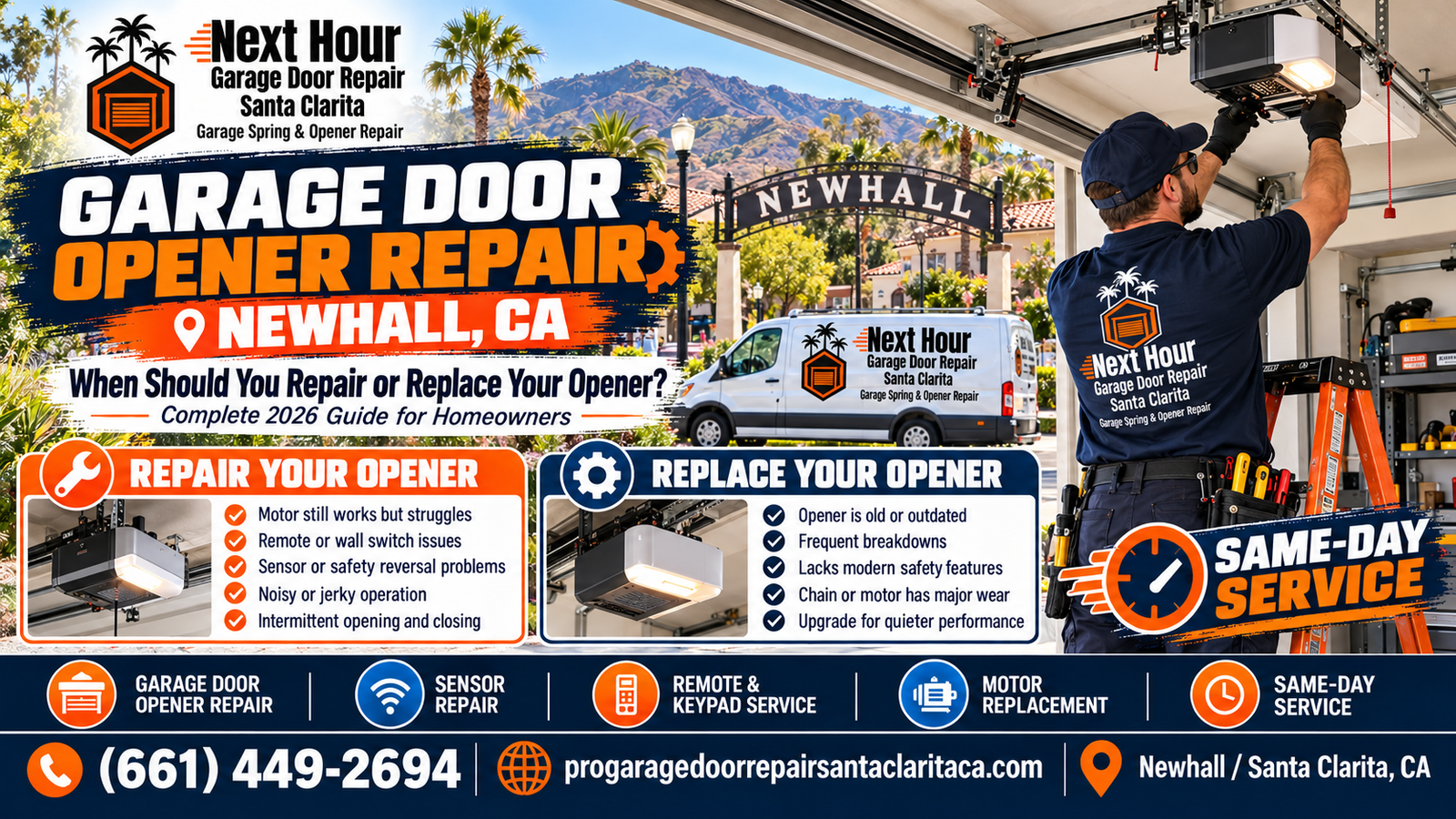
Garage Door Opener Repair Newhall, CA: When Should You Repair or Replace Your Opener?
A garage door opener that hums, stops halfway, refuses to close, ignores the remote or suddenly sounds strained does not automatically need replacement. This Newhall guide explains what may be repairable, when a new opener makes more sense, and what should be checked before blaming the motor itself.
Garage door opener problems are especially frustrating because several different failures can create the same symptom. A door that will not open may have an opener problem, but it can also have a broken spring. A door that will not close may involve the opener, but safety sensors or wiring are often worth checking first.
The current Newhall repair pattern on the Next Hour website focuses heavily on sensor failures, older opener systems, doors that will not close and safety inspections. That makes complete diagnosis particularly important before recommending a new motor.
Older Newhall homes can also have opener installations, track layouts or garage-door hardware that differ from newer Santa Clarita construction. The opener should therefore be evaluated as part of the complete garage door system.
For a broader overview of opener troubleshooting, see Garage Door Opener Not Working? 10 Common Problems .
On This Page
Should You Repair or Replace Your Garage Door Opener in Newhall?
Repair May Make Sense When:
- The safety sensors are dirty or misaligned.
- A sensor or sensor wire has failed.
- A remote or keypad needs programming.
- A wall control has stopped working.
- A replaceable gear or trolley component has worn out.
- Travel limits need adjustment.
- The opener has otherwise been reliable.
- Compatible replacement parts are readily available.
Replacement May Make Sense When:
- The opener has needed repeated major repairs.
- The motor has significant damage.
- Several internal components are worn.
- Important electronics are no longer available.
- The opener is excessively noisy for the home.
- You want battery backup or modern controls.
- The existing opener is poorly matched to the door.
Age alone should not make the decision. A well-maintained older opener with one repairable problem may still be worth fixing, while a newer opener with severe electronic and motor damage may be a poor repair candidate.
Garage Door Opener Symptoms: Repair, Replace or Inspect First?
| What You Notice | Possible Cause | First Direction |
|---|---|---|
| Remote stopped working | Battery, programming, remote or receiver problem | Usually repair / troubleshoot |
| Door will not close and sensor lights blink | Obstruction, alignment, wiring or sensor failure | Usually repair first |
| Door opens only several inches | Broken spring, heavy door, opener setting or motor strain | Check door balance first |
| Motor hums but door does not move | Drive gear, trolley, spring or motor issue | Inspect opener and door |
| Grinding inside motor housing | Gear, sprocket or drive component wear | Repair may be practical |
| Opener works intermittently | Wiring, board, receiver or overheating issue | Diagnosis required |
| Several major failures over a short period | General opener deterioration | Compare replacement |
| Required parts are discontinued | Older or obsolete opener platform | Replacement may be practical |
The Garage Door Opener May Not Be the Real Problem
This is one of the most important checks before replacing an opener. The technician should determine how freely the garage door moves and whether the spring system is properly counterbalancing its weight.
Door Problems That Can Mimic Opener Failure
- Broken torsion spring
- Weak or incorrectly sized spring
- Loose or damaged lift cable
- Binding roller
- Bent track
- Damaged hinge
- Door sections rubbing in the track
- Manual door lock left engaged
If the garage door recently became extremely heavy or you heard a loud bang before the opener stopped lifting it, see the broken garage door spring guide .
When Garage Door Opener Repair Makes Sense
Many opener problems do not require replacing the complete ceiling unit. Repair is particularly worth evaluating when one component has failed while the motor, rail and remaining electronics are in good condition.
Sensor Repair
Alignment, wiring and failed photo-eye problems can often be handled separately from the motor.
Remote & Keypad
Batteries, programming and control-device issues rarely justify replacing the entire opener by themselves.
Drive Components
Depending on opener design, gears, belts, chains or trolley components may be replaceable.
Wall Control
Loose wiring or a failed wall station may cause an opener complaint while the motor remains functional.
Travel Adjustment
Incorrect opening or closing limits can cause stopping, reversal or incomplete travel.
Isolated Electronics
Some electronic problems can be repaired when compatible replacement parts remain available.
When Should Newhall Homeowners Consider Opener Replacement?
Replacement should be based on overall condition and long-term usefulness—not simply the fact that one part stopped working.
Repeated Major Repairs
If the opener has required several significant repairs over a relatively short period, installing another major component may not provide the best long-term value.
Major Motor Damage
A worn remote is different from a failing motor. When major motor, drive and electronic issues occur together, replacement becomes more reasonable to compare.
Obsolete Electronics
Older Newhall opener systems may use control boards, receivers, remotes or sensors that are no longer readily available.
Noise
Older chain-drive systems may be noticeably louder than modern alternatives. If bedrooms or living areas are near the garage, noise can become a meaningful upgrade consideration.
Modern Features
Homeowners may choose replacement for battery backup, newer remote controls, keypads, connected access or another feature not available on the existing opener.
Garage Door Will Not Close? Check the Sensors Before Replacing the Opener
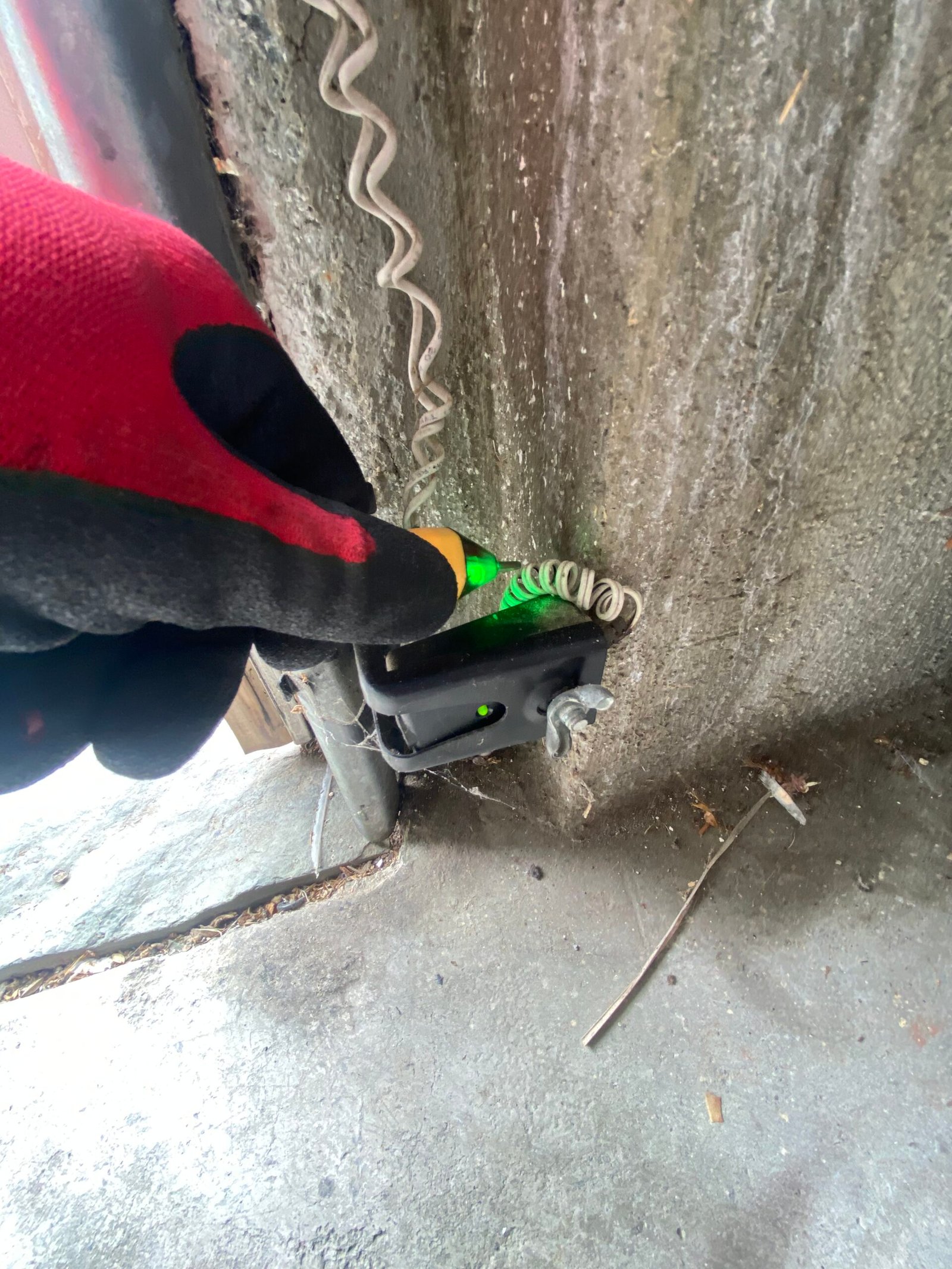
Garage door safety sensors sit near the bottom of the opening. They can be affected by dirt, misalignment, storage items, bracket movement or damaged wiring.
Check These Items First
- Remove anything blocking the sensor beam.
- Gently clean both sensor lenses.
- Look for a bracket that has been bumped.
- Check whether indicator lights are blinking.
- Inspect visible low-voltage wires for obvious damage.
If the sensors appear normal but the door still will not close, the problem may involve the wiring, opener logic board, travel setting or another garage door component.
More troubleshooting is available in Garage Door Won't Close? Sensors, Tracks, Openers & Other Causes .
Remote, Keypad and Wall-Control Problems
Which control works—and which one does not—can help narrow down the problem quickly.
Remote Fails but Wall Control Works
The opener is clearly receiving power and can operate the door. Check the remote battery, programming and whether another remote behaves the same way.
Keypad Fails but Remote Works
The issue may be limited to keypad batteries, programming or the keypad itself.
All Wireless Controls Fail
When several remotes and the keypad stop responding at the same time, receiver, antenna or opener electronics should be considered.
Nothing Works
Check whether the opener has electrical power. If power is present, diagnosis can move toward controls, wiring, electronics or motor issues.
What If the Opener Hums but the Garage Door Does Not Move?
The first question is whether the garage door itself can move normally. If a spring has broken, the motor may be trying to lift far more weight than it should.
Repeatedly pressing the opener button can put additional strain on gears, the trolley and motor.
Stop Forcing an Opener That Is Struggling
If the motor hums, grinds, stops after a few inches or repeatedly reverses, the garage door system should be inspected before continued operation.
Does a Noisy Garage Door Opener Need Replacement?
Not necessarily. Before replacing the opener, determine whether the sound actually comes from the motor.
Noise Can Come From:
- Worn rollers
- Dry hinges
- Loose track hardware
- Chain vibration
- Loose opener mounting
- Worn drive components
- Door sections rubbing in the tracks
Replacing a motor will not correct worn rollers or loose track hardware. The complete garage door should be inspected before deciding on an opener upgrade.
See Why Is My Garage Door So Noisy? for additional causes.
Older Garage Door Opener Systems in Newhall
The company's current neighborhood study specifically identifies older opener systems as one of the recurring Newhall service patterns.
An older opener does not automatically require replacement, but age can become relevant when parts are no longer readily available or several components have begun failing.
Questions to Ask Before Repairing an Older Opener
- What exact component failed?
- Is the replacement component still manufactured?
- What condition is the motor in?
- Are the rail and drive system still in good shape?
- Has the opener needed recent repairs?
- Does it have battery backup?
- Is the garage door itself balanced correctly?
- Would replacement meaningfully improve reliability or usability?
Do Not Replace an Opener Just Because It Is Old
The best decision is based on condition, repairability, compatibility and the homeowner's needs. An older opener with one simple repair may still be useful.
California Battery Backup Rules Can Affect Opener Replacement
This is an important consideration when comparing repair and replacement in Newhall.
California Health and Safety Code Section 19892 also says that a replacement residential garage door cannot be installed in a way that connects it to an existing residential opener that does not meet the battery-backup requirement.
What This Means for a Newhall Homeowner
- A new residential opener installation should include compliant battery backup.
- If you are replacing the garage door itself, the existing opener should be checked for compliance before the new door is connected.
- An older opener that still works may therefore become part of the replacement discussion when the door itself is being replaced.
- Battery backup can also provide useful access during an electrical outage.
This section is general information about the current California requirement. Installation-specific questions should be checked against the opener, door and applicable local requirements.
How Long Does Garage Door Opener Repair Take?
Service time depends on whether the problem is a simple control issue, an internal repair or a full opener replacement.
| Service | Typical Planning Range | What Can Add Time? |
|---|---|---|
| Remote / keypad programming | 20–60 minutes | Receiver or logic-board problems |
| Sensor alignment | 15–45 minutes | Damaged wiring or failed sensor hardware |
| Common opener repair | 45 minutes–2 hours | Intermittent wiring, motor or electronics problems |
| Complete opener replacement | 1.5–3 hours | Mounting, rail, wiring, programming or door-balance work |
These are planning ranges rather than guarantees. The actual appointment depends on the opener model, condition of the garage door and whether the necessary repair parts are available.
For broader repair-time information, see How Long Does Garage Door Repair Take in Santa Clarita, CA? .
Garage Door Opener Repair for Newhall Homes
Newhall is one of the established communities within the Santa Clarita Valley, and the company currently highlights downtown Newhall and ZIP code 91321 as part of its regular service coverage.
Newhall Opener Issues Worth Watching
- Older garage door opener systems
- Safety sensor failures
- Garage doors that open but will not close
- Older door hardware creating opener strain
- Track or balance problems on older garage doors
- Remote and keypad compatibility
- Battery-backup considerations when upgrading
- Safety inspection of the complete door system
Next Hour Garage Door Repair Santa Clarita serves Newhall and surrounding Santa Clarita Valley communities with opener, spring, cable, sensor, roller and general garage door service.
Older homes can also have lower headroom, different mounting conditions or door configurations that deserve inspection before selecting a replacement opener.
A Simple Garage Door Opener Repair-or-Replace Process
Identify the Symptom
Determine whether the opener is dead, humming, grinding, reversing, stopping or ignoring controls.
Inspect the Door
Check springs, cables, rollers, tracks and balance before condemning the opener.
Diagnose the Opener
Identify whether the failure is in the motor, drive system, controls, sensors or electronics.
Check Parts
Confirm that compatible repair parts remain available for the opener model.
Compare Replacement
Review reliability, noise, battery backup, controls and overall condition.
Test the System
After service, test normal door movement and applicable safety features.
What Can Newhall Homeowners Safely Check Before Calling?
Reasonable Basic Checks
- Confirm that the opener has electrical power.
- Replace remote-control batteries.
- Check whether the wall button works.
- Remove objects blocking the safety sensors.
- Gently clean the sensor lenses.
- Check whether the manual door lock is engaged.
- Look for an obviously disconnected opener plug.
Stop and Request Professional Service When:
- A torsion spring is broken.
- The garage door feels unusually heavy.
- A cable is loose or hanging.
- The door is crooked.
- A roller has left the track.
- The motor repeatedly strains or stalls.
- Electrical components smell burned or appear damaged.
- The safety reversal system is not working correctly.
Do Not Increase Opener Force to Hide a Mechanical Problem
If the garage door is heavy, binding or poorly balanced, increasing opener force does not correct the original problem and can put more stress on the system.
Questions to Ask Before Approving Opener Replacement
- What specific opener component failed?
- Was the garage door balance checked first?
- Are replacement parts still available?
- Are other opener components also worn?
- Does the existing opener have battery backup?
- Would repair restore dependable operation?
- What additional features would replacement provide?
- Will the replacement opener be properly matched to the door?
- Are the sensors and safety systems being replaced or reused?
- What testing will be performed after installation?
Need Garage Door Opener Repair in Newhall, CA?
Next Hour Garage Door Repair Santa Clarita provides garage door opener troubleshooting and repair for Newhall homeowners. Problems may involve sensors, remotes, controls, gears, wiring, motor components or another part of the garage door system.
The first step is finding out what actually failed before deciding whether opener repair or replacement makes more sense.
Garage Door Opener Repair Newhall, CA: Frequently Asked Questions
Should I repair or replace my garage door opener?
Repair may make sense when one component has failed, the rest of the opener is in good condition and compatible replacement parts are available. Replacement becomes more practical when major failures keep returning, important parts are unavailable or the motor and electronics have significant damage.
Does a garage door opener that hums need to be replaced?
Not necessarily. Humming may involve a drive component, broken spring, trolley problem, heavy door or motor issue. The door and opener should both be inspected first.
Why does my opener run but the garage door not move?
Possible causes include stripped drive components, a disconnected trolley, broken spring, cable problem, door-balance issue or opener failure.
Why will my garage door open but not close?
Safety-sensor problems are a common cause. Dirt, misalignment, damaged wiring or failed sensors can prevent normal closing. Travel settings or opener electronics may also be involved.
Are sensor problems common in Newhall?
Next Hour's current neighborhood repair study identifies sensor failures and door-won't-close problems as important Newhall service themes, along with older opener systems and safety inspections.
Can an older garage door opener still be repaired?
Sometimes. The decision depends on what failed, overall condition and whether compatible replacement parts remain available.
Does a new garage door opener in California need battery backup?
California requires residential automatic garage door openers installed on or after July 1, 2019 to include a battery-backup function designed to operate during an electrical outage.
How long does garage door opener repair take?
Simple programming or sensor work may take less than an hour. More involved opener repairs may take roughly 45 minutes to 2 hours, while complete opener replacement commonly requires a longer installation window.
Does a noisy opener always need replacement?
No. Rollers, hinges, tracks and loose hardware can create significant noise. The source should be identified before replacing the opener.
Does Next Hour Garage Door Repair Santa Clarita serve Newhall?
Yes. Next Hour Garage Door Repair Santa Clarita serves Newhall, including downtown Newhall and the 91321 area. Call (661) 449-2694 for current service availability.
Garage Door Opener Repair Near Newhall, CA
Next Hour Garage Door Repair Santa Clarita provides garage door opener and general garage door service in Newhall and surrounding Santa Clarita Valley communities.
Diagnose the Problem Before Replacing the Opener
A garage door opener should not be replaced simply because the door stopped moving. Springs, cables, rollers, tracks, sensors, controls and door balance can all create symptoms that look like opener failure.
Next Hour Garage Door Repair Santa Clarita can inspect the garage door and opener system in Newhall and explain whether repair or replacement is the more practical option.
Call (661) 449-2694
One Response