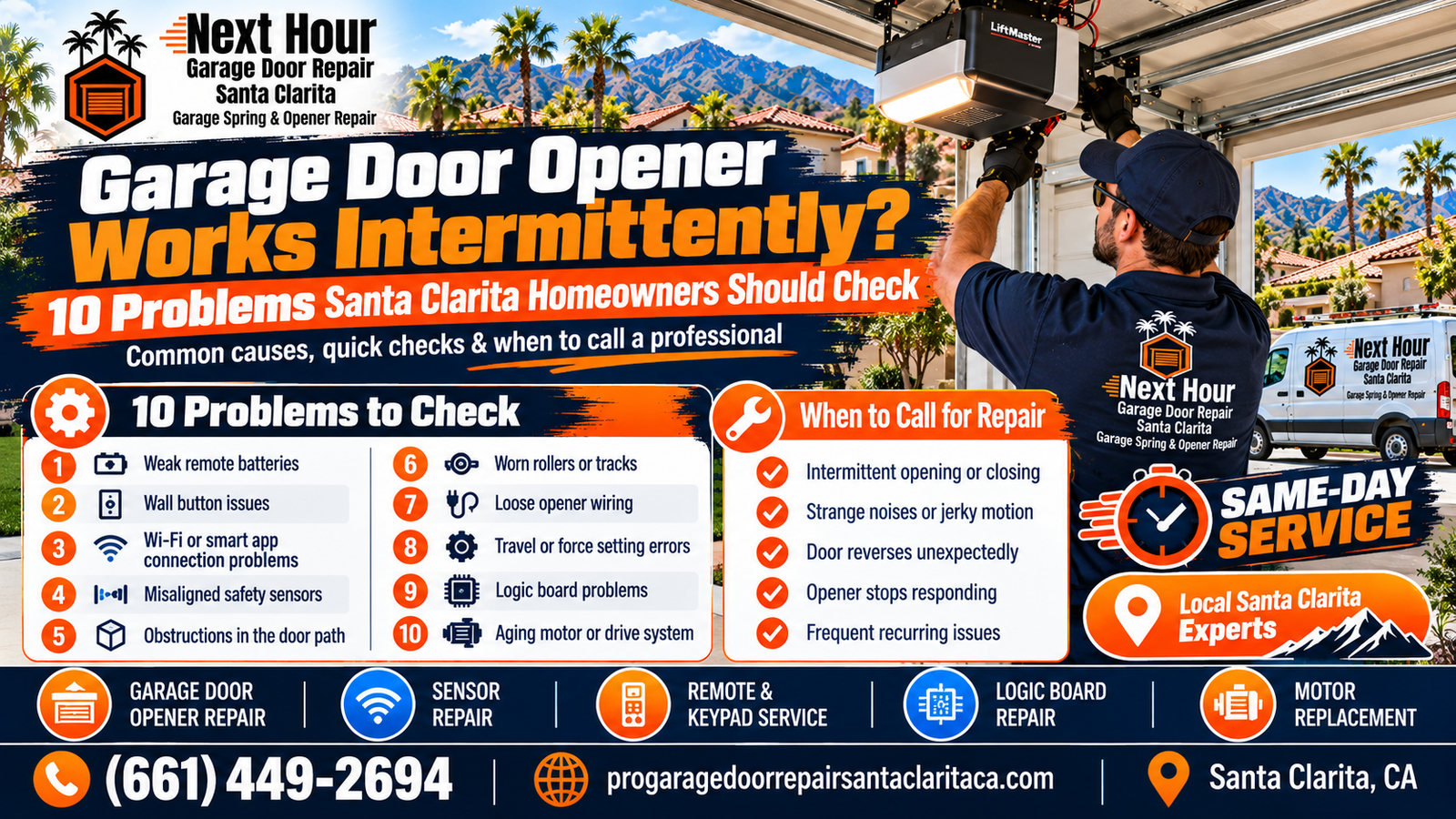
Garage Door Opener Works Intermittently? 10 Problems Santa Clarita Homeowners Should Check
A garage door opener that works perfectly one minute and refuses to respond the next can be harder to diagnose than a complete failure. Remote signals, sensor wiring, heat, logic boards, power, springs, rollers and opener components can all create intermittent symptoms. Here are 10 problems Santa Clarita homeowners should consider before assuming the entire opener needs replacement.
Intermittent garage door opener problems can feel random, but the pattern often provides useful clues. An opener that stops working only from one remote is different from an opener that loses every control at once. A door that fails only late in the afternoon may point toward a different problem than one that stops after several consecutive cycles.
The goal is not to replace parts until the symptom disappears. The goal is to identify what changes between the moments when the opener works and the moments when it does not.
Next Hour's current Santa Clarita opener failure study specifically identifies intermittent operation as a symptom associated with circuit-board problems, sensor wiring, remote signals and overheating.
For the broader overview, see the Santa Clarita Garage Door Opener Failure Study .
On This Page
Start by Finding Out What Still Works
Before focusing on a specific component, compare every available garage door control.
| What Still Works? | What Fails? | Where to Look First |
|---|---|---|
| Wall button | One remote | Remote battery, programming or transmitter |
| Wall button | All remotes and keypad | Receiver, antenna, programming or logic board |
| Remote and wall button | Door occasionally refuses to close | Safety sensors, wiring or track resistance |
| Everything works when opener is cool | Failure after repeated cycles or hot periods | Motor, capacitor or heat-sensitive electronics |
| Controls activate opener | Door moves only partway | Spring, door balance, rollers, tracks or travel settings |
| Nothing works during failure | Opener later comes back by itself | Power supply, motor protection or electronics |
Write Down the Pattern
Note whether the problem happens from one control or every control, whether it happens only when closing, whether the opener has been running repeatedly, and whether heat, sunlight or a recent power event seems related. Intermittent problems are easier to diagnose when the pattern is known.
10 Problems That Can Make a Garage Door Opener Work Intermittently
Weak Remote Battery or Signal
One remote may work only at close range or fail randomly while the wall control continues working.
Receiver or Programming Problem
Several wireless controls may lose response while local wall control still works.
Wall-Control Wiring
Loose or damaged low-voltage wiring can produce inconsistent button response.
Safety Sensors
Misalignment, dirty lenses or damaged sensor wiring can create closing problems that seem random.
Power Supply
Outlet, breaker, GFCI or electrical connection problems can interrupt opener operation.
Logic Board
Heat, age, surge damage or electronic faults can cause inconsistent response.
Motor Overheating
An opener may stop after several cycles and begin working again after cooling.
Worn Drive Components
Gears, trolley parts or other drive components can slip or struggle under load.
Travel or Force Settings
Incorrect settings can cause random-looking stops or reversals.
Door Resistance
Springs, rollers, tracks or poor balance can overload the opener only at certain points in door travel.
1. Weak Remote Battery or Intermittent Radio Signal
Start with the simplest control before assuming the opener motor is failing. A weak remote battery can reduce transmission strength.
Common Signs
- Remote works from the driveway but not farther away.
- You must press the button several times.
- One remote fails while another works.
- Wall control remains reliable.
- Problem improves after changing the remote battery.
Signal interference, antenna condition or the opener receiver can also affect wireless range.
If one remote is the only failing control, diagnose that remote before replacing any opener hardware.
2. Remote, Keypad, Antenna or Receiver Problem
The diagnosis changes when several wireless controls become unreliable at the same time.
If the Wall Button Works but All Wireless Controls Fail
Possible areas include:
- Remote programming
- Receiver problems
- Opener antenna issues
- Radio interference
- Logic-board receiver circuitry
Next Hour's opener failure study specifically lists battery, programming, signal interference, antenna, receiver and logic-board problems as possible causes of remote failure.
If both the keypad and several remotes fail together but the wall station remains dependable, the problem is less likely to be three separate dead batteries and more likely to involve the opener's wireless communication side.
3. Loose Wall-Control Wiring or Control Connection
Garage door wall stations commonly use low-voltage wiring between the control and opener. Loose connections or damaged wiring can interrupt the command signal.
Possible Warning Signs
- Wall button sometimes does nothing.
- Opener works from remote but not consistently from the wall.
- Control lights flicker.
- Problem began after work was done near the wall wiring.
- Visible wire damage is present.
Avoid assuming the motor is failing when only one wired control path has the problem.
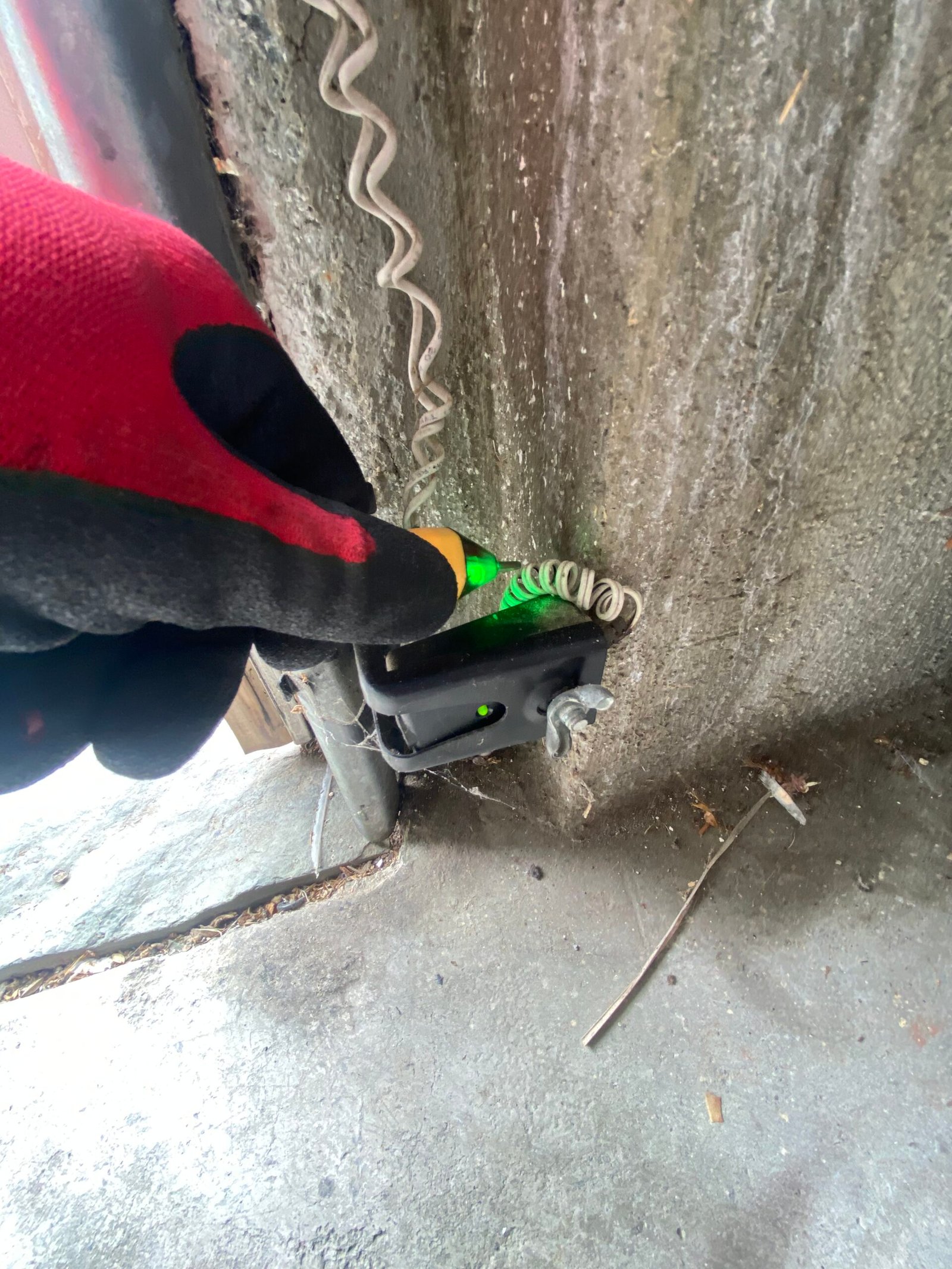
4. Safety Sensor Misalignment, Sunlight or Intermittent Wiring
Safety sensors are a major source of closing problems because the opener must receive the correct safety signal before normal closing.
A sensor may be only slightly out of alignment. Vibration can allow it to work on one cycle and lose alignment on another.
Check for:
- Dirty sensor lenses
- A sensor bracket that moves easily
- Storage items partially blocking the beam
- Loose or damaged sensor wiring
- Blinking indicator lights
- Direct sunlight affecting the receiving sensor at certain times
For a deeper closing-problem guide, see Garage Door Won't Close? Sensors, Tracks, Openers & Other Causes .
5. Inconsistent Power at the Opener
An opener cannot operate consistently if its electrical supply is inconsistent.
Power-Related Areas to Check
- Ceiling outlet
- Opener power cord
- Garage circuit breaker
- Applicable GFCI circuit
- Loose electrical connection
- Recent outage or surge
Look for Total Loss of Power
If the opener light, wall control and all other opener functions disappear at the same time during the failure, electrical power deserves attention before remote programming or door hardware.
Next Hour's current opener diagnostic checklist specifically recommends checking the outlet, GFCI and breaker when the opener is completely silent.
6. Intermittent Logic-Board or Circuit-Board Failure
The logic board controls major electronic functions inside many garage door openers. Age, electrical faults, power surges and heat can damage board components.
Possible Logic-Board Symptoms
- Opener randomly fails to respond.
- Remote reception becomes inconsistent.
- Motor receives commands only sometimes.
- Opener clicks but does not always run.
- Settings or behavior change unexpectedly.
- Problem began after a surge or electrical event.
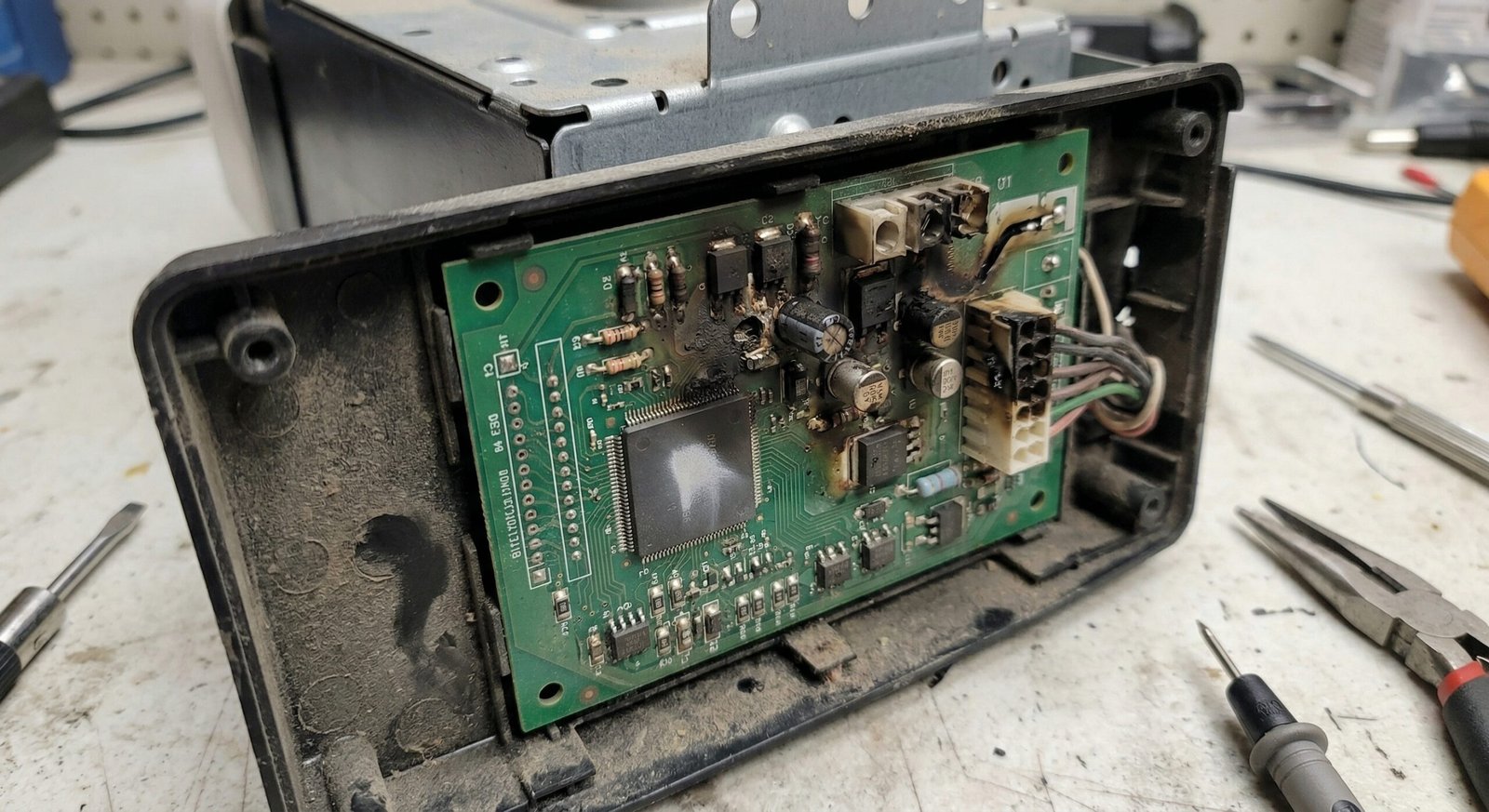
Intermittent Operation Does Not Automatically Prove the Board Is Bad
Sensors, wiring, power supply, remotes, motor temperature and mechanical door resistance should also be considered before replacing an expensive electronic board.
7. Garage Door Opener Motor Overheating
An overheating motor can create a particularly confusing intermittent symptom because the opener may appear completely normal after it cools down.
What Can Increase Motor Load?
- Heavy or unbalanced garage door
- Weak spring system
- Worn rollers
- Track resistance
- Internal opener wear
- Repeated opening and closing cycles
- High garage temperatures
Next Hour's opener failure study specifically includes overheating motor as a possible cause of intermittent operation.
The company also discusses heat exposure as a factor affecting opener electronics and motor components in Santa Clarita garages.
Read How Santa Clarita Heat Affects Garage Door Springs, Openers & Rollers .
8. Worn Internal Gears, Trolley or Drive Components
Internal opener components do not always fail instantly. Wear can progress until the opener works under light conditions but slips, grinds or struggles when more load is applied.
Possible Symptoms
- Motor sounds normal but door does not always move.
- Grinding noise comes from the opener housing.
- Chain or belt moves inconsistently.
- Door starts moving, then trolley motion stops.
- Problem becomes more frequent over time.
Next Hour's current opener information identifies stripped internal gears as a common reason a motor can run while the garage door remains still.
Do Not Keep Running a Grinding Opener
Continued cycling can turn a smaller internal wear problem into additional damage. If the opener grinds or hums without moving the door normally, stop forcing it.
9. Travel Limits or Force Settings Are Marginal
Opener travel settings tell the system where the door's open and closed positions are. Depending on the opener, force or sensitivity settings also affect how the opener reacts to resistance.
Incorrect Settings Can Cause:
- Door stopping before fully closing
- Unexpected reversal
- Door stopping short while opening
- Repeated attempts needed to complete a cycle
Next Hour's opener failure study specifically lists travel-limit problems as a cause of early stopping and unexpected reversal.
Do Not Increase Force Just to Make the Door Move
If the opener is encountering real resistance from a heavy door, damaged roller, bent track or spring problem, increasing opener force does not repair the underlying mechanical issue.
10. Spring, Door Balance, Rollers or Tracks Are Overloading the Opener
A mechanical problem can appear intermittent because resistance may change depending on the door position.
Examples
- A weak spring provides less assistance at part of the travel.
- A worn roller binds only when entering the curved track.
- A bent section rubs at one specific height.
- A loose cable changes door balance from cycle to cycle.
- Track alignment creates resistance only on one side.
This can cause the opener to work one time, stop another time or behave differently as temperatures and mechanical loads change.
If the door feels unusually heavy, opens only a few inches or looks crooked, do not keep testing the opener.
Read Why Your Garage Door Won't Open in Santa Clarita for more information about springs, cables, tracks and door balance.
Why Does My Garage Door Opener Work in the Morning but Fail Later?
A temperature-related pattern can be valuable diagnostic information.
Electronics, motors and garage door materials experience different conditions as a Santa Clarita garage warms during the day.
If the Problem Appears Mainly When the Garage Is Hot, Check:
- Motor overheating
- Logic-board heat damage
- Capacitor or electrical component performance
- Door resistance changing with heat
- Sensor sunlight exposure
A technician should still diagnose the actual failed component rather than assuming every hot-weather symptom is caused by the motor.
What If Only the Smart App Works Intermittently?
Smart opener problems can involve:
- Weak garage Wi-Fi signal
- Router changes
- New Wi-Fi password
- Smart app problems
- Network reconnection
- Smart-module or logic-board communication
We covered that troubleshooting path in Smart Garage Door Opener Wi-Fi Problems: App, Router, Logic Board or Opener? .
What the Intermittent Pattern Can Tell You
| Pattern | Possible Area | What to Check |
|---|---|---|
| One remote works only sometimes | Remote / signal | Battery, programming and transmitter |
| All wireless controls fail together | Receiver / logic board | Antenna, receiver and board response |
| Only closing is intermittent | Sensors / resistance | Alignment, wiring, sunlight and track condition |
| Fails after several cycles | Heat / motor | Motor temperature and door load |
| Fails in hottest part of day | Heat / electronics / sensors | Board, motor and sunlight on sensor |
| Fails at same height every time | Track / roller / travel settings | Door resistance and opener limits |
| Everything loses power randomly | Electrical supply | Outlet, breaker, GFCI and wiring |
| Motor runs but door sometimes stays still | Gear / trolley / spring / balance | Drive system and garage door weight |
Safe Checks Santa Clarita Homeowners Can Make
You can gather useful diagnostic information without taking apart the opener or touching spring hardware.
- Try the wall control. Note whether it works when the remote does not.
- Try another remote. Compare whether the problem follows one transmitter.
- Replace the remote battery. This is a simple way to eliminate one variable.
- Look at sensor indicator lights. Note whether they blink or change when the door refuses to close.
- Check for an obstruction. Remove objects near the sensor beam and tracks.
- Listen to the opener. Note humming, clicking, grinding or complete silence.
- Notice the time and temperature. Record whether failures happen mainly during hotter periods.
- Notice where the door stops. The same stopping point can suggest resistance or limit problems.
Stop Testing if the Door Looks Unsafe
Do not continue cycling the opener if a spring is visibly broken, a cable is loose, the door hangs crooked, a roller has left the track or the opener is grinding under heavy load.
What Should a Professional Intermittent-Opener Inspection Include?
Control Test
Compare the wall button, remotes, keypad and smart controls.
Sensor Test
Inspect alignment, lenses, brackets, wiring and indicator lights.
Power Check
Confirm stable electrical power at the opener.
Board Inspection
Look for heat, surge or electrical damage to opener electronics.
Motor & Gear Check
Listen for overheating, grinding, slipping and drive wear.
Door Balance Review
Inspect springs, cables, rollers, tracks and door resistance.
Next Hour's current opener study uses this same system-wide approach: opener response, safety sensors, door balance, logic board and motor are all reviewed before deciding on repair or replacement.
Does an Intermittent Garage Door Opener Need Replacement?
Repair May Make Sense When:
- One remote is the problem.
- Sensor wiring or alignment is causing the failure.
- A replaceable control or logic board has failed.
- A gear or drive component is worn but the motor is healthy.
- The opener has otherwise been dependable.
Replacement May Deserve Consideration When:
- Major electrical failures keep returning.
- The motor repeatedly overheats or shuts down.
- Important repair parts are unavailable.
- Motor, board and drive components are all deteriorating.
- The opener is old and repeated repairs are accumulating.
- You also want battery backup or modern smart controls.
For the full decision framework, read Repair or Replace a Garage Door Opener in Santa Clarita? Age, Parts & Upgrade Guide .
Intermittent Garage Door Opener Problems Across Santa Clarita
Next Hour Garage Door Repair Santa Clarita provides opener troubleshooting throughout Santa Clarita Valley, including Valencia, Saugus, Canyon Country, Newhall, Stevenson Ranch and nearby communities.
Local Conditions Worth Mentioning During Diagnosis
- Problem happens mainly in hot afternoon conditions
- Opener has recently experienced a power outage or surge
- Home has older opener electronics
- Garage door is used many times each day
- Door has a heavy insulated or custom construction
- Smart Wi-Fi functions fail while local controls continue working
- Late-afternoon sunlight affects the safety sensor area
- Garage door has recently become noisier or harder to move
Providing those details can make an intermittent problem easier to reproduce and diagnose.
Garage Door Opener Works Sometimes but Not Others?
Next Hour Garage Door Repair Santa Clarita can inspect the remote system, safety sensors, wiring, electrical power, logic board, motor, gears, springs, rollers, tracks and door balance to find the actual cause of intermittent operation.
Intermittent problems are easier to solve when the full system is diagnosed instead of replacing random parts until the symptom disappears.
Garage Door Opener Works Intermittently: Frequently Asked Questions
Why does my garage door opener work sometimes and not others?
Possible causes include remote signal problems, sensor wiring, inconsistent electrical power, logic-board faults, overheating, worn opener components, incorrect travel settings or resistance from the garage door itself.
Can a bad logic board cause intermittent garage door opener problems?
Yes. A damaged logic board can cause inconsistent remote, receiver or motor response. Heat, age, electrical faults and power surges can contribute to board problems.
Can an overheating opener stop working and then start again?
Yes. An opener may stop operating when the motor or another component becomes too hot and appear normal again after cooling. The cause of the overheating should still be diagnosed.
Why does my remote work only sometimes?
Check the remote battery, programming and transmitter first. Signal interference, antenna, receiver or opener logic-board problems can also affect wireless controls.
Why does the garage door fail only when closing?
Safety sensors are one of the first areas to inspect. Dirty lenses, slight misalignment, loose wiring, obstructions or sunlight can interfere with the closing safety system.
Why does my opener stop after several uses?
Repeated cycles can reveal motor overheating, electrical problems or excessive load caused by a heavy or poorly balanced garage door.
Can a broken spring make the opener work intermittently?
A broken or weak spring can make the door too heavy for normal opener operation. The opener may stop, reverse, hum or lift only partway when the door is not properly counterbalanced.
Can rollers or tracks cause intermittent opener failure?
Yes. A worn roller, bent track or other source of resistance may affect the opener only at a particular point in door travel, causing stops or reversals that seem intermittent.
Should I replace an opener that works intermittently?
Not automatically. Repair may be appropriate when the problem is an isolated remote, sensor, wiring, board or drive-component failure. Replacement deserves consideration when major failures are recurring, the motor is deteriorating or parts are unavailable.
Does Next Hour Garage Door Repair Santa Clarita diagnose intermittent opener problems?
Yes. Next Hour Garage Door Repair Santa Clarita provides opener, motor, sensor, remote, keypad, logic-board and complete garage door system troubleshooting throughout Santa Clarita Valley. Call (661) 449-2694 for current service availability.
Garage Door Opener Repair in Santa Clarita, CA
Next Hour Garage Door Repair Santa Clarita provides garage door opener troubleshooting throughout Santa Clarita and surrounding Santa Clarita Valley communities.
Intermittent Problems Need Diagnosis, Not Guesswork
When a garage door opener works only sometimes, the problem may be as small as a remote battery or as involved as an overheating motor, damaged logic board or garage door that is placing too much load on the opener.
Next Hour Garage Door Repair Santa Clarita can inspect the controls, sensors, wiring, electronics, motor and complete garage door system to identify the actual source of the problem.
Call (661) 449-2694