Next Hour Garage Door Repair Santa Clarita · Gap Diagnosis Guide
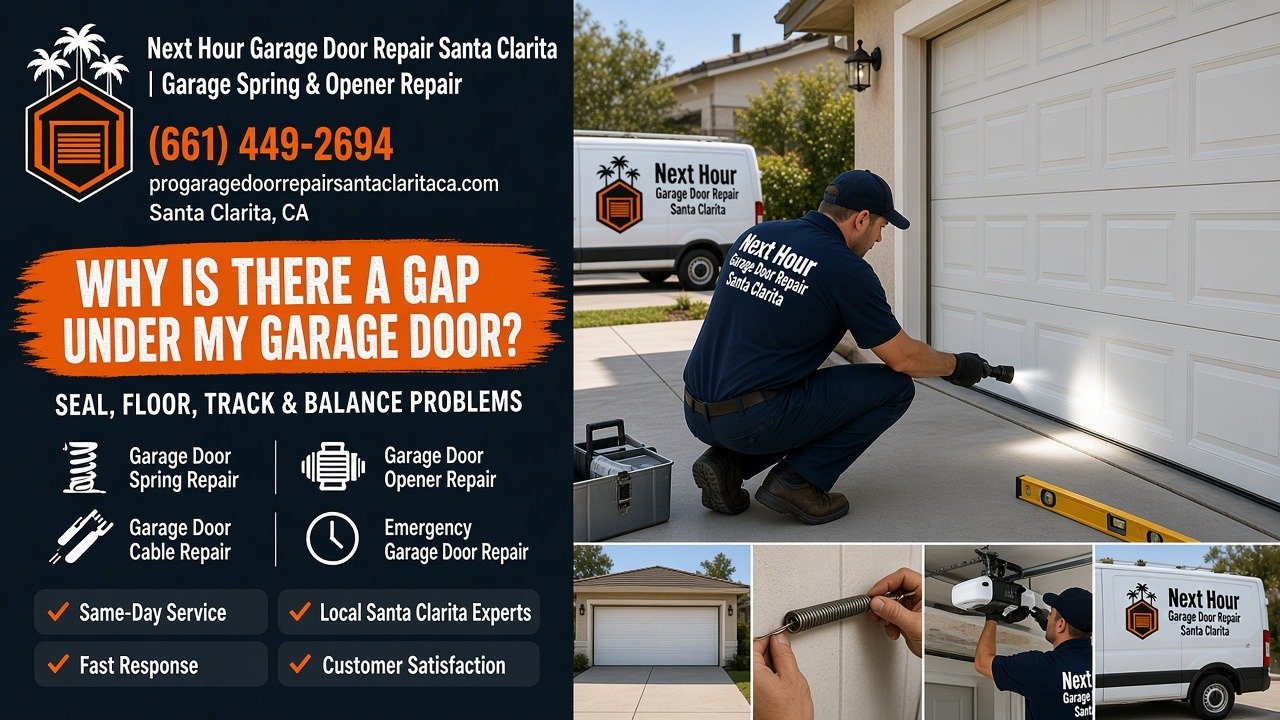
Why Is There a Gap Under My Garage Door? Seal, Floor, Track & Balance Problems
A gap under your garage door has one of five sources: a worn bottom seal, an uneven or settled floor, a door that’s tilted from a cable or spring problem, a track or door that’s out of position, or an opener that stops before the door reaches the floor. The shape of the gap is the best clue. A thin, even line of light across the whole door usually means a flattened or hardened seal. A wedge, wide at one end and closed at the other, points to a tilted door or a sloped floor. A gap in one spot points to a low spot in the slab or a torn piece of seal. A gap that appeared suddenly often means an opener limit or a cable has changed. This guide shows how to read the gap, check each cause safely, and know which fix you actually need.
Why is there a gap under my garage door? The short answer
Look at the gap’s shape. Even all the way across: the seal is worn or the opener stops short. Wedge-shaped: the door is tilted (cable, drum, or spring) or the floor slopes. One spot: a floor low spot or a damaged section of seal. If the gap is wedge-shaped and a cable looks slack or a spring has a gap, stop using the door, since a tilted door under spring tension can come off the track.
DASMA advises against adjusting springs, cables, or bottom brackets yourself; see the DASMA garage door safety tips.
Local help: Next Hour Garage Door Repair Santa Clarita diagnoses gaps under doors and fixes the cause, whether that’s the seal, cables, springs, tracks, or opener, across Santa Clarita, Valencia, Saugus, Canyon Country, Newhall, Stevenson Ranch, and Castaic. Call (661) 449-2694.
Read the Gap’s Shape First
| Gap shape | Most likely cause | Confirm by |
|---|---|---|
| Thin, even line across the door | Worn, flattened, or hardened seal | Seal feels hard or flat; door bottom is level |
| Even gap, a bit larger, appeared suddenly | Opener down limit stopping short | Door rests above the floor and seal isn’t compressed |
| Wedge: open at one end, closed at the other | Tilted door (cable, drum, spring) or sloped floor | Level on the door bottom vs. level on the floor |
| One spot in the middle | Low spot or crack in the slab | Straightedge across the floor at the door line |
| Corner gaps only | Seal ends shrunk or pulled out; worn side weatherstrip | Seal ends visible outside the retainer |
| Door won’t come all the way down; reverses | Sensors, force setting, or binding track | Door reverses near the floor |
Cause 1: The Bottom Seal
A seal that’s hardened from heat or flattened from years of compression can’t fill the normal small dips in a slab, so light shows through. This is the most common cause and the simplest fix. Seal types, heat and dust wear, and what replacement involves are covered in our separate guide to garage door bottom seal replacement. The key point here: only replace the seal after ruling out the causes below, because a new seal over a tilted door just fails faster.
Cause 2: The Floor
Garage slabs settle, crack, and sometimes slope toward the driveway or to one side. Hillside lots and older slabs are more prone to it. Set a level on the floor along the door line, and a straightedge to find dips. If the floor slopes but the door bottom is level, the door is fine; the fix is a thicker bulb seal that compresses into the low side, or a floor threshold seal. A crack or heaved section may need concrete work.
Cause 3: A Tilted Door (Cables, Drums, Springs)
If the floor is level but the door bottom isn’t, the door is hanging unevenly. That comes from a cable that’s stretched or slipped, a drum that moved on the shaft, or one weak or broken spring on a two-spring door. It’s the one cause on this list that can turn dangerous. See crooked garage door: is it safe to keep using? and cable drum problems.
Stop using the door if a cable is slack or a spring has a gap. Don’t try to level it at the drums or bottom brackets; that work is under spring tension.
Cause 4: Track or Door Position
A vertical track that’s mounted too high, has pulled loose, or is bent can hold one side of the door off the floor or make it bind before it lands. A door that rubs or drags one side may also stop short on that side. See bent garage door track and garage door rubs or scrapes one side. Worn bottom rollers can also let the bottom section sit off-line; see roller wear signs.
Cause 5: Opener Down Limit
The opener’s down limit tells it where to stop. If it’s set short, after a power surge, an opener reset, or a new seal, the door stops an inch or so above the floor and leaves an even gap. Pull the emergency release with the door closed (only if springs and cables look intact) and let the door rest. If it settles to the floor, the limit is the issue. Adjusting the limit is in the opener’s manual, but the safety reversal must be re-tested afterward. A limit set too far the other way makes the door shudder as it lands; see why a garage door shakes when closing.
A Safe Step-by-Step Check
- Close the door and look at the gap from inside with the lights off outside (or vice versa). Note its shape.
- Check both cables and springs from the floor. Slack cable or spring gap: stop here and call.
- Put a level on the floor at the door line, then on the door’s bottom edge.
- Look at the seal: hard, flat, torn, or pulled out at the ends?
- Look at both tracks for bends or loose brackets.
- If the gap is even and everything else looks right, test whether the opener limit is stopping short.
Why a Gap Is Worth Fixing
A gap lets in dust on wind days, leaves, insects, and rodents, and lets cool air out of an attached garage in summer. More importantly, a wedge-shaped gap is an early warning of a cable or spring problem, which is far easier to fix before a cable comes off its drum. If the door is stuck open or hanging crooked, use our emergency garage door repair page.
Garage Door Gap Repair Across the Santa Clarita Valley
Next Hour Garage Door Repair Santa Clarita serves Santa Clarita and the surrounding valley, including Valencia, Saugus, Canyon Country, Newhall, Stevenson Ranch, Castaic, and Hasley Canyon, plus ZIP codes 91321, 91350, 91351, 91354, 91355, 91381, 91384, and 91387. Services include bottom seal replacement, cable and spring repair, door leveling and balancing, track repair, and opener limit adjustment.
Call (661) 449-2694 or view Next Hour Garage Door Repair Santa Clarita on Google Maps.
Frequently Asked Questions About a Gap Under a Garage Door
Why is there a gap under my garage door?
Usually a worn bottom seal, an uneven floor, a tilted door from a cable or spring problem, a track issue, or an opener down limit that stops short.
Why is the gap bigger on one side?
A wedge-shaped gap points to a tilted door (cable, drum, or spring) or a sloped floor. Use a level on the floor and on the door bottom to tell which.
Will a new bottom seal fix the gap?
Only if the seal is the cause. If the door is tilted or the opener stops short, a new seal won’t close the gap for long.
Is a gap under my garage door dangerous?
An even gap from a worn seal isn’t dangerous. A wedge-shaped gap with a slack cable or broken spring is; stop using the door.
How do I fix a gap from an uneven floor?
If the door is level and the floor isn’t, a thicker bulb seal or a floor threshold seal can fill the low side. Cracked or heaved concrete may need repair.
Why did a gap suddenly appear under my garage door?
Often the opener’s down limit changed, a cable slipped, or a spring broke. Check the cables and springs before anything else.
Can the opener cause a gap under the door?
Yes. If the down limit is set short, the door stops above the floor. Adjust it per the manual and re-test the safety reversal.
Who fixes gaps under garage doors in Santa Clarita?
Next Hour Garage Door Repair Santa Clarita finds and fixes the cause, whether that’s the seal, cables, springs, tracks, or opener, across the Santa Clarita Valley. Call (661) 449-2694.
Find Next Hour Garage Door Repair Santa Clarita
View Next Hour Garage Door Repair Santa Clarita on Google Maps
Close the Gap the Right Way
If there’s a gap under your garage door, call Next Hour Garage Door Repair Santa Clarita at (661) 449-2694. We’ll find out whether it’s the seal, floor, door, or opener and fix the cause.
Serving Santa Clarita, the Santa Clarita Valley & northern Los Angeles County