Next Hour Garage Door Repair Santa Clarita · Vibration Diagnosis Guide
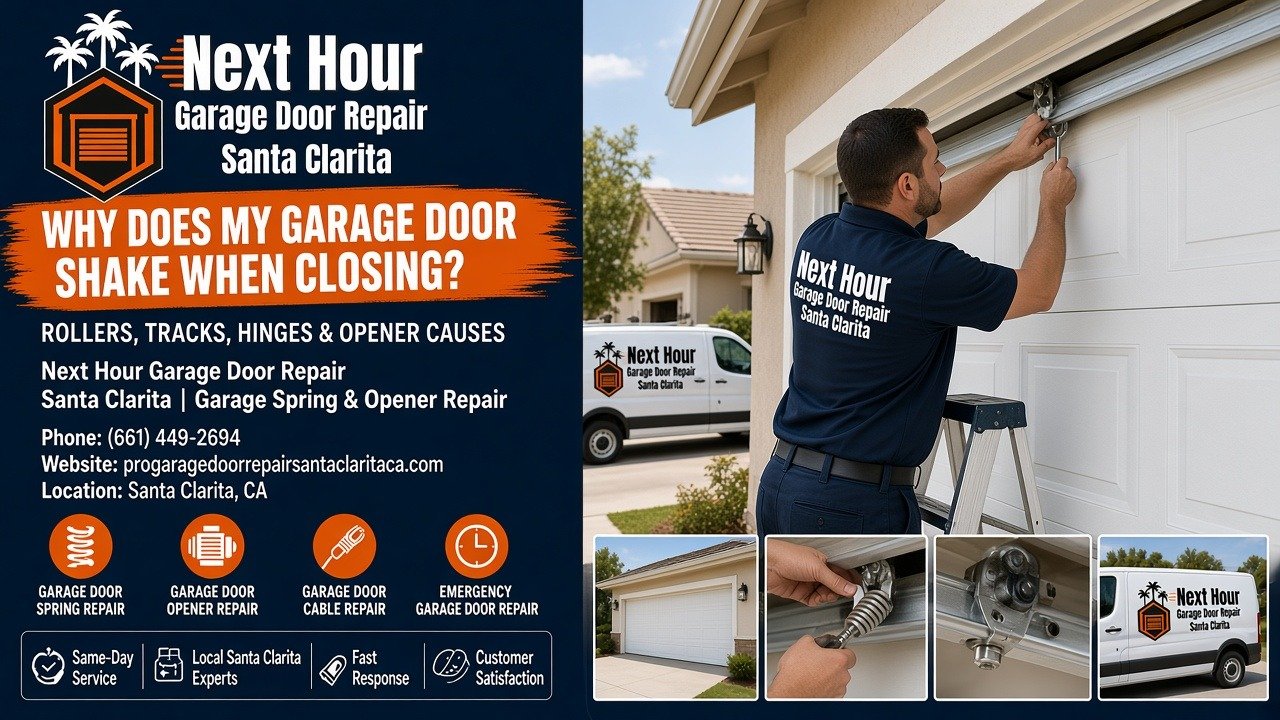
Why Does My Garage Door Shake When Closing? Rollers, Tracks, Hinges & Opener Causes
A garage door that shakes when closing is usually telling you something is loose, worn, or fighting the door’s motion. The most common causes are worn rollers that stutter in the track, loose or cracked hinges that let sections flex, a track that’s out of line or has a bump, an opener chain or belt that’s slack or a rail that’s loose, and a door that’s out of balance so it pushes down harder than the opener expects. The clue is when the shaking happens. Shaking all the way down points to rollers or a loose opener rail. Shaking at one spot points to the track. Shaking that starts as the door nears the floor often points to balance or the opener’s down-limit and force settings. This guide shows how to sort them out without touching parts under spring tension.
Why does a garage door shake when closing? The short answer
Closing is when a door’s weight is pulling it down, so anything loose or worn shows up as vibration: rollers that skip, hinges that flex, a loose opener rail, a slack chain, or springs that no longer balance the door. Most causes are wear, not emergencies, but if the shaking comes with a slack cable, a spring gap, a roller out of the track, or a door that slams the last foot, stop using it.
DASMA recommends a monthly visual check and a yearly inspection by a trained technician, and warns against adjusting springs, cables, or bottom brackets yourself; see the DASMA garage door safety tips.
Local help: Next Hour Garage Door Repair Santa Clarita fixes shaking and noisy doors (rollers, hinges, tracks, springs, and openers) across Santa Clarita, Valencia, Saugus, Canyon Country, Newhall, Stevenson Ranch, and Castaic. Call (661) 449-2694.
Use When It Shakes to Narrow It Down
| When it shakes | Most likely cause | Quick tell |
|---|---|---|
| The whole way down | Worn rollers or loose opener rail | Rollers wobble; rail visibly bounces at the header |
| At the same spot every time | Track dent, joint, or loose track bracket | Shiny mark or kink at that height |
| Through the curve at the top | Curve misalignment or worn top rollers | Thump as each roller enters the vertical track |
| Near the floor, door seems to drop | Weak springs (door too heavy) | Door won’t stay put halfway with opener disconnected |
| Starting and stopping with a jerk | Slack chain/belt or worn opener drive | Chain slaps the rail; trolley lurches |
| Sections flex or ripple | Loose or cracked hinges | Hinges move or bolts missing |
| Only on closing, not opening | Balance or force/limit settings | Opening is smooth; closing shudders |
Rollers
A roller that doesn’t spin freely slides, catches, and slides again. Multiply that by a dozen rollers and the door chatters. Bare steel and bearing-less rollers are the usual culprits. Flat spots on nylon wheels cause a rhythmic thump. Signs and lifespan are covered in how long garage door rollers last, and choosing replacements in nylon vs. steel rollers. Upgrading to sealed-bearing rollers is often the single biggest fix for a shaky door.
Hinges
Hinges join the sections and hold the rollers. When hinge bolts loosen from vibration, or a hinge cracks, the sections flex as the door bends through the curve, and you see it ripple. A worn roller hole in a hinge also lets a roller rattle even when the roller itself is fine. Tightening loose hinge fasteners on the middle sections is one of the few things a careful owner can do with the door closed. Leave the bottom hinge and bracket alone, since that bracket holds the cable under spring tension.
Tracks
A track that’s dented, out of plumb, or loose at its brackets gives the rollers a rough path. Shaking at one height is the classic sign. A gap or step where the curved track meets the vertical track causes a thump at the top of the close. Bent track is covered in repair or replace a bent track; if the door also drags one side, see garage door rubs or scrapes one side.
Opener Causes
The opener’s rail is hung from the ceiling and attached to the header above the door. If the header bracket or ceiling hangers are loose, the whole rail bounces and the door shakes with it. A chain that’s too slack slaps and jerks; a stretched belt can do the same. Worn drive gears make the trolley move in surges. Opener vibration is easy to see: watch the rail and the hangers while the door runs.
Force and down-limit settings matter too. If the down limit is set past the floor, the opener keeps pushing after the door lands, and the door shudders or bows. That also loosens cables, which links to cable drum problems.
Springs and Balance
Springs should carry nearly all the door’s weight. As they lose tension with age, the door gets heavier, and on the way down the opener is effectively braking a falling weight. That shows up as shaking near the bottom or a door that lands hard. To test, close the door, pull the release (only if springs and cables look intact), lift the door halfway by hand, and let go. A balanced door roughly stays put; one that drops has weak springs. Spring adjustment is technician work.
What You Can Safely Check
- Watch one full close from a safe distance: which part moves oddly, and where?
- With the door closed and opener unplugged, look at every roller and hinge with a flashlight.
- Look along each track for dents and loose bracket bolts.
- Check the opener rail, header bracket, and ceiling hangers for movement or loose bolts.
- Tighten loose hinge and track-bracket bolts on the middle sections only.
- Lubricate hinges, spring coils, and open bearings lightly; don’t grease the tracks.
Stop if you see a slack cable, spring gap, or roller out of the track. That door shouldn’t be run; a crooked door that still works is covered separately.
How a Shaking Door Gets Fixed
A full tune-up for a shaky door usually covers: replacing worn rollers with sealed-bearing rollers, replacing cracked hinges and tightening the rest, re-aligning tracks and fixing joints, re-securing the opener rail and adjusting chain or belt tension, rebalancing springs, and resetting the opener’s force and limits. Doing these together matters, since a new roller in a crooked track, or a tight chain on an unbalanced door, just moves the shake somewhere else.
Santa Clarita Factors
Summer heat dries out lubricant on hinges and springs faster, and wind-blown dust grinds open roller bearings. Both make doors noisier and shakier over a summer. A light lubrication of hinges and springs as the weather turns hot, and sealed rollers instead of open ones, go a long way here.
When to Call
Call if the shaking is new or getting worse, if the door lands hard, if the opener reverses on its own, or if any roller, hinge, or track looks damaged. If a spring or cable is involved, or the door is crooked, stop using it; our emergency garage door repair page explains what to do next.
Shaking Door Repair Across the Santa Clarita Valley
Next Hour Garage Door Repair Santa Clarita serves Santa Clarita and the surrounding valley, including Valencia, Saugus, Canyon Country, Newhall, Stevenson Ranch, Castaic, and Hasley Canyon, plus ZIP codes 91321, 91350, 91351, 91354, 91355, 91381, 91384, and 91387. Services include roller and hinge replacement, track alignment, spring repair and balancing, opener repair and adjustment, and tune-ups.
Call (661) 449-2694 or view Next Hour Garage Door Repair Santa Clarita on Google Maps.
Frequently Asked Questions About a Garage Door Shaking When Closing
Why does my garage door shake when it closes?
Usually worn rollers, loose or cracked hinges, a misaligned or dented track, a loose opener rail or slack chain, or weak springs that leave the door out of balance.
Is it dangerous if my garage door shakes?
Most shaking is wear, not an emergency. Stop using the door if it also tilts, lands hard, or has a slack cable, broken spring, or roller out of the track.
Why does my garage door shake only when closing and not opening?
Closing is when the door’s weight pulls down, so balance problems and loose parts show up more. Weak springs and down-limit or force settings are common causes.
Can loose hinges make a garage door shake?
Yes. Loose or cracked hinges let sections flex, especially through the curve. Tighten middle-section hinge bolts; leave the bottom bracket to a technician.
Can the opener make the door shake?
Yes. A loose rail, loose header bracket or ceiling hangers, a slack chain or belt, or worn gears can all cause shaking.
Will lubricating my garage door stop the shaking?
Lubricating hinges, springs, and open bearings can help, but don’t grease the tracks. Lubricant won’t fix worn rollers or misalignment.
Will new rollers stop my garage door shaking?
Often, if the rollers are worn or bearing-less. If the cause is the track, hinges, opener, or balance, rollers alone won’t fix it.
Who fixes shaking garage doors in Santa Clarita?
Next Hour Garage Door Repair Santa Clarita repairs rollers, hinges, tracks, springs, and openers across the Santa Clarita Valley. Call (661) 449-2694.
Find Next Hour Garage Door Repair Santa Clarita
View Next Hour Garage Door Repair Santa Clarita on Google Maps
Stop the Shake at Its Source
If your garage door shakes when closing, call Next Hour Garage Door Repair Santa Clarita at (661) 449-2694. We’ll check rollers, hinges, tracks, springs, and the opener together and fix what’s causing it.
Serving Santa Clarita, the Santa Clarita Valley & northern Los Angeles County