Next Hour Garage Door Repair Santa Clarita · Power Outage Guide
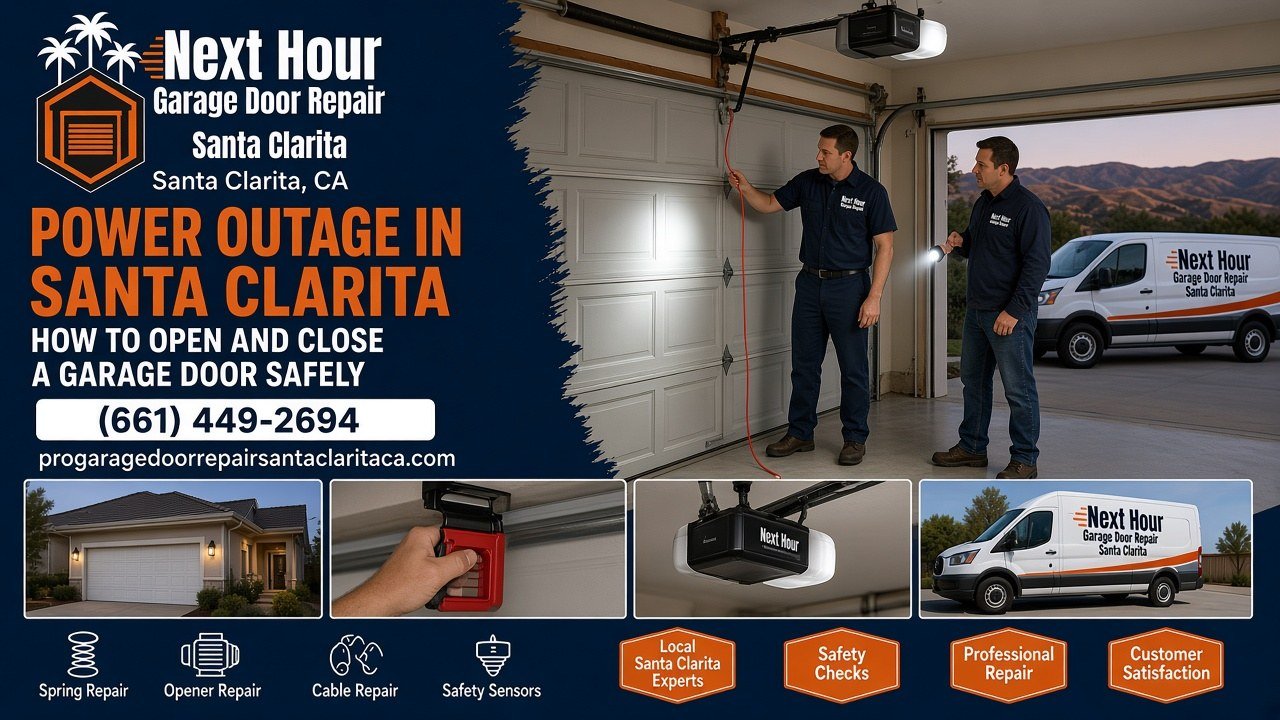
Power Outage in Santa Clarita: How to Open and Close a Garage Door Safely
When the power goes out in the Santa Clarita Valley, the garage door is often the first thing that reminds you. The opener goes quiet, the wall button does nothing, and the car you need is on the wrong side of a door that weighs as much as a large piece of furniture. Outages here come from storms, heat waves, equipment trouble, and, during Santa Ana wind events, planned Public Safety Power Shutoffs. Every garage door with an opener has a way to be run by hand, but doing it safely depends on a few checks first. This guide explains what happens to the door when the power fails, how to use the emergency release, how to lift, lower, and lock the door by hand, what to plan before the next shutoff, and the warning signs that mean you should leave the door alone and call a technician.
How do you open a garage door when the power is out? The short answer
Make sure the door is fully closed if you can, and check that the springs and cables look intact. Pull the red emergency release cord on the opener trolley to disconnect the door from the opener. Then lift the door slowly and steadily by its handle, keeping your fingers out of the gaps between sections. A balanced door should lift with moderate effort and stay put partway open. To close it, lower it by hand the same way, then use the manual lock or reconnect the opener so the door is secured. If the door is very heavy, crooked, or a spring looks broken, stop and call a technician.
If your opener has a battery backup, try the wall button or remote first, since it may still run the door for a limited number of cycles. Springs, cables, and bottom brackets hold high tension, and DASMA advises homeowners not to adjust them; see DASMA garage door safety tips.
Local help: Next Hour Garage Door Repair Santa Clarita repairs springs, cables, and openers, reconnects and adjusts doors after outages, and installs battery backup openers across Santa Clarita, Valencia, Saugus, Canyon Country, Newhall, Stevenson Ranch, and Castaic. Call (661) 449-2694.
What Happens to Your Garage Door When the Power Goes Out
A garage door opener does two jobs. It moves the door, and while it is connected, it also holds the door in place. The trolley that rides along the rail is locked to the door arm, so nobody can push the door up from outside while the opener is engaged. When the power fails, the motor stops, but that connection stays. That is why a door with a dead opener won’t budge when you pull on it: you are fighting the opener, not the springs.
The springs are what actually carry the weight. Torsion springs on a bar above the door, or extension springs along the horizontal tracks, are wound to balance the door so it feels light. They work with or without power. Once you disconnect the opener, the springs should let you move the door by hand. If they don’t, that tells you something about the springs.
| Opener setup | What happens in an outage | What to do |
|---|---|---|
| Standard opener, no battery backup | Wall button, remotes, keypad, and app stop working; door stays locked to the trolley | Use the emergency release and move the door by hand |
| Opener with battery backup | Runs on battery for a limited number of cycles; may beep or flash, and some accessories may turn off to save power | Use the wall button or remote as normal and limit trips until power returns |
| Wall-mount (jackshaft) opener | Motor stops; the release is usually a lever or cord on the unit beside the door | Follow the manual for that model’s release, then lift by hand |
| Smart opener with app | Wi-Fi and app control drop out with the router unless both have backup power | Use battery operation if available, or the manual release |
| Door with no opener | No change | Use the door as usual; keep the manual lock engaged when closed |
California law changed what most homeowners see here. Under California SB 969, residential garage door openers sold or installed in the state since July 1, 2019 must include a battery backup that works during an outage. If your opener is older than that, it very likely has no backup and will need the manual release. Our guide to garage door opener battery backup in California covers the law in more detail.
Before You Pull the Release: A Quick Safety Check
Take a minute with a flashlight before you do anything. Most outage injuries with garage doors happen when someone pulls the release on a door that is not balanced, or tries to force a door that has a mechanical problem.
- Is the door closed? The safest time to pull the release is with the door fully closed. If the door is open or partway open, a weak or broken spring can let it drop as soon as the opener lets go.
- Look at the springs. A torsion spring with a visible gap in the coils is broken. Extension springs should be attached at both ends with safety cables running through them.
- Look at the cables. The lift cables run from the bottom corners of the door up to drums or pulleys. They should be tight and seated, not frayed, slack, or hanging.
- Look at the door. A door that sits crooked, has a roller out of the track, or has a bent section should not be moved by hand.
- Clear the area. Move kids, pets, bikes, and storage out of the door’s path. Wear shoes, and keep a flashlight or headlamp so both hands are free.
If the door is open and you need to release it, make sure nobody is under it, stand to the side, and be ready to hold the door with both hands on the handle. If it starts to fall quickly when released, let it go and step away rather than trying to catch it. If you can see a broken spring or cable on an open door, leave it open, keep everyone out from under it, and call for repair.
If anything on that list looks wrong, don’t pull the release. A door that the opener is still holding is safer than one you are trying to control by hand with a failed spring. Our guides to garage door spring wear and a broken or loose garage door cable show what those problems look like.
How to Open the Garage Door by Hand, Step by Step
Once the springs, cables, and door look normal, here is the general sequence. Your opener’s manual has the details for your model, and it is worth reading it now while the lights are on.
- Find the emergency release. On most ceiling-mounted openers it is a red cord with a handle hanging from the trolley, the part that rides along the rail near the door. On wall-mount openers it is usually on the motor unit beside the door.
- Pull the release. With the door closed, pull the handle firmly straight down, or down and back toward the motor if your manual says so. You may hear or feel the trolley unlatch from the door arm.
- Unlock any manual lock. If the door has a slide bolt or a T-handle lock, make sure it is open before you lift.
- Lift from the handle or the bottom section. Use the lift handle or grip the bottom edge with palms facing up, never the joints between sections. Lift slowly and steadily.
- Feel the weight. A balanced door should rise with moderate effort and get easier as it goes up. If it feels like you are lifting the whole door yourself, stop and lower it gently.
- Open it all the way. Push the door up until it is fully open and resting on the horizontal tracks. A balanced door should stay there. If it creeps down, keep your hand on it and lower it rather than driving under a door that won’t hold.
Back the car out slowly and watch for people and pets. If you are leaving, plan how you will close and secure the door behind you, because the opener won’t do it.
A quick way to test balance on a closed door is to lift it about halfway by hand and let go carefully. It should stay roughly in place. If it falls or rises on its own, the springs are out of adjustment or worn. That is a job for a technician, not something to adjust yourself.
How to Close and Lock the Door Without Power
Closing by hand is the reverse of opening, but it takes more care, because gravity is now helping the door.
- Check the path. Make sure nothing and nobody is under the door, including the car’s rear bumper.
- Pull the door down by the handle or a pull rope, not by the sections. Keep your feet out from under the bottom edge.
- Lower it in a controlled way. Don’t let it drop the last few feet. A door that slams shut can damage the bottom section and the seal, and a door that drops fast may have a spring problem; see garage door slams shut or drops too fast.
- Secure the door. With the opener disconnected, the door is no longer held closed. Use the manual slide lock if your door has one, or a T-handle lock on older doors.
Remember to unlock before the power returns. If you leave a manual lock engaged and someone presses the wall button once power is back, the opener can strain against the locked door, bend the top section, or damage the trolley. Put a note on the wall button or the door to the house as a reminder.
Some homeowners prefer to reconnect the trolley while the power is still off, so the opener holds the door closed again. On many models, the trolley reconnects the next time the opener runs, and on some you can reset the release lever and move the door by hand until it latches. Check your manual before trying this.
If the garage is the only way into your home, an emergency release key lock lets you pull the release from outside through a small cylinder lock on the door. It is worth having in place before an outage happens.
If Your Opener Has a Battery Backup
A battery backup is the easiest way through a short outage. When the power drops, the opener switches to the battery and the wall button and remotes keep working, often with some changes:
- Slower travel and a beep or flashing light to show it is on battery power.
- Accessories turned off to save power, such as the light, the keypad, or Wi-Fi, depending on the model.
- A limited number of cycles. A charged battery is meant to get you through a short outage, not a multi-day shutoff. Make each trip count.
The backup only helps if the battery is charged and in good health. Batteries wear out with age and heat, and a hot Santa Clarita garage is hard on them. If your opener has been beeping on and off, or the battery indicator shows a fault, the battery may need replacing. Test it before fire season by unplugging the opener and running the door from the wall button.
If the backup battery dies partway through a long outage, use the emergency release just as you would with an opener that has no backup. For what to do once the power is restored, including reconnecting the trolley, resetting remotes, and checking the battery, see our garage door opener reset and battery backup guide.
Planning for PSPS Shutoffs, Wind Events, and Evacuations
Southern California Edison serves the Santa Clarita Valley, and during high fire-risk weather it can shut off power to reduce the chance of its equipment starting a fire. These Public Safety Power Shutoffs often come with strong, dry Santa Ana winds in the fall, and they tend to affect foothill and canyon neighborhoods. SCE says it begins sending notifications up to three days ahead when conditions may lead to a shutoff, and that a shutoff can last more than a day. You can check status and sign up for alerts on the SCE Public Safety Power Shutoff page.
A planned shutoff is a good reason to get the garage ready while you still have power:
- Practice the manual release with an adult in the household, so the first time isn’t in the dark.
- Test the battery backup by unplugging the opener and running the door.
- Park facing out if you may need to leave quickly, or park the car you need in the driveway.
- Keep a flashlight or headlamp on a hook by the door to the garage.
- Clear the floor around the door and under the release cord.
- Know where the manual lock is and whether it is engaged.
- Charge phones and keep keys handy, including any key for an emergency release lock.
During a wildfire evacuation, a stuck garage door costs time you don’t have. Wind events also push dust and debris into tracks, and heat wears on openers and batteries. Our guide to how Santa Clarita heat affects garage doors explains how summer heat wears on springs, rollers, and openers. For general outage preparation, see Ready.gov power outage guidance.
Outage Mistakes That Cause Injuries or Damage
- Running a generator in the garage. Never do this, even with the door open. Generator exhaust contains carbon monoxide, which can build to deadly levels in a garage. The CDC says to keep generators outside, more than 20 feet from windows, doors, and vents; see CDC carbon monoxide guidance.
- Warming up the car in an attached garage. The same carbon monoxide risk applies. Open the door fully first and back out without letting the engine idle inside.
- Pulling the release on an open door with a broken spring. The door can come down hard once the opener lets go.
- Lifting by the section joints. The gaps close as the door bends over the track curve and can pinch fingers.
- Forcing a door that won’t move. If it doesn’t move after you pull the release, check for a manual lock. If it is unlocked and still won’t move, something is binding or broken.
- Adjusting springs, cables, or bottom brackets. These hold the tension that lifts the door. Leave them to a trained technician.
- Leaving a pet in a closed, hot garage during a summer outage, when there is no fan or air movement.
- Leaving the manual lock on when the power returns and the opener tries to move the door.
When the Power Comes Back
The door won’t go back to normal by itself. Before you use the opener, make sure the manual lock is off and the door path is clear. Then reconnect the trolley, run the door through one full cycle while you watch, and test the safety reverse. Many openers reconnect on their own the next time they run, but some need the release lever reset first.
Power surges when the grid comes back can also affect openers. If the opener light is blinking, remotes don’t respond, the door reverses for no reason, or a smart opener won’t reconnect to Wi-Fi, our opener reset, reconnect, and battery backup guide covers each of those. You can also check what a blinking opener light may mean.
When to Stop and Call a Technician
- The door is so heavy you can’t lift it, or it falls when you let go partway open.
- A torsion spring has a gap, or an extension spring is stretched, loose, or missing its safety cable.
- A cable is frayed, slack, or has come off its drum.
- The door is crooked, a roller has come out of the track, or a section is bent. See garage door off track.
- The release cord won’t disconnect the trolley, or the trolley won’t reconnect.
- Once power is back, the opener hums but doesn’t move the door, or the door won’t reverse on the safety test.
In any of these cases, leave the door where it is, keep everyone away from it, and call for repair. Moving a door with a mechanical failure can turn a single broken part into several.
Garage Door Repair for Santa Clarita Valley Homes
Next Hour Garage Door Repair Santa Clarita serves Santa Clarita and the surrounding valley, including Valencia, Saugus, Canyon Country, Newhall, Stevenson Ranch, Castaic, and Hasley Canyon, plus ZIP codes 91321, 91350, 91351, 91354, 91355, 91381, 91384, and 91387. Services include spring and cable repair, emergency release and trolley repair, opener repair and replacement, battery backup opener installation, safety sensor alignment, and roller and track repair.
Call (661) 449-2694 or view Next Hour Garage Door Repair Santa Clarita on Google Maps.
Frequently Asked Questions About Garage Doors in a Power Outage
Can I open my garage door without power?
Yes. Pull the red emergency release cord to disconnect the door from the opener, then lift the door by hand. Check first that the springs and cables look intact, and do it with the door closed when possible.
Where is the emergency release on a garage door opener?
On most ceiling-mounted openers it is a red cord and handle hanging from the trolley on the rail near the door. On wall-mount openers it is usually on the motor unit beside the door.
Why is my garage door so heavy to lift by hand?
A properly balanced door should lift with moderate effort. If it feels very heavy, the springs may be worn or broken. Lower it gently and have the springs checked.
How do I lock my garage door when the opener is disconnected?
Use the manual slide lock or T-handle lock if the door has one, or reconnect the trolley so the opener holds the door. Unlock any manual lock before running the opener again.
Does a battery backup opener work during a long outage?
It runs for a limited number of cycles on a charged battery. During a multi-day shutoff, it may run down, and you will need to use the emergency release.
Can I run a generator in my garage with the door open?
No. The CDC says never to use a generator inside a home or garage, even with doors and windows open. Keep it outside, more than 20 feet from windows, doors, and vents.
How do I reconnect my garage door after the power comes back?
Make sure any manual lock is off, then run the opener. Many trolleys reconnect on the next cycle. Some models need the release lever reset first, so check your manual.
Who repairs garage doors after an outage in Santa Clarita?
Next Hour Garage Door Repair Santa Clarita repairs springs, cables, openers, and release mechanisms across the Santa Clarita Valley. Call (661) 449-2694.
Find Next Hour Garage Door Repair Santa Clarita
View Next Hour Garage Door Repair Santa Clarita on Google Maps
Get the Garage Door Ready Before the Next Outage
If your door is too heavy to lift by hand, the release won’t work, or you want a battery backup opener before the next shutoff, call Next Hour Garage Door Repair Santa Clarita at (661) 449-2694. We’ll check the springs, cables, and opener and show you how to use the release safely.
Serving Santa Clarita, the Santa Clarita Valley & northern Los Angeles County