Next Hour Garage Door Repair Santa Clarita · Home Buyer Guide
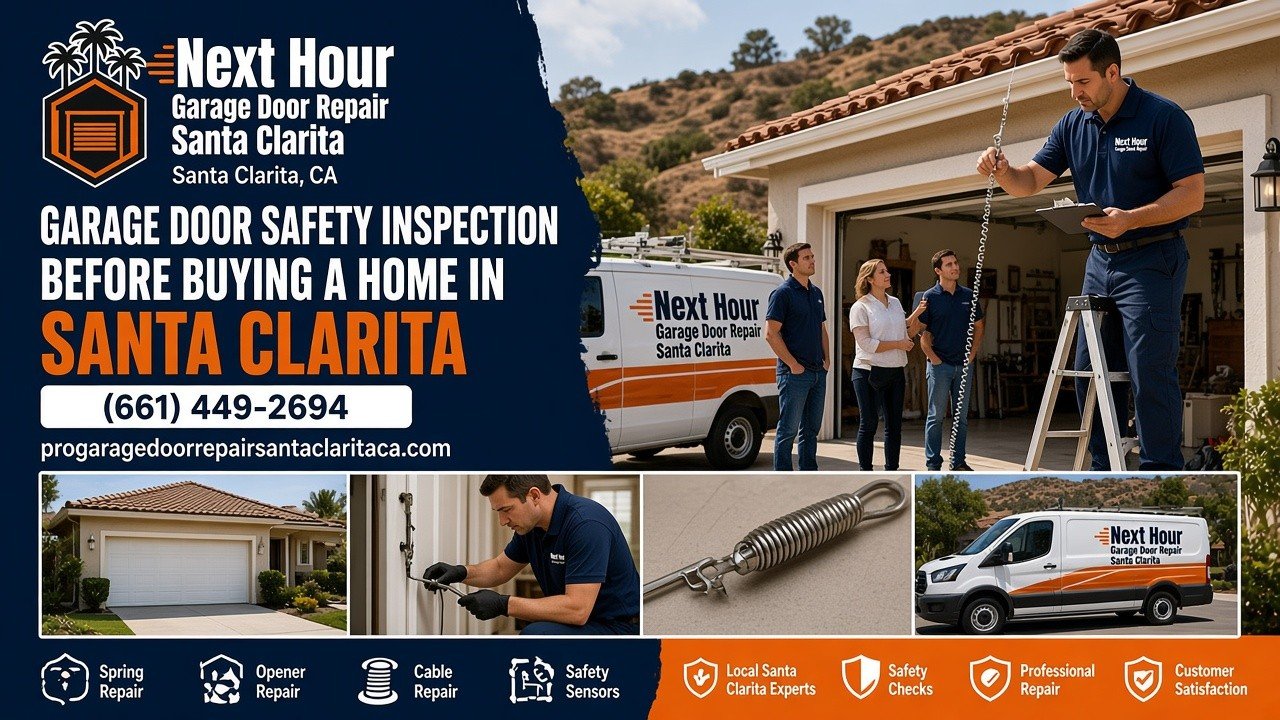
Garage Door Safety Inspection Before Buying a Home in Santa Clarita
The garage door is the largest moving object in most homes, and in a lot of Santa Clarita neighborhoods it is also the door the family uses every day. When you are buying a house, it usually gets a quick look during the general home inspection: someone presses the button, watches it go up and down, and maybe checks that it reverses. That is a start, but it does not tell you how worn the springs are, whether the door is balanced, whether the opener has the safety features California and federal rules expect, or who still has a remote. This guide walks through what to check on the garage door before you close, which findings are worth raising with the seller, and what to do in your first week in the new home.
What should you check on a garage door before buying a home? The short answer
Before closing, confirm that the door opens and closes smoothly without jerking, scraping, or loud bangs; that it reverses when it touches an object on the floor; that the photo-eye sensors stop it when the beam is blocked; that the springs and cables show no gaps, fraying, or rust; and that the door stays put when lifted halfway by hand. Ask how old the opener is and whether the springs have ever been replaced. Plan to change every remote, keypad code, and smart opener account after you move in.
Leave the springs, cables, and bottom brackets alone during any check. They hold a lot of stored tension, and DASMA advises homeowners not to adjust them; see DASMA garage door safety tips.
Local help: Next Hour Garage Door Repair Santa Clarita checks springs, cables, rollers, tracks, openers, and safety sensors for buyers and new homeowners across Santa Clarita, Valencia, Saugus, Canyon Country, Newhall, Stevenson Ranch, and Castaic. Call (661) 449-2694.
Why the Garage Door Deserves Its Own Look
A sectional garage door is held up by springs wound to match the weight of the door. When everything is right, the door feels light, and the opener only has to guide it. When the springs are tired, a cable is fraying, or a section is bent, the door gets heavier and less predictable, and the opener works harder to move it. None of that is obvious from pressing a button once.
For a buyer, the garage door matters for three reasons. It is a safety item: a door that doesn’t reverse, or one with a failing spring, can hurt someone. It is a security item: an old opener, a keypad with a code you don’t know, or a door that doesn’t close fully leaves the house open. And it is a cost item: a door near the end of its spring life or an opener that is many years old will need attention soon after you move in, and it is better to know that before you sign.
Homes in the Santa Clarita Valley add a few local factors. Many garages face long afternoons of direct sun, which fades panels, dries out seals, and can make safety sensors act up. Wind and dust from the canyons work their way into tracks and rollers. And a lot of homes in Valencia, Saugus, and Canyon Country were built in the same decades, so plenty of original doors and openers are still in service.
What a General Home Inspection Usually Covers
A general home inspector looks at the whole house in a limited amount of time. For the garage door, that often means running the opener, watching the door move, and checking that it reverses when it meets resistance or when the sensor beam is blocked. Many inspectors will note obvious problems such as a broken spring, a missing sensor, or a damaged panel.
What a general inspection usually doesn’t do is look closely at spring wear, test the door’s balance with the opener disconnected, check whether the springs are sized for the door’s weight, measure the opener’s force setting, or look at the cable ends at the bottom brackets. Those are garage door specifics. If the inspection report says “garage door operational” or “recommend evaluation by a garage door technician,” that second line is your cue to get a closer look while you still have time in escrow.
Read the inspection report carefully and look for wording such as “noisy operation,” “door did not reverse,” “sensor misaligned,” “spring appears worn,” or “door is heavy.” Each one points to a different part of this checklist.
The Pre-Purchase Garage Door Checklist
You can do most of this during a walkthrough or a second visit with the seller’s agent present. Stand clear of the door while it moves, and keep kids and pets out of the garage while you test.
| Check | What good looks like | Red flag |
|---|---|---|
| Normal open and close | Smooth, steady travel, fairly quiet | Jerking, grinding, banging, or the door stopping partway |
| Auto-reverse on contact | Door reverses after touching a 2×4 laid flat on the floor | Door crushes the board or stalls without reversing |
| Photo-eye sensors | Door stops and reverses when the beam is blocked | Door keeps closing, or sensors are missing, taped, or mounted high |
| Springs (look, don’t touch) | Even coils, no gap, no heavy rust | A gap in a torsion spring, stretched or mismatched extension springs |
| Lift cables | Tight and even on both sides | Fraying, rust, kinks, or one side slack |
| Rollers and tracks | Rollers turn and sit centered in straight tracks | Wobbling or cracked rollers, bent or loose tracks |
| Sections and hinges | Flat sections, tight hinges | Creased or cracked sections, bent or cracked hinges |
| Bottom seal | Seals the floor evenly when closed | Daylight under the door, torn or brittle seal |
| Wall button and remotes | Button mounted high, remotes and keypad work | Button within a small child’s reach, no remotes left, unknown keypad code |
The auto-reverse and sensor tests come from DASMA’s homeowner guidance. Federal rules in 16 CFR Part 1211 require entrapment protection on residential openers made since 1993, so a door that doesn’t reverse is a real safety problem, not a quirk of an older house.
Springs, Cables, and Balance
Springs do the lifting, so they are the part buyers most need to understand. Most Santa Clarita homes have torsion springs on a bar above the door; some older or single-car doors use extension springs that run along the horizontal tracks. Springs are rated for a certain number of open-and-close cycles, and a door used several times a day goes through those cycles faster than many people expect. Our guide to how long garage door springs last covers the signs of wear.
From a safe distance, look for a visible gap in a torsion spring (a sign it has broken), heavy rust, or a spring that looks different from its partner. On extension springs, look for stretched coils and a safety cable running through the middle of each spring. Then look at the lift cables at the bottom corners of the door for fraying or rust.
A balance check tells you more than a visual. With the door fully closed and the springs and cables looking intact, pull the opener’s emergency release cord, then lift the door by hand to about halfway and let go carefully. A balanced door stays roughly where you leave it. If it drops or shoots up, the springs are out of adjustment or worn. Lower it by hand, reconnect the opener, and note the result. If a spring looks broken or a cable is loose, skip this test entirely; see garage door slams shut or drops too fast for why.
Don’t try to adjust springs, cables, or bottom brackets during a showing or after closing. Note what you see and have a garage door technician handle the hardware.
Opener, Sensors, and Auto-Reverse
Look at the opener on the ceiling. A label usually shows the brand and model, and sometimes a manufacture date. Openers last many years, but an older unit may lack features buyers now expect, such as rolling-code remotes, a battery backup, or smart access. Our guide to how long a garage door opener lasts explains the signs that one is near the end.
California law (SB 969) has required new and replacement residential openers installed since July 1, 2019 to have a battery backup, so the door can still be operated during a power outage. If the house has an older opener without one, that is not a violation for the existing unit, but it is worth knowing. See garage door opener battery backup in California for details.
Check the photo-eye sensors on each side of the door near the floor. They should be mounted low, aimed at each other, and both indicator lights should be steady. If the door only closes when someone holds the wall button down, the sensors are probably misaligned or failing; see garage door sensor alignment and testing. In west-facing garages, low afternoon sun can also interfere with the beam, which is covered in garage door won’t close in afternoon sun.
Panels, Tracks, Rollers, and Seals
Walk the inside of the door with a flashlight. Look for creased or cracked sections, especially the bottom one, which takes most car bumps. Check that the hinges between sections are tight and not cracked; see cracked or bent garage door hinges. Check that the rollers turn freely and sit in the middle of the track, and that the tracks are straight and firmly attached to the wall.
From outside, look at the finish. Sun-faded or peeling panels are mostly cosmetic but tell you how much exposure the door gets. Close the door and look for daylight along the bottom and sides; a gap lets in dust, heat, and pests. See why there is a gap under a garage door for the usual causes.
A door that hangs crooked, runs unevenly, or rubs one side is worth a closer look before closing. Our guide on a crooked garage door that still works explains why “it still opens” isn’t the same as “it’s safe.”
Questions to Ask the Seller
- How old is the door, and how old is the opener? Even an approximate year helps.
- Have the springs or cables ever been replaced? If so, when, and was it one spring or both?
- How many remotes are there, and will they all be left? Ask for every remote, including ones clipped in cars.
- What is the keypad code, and who else knows it? Plan to change it either way.
- Is the opener connected to a smart app? Ask the seller to remove the opener from their account before closing.
- Are the manuals available? They make reprogramming and adjustments much easier.
- Has the door been hit or repaired? A past impact can explain a stiff section or bent track.
If the inspection or your own checks turn up a broken spring, a door that won’t reverse, or a damaged section, your agent can raise it during escrow as a repair request or a credit. Getting a written assessment from a garage door technician makes that conversation clearer, because it names the parts involved instead of “door seems heavy.”
Your First Week in the New Home
- Clear the opener’s memory and reprogram the remotes you received. This removes any remotes that left with the previous owners.
- Change the keypad code. See garage door keypad troubleshooting if the keypad won’t accept a new code.
- Set up or reset smart access under your own account, and confirm the old account no longer has access. If the door ever moves on its own, read garage door opens by itself.
- Repeat the reversal and sensor tests and put them on a monthly reminder.
- Find the emergency release and show everyone in the house how it works, and when not to use it.
- Move the wall button if it is within reach of small children.
- Schedule any repairs you noted during the inspection before they turn into a stuck door.
For ongoing care after that, our Santa Clarita garage door maintenance checklist covers what to look at through the seasons.
Garage Door Checks for Home Buyers Across the Santa Clarita Valley
Next Hour Garage Door Repair Santa Clarita serves Santa Clarita and the surrounding valley, including Valencia, Saugus, Canyon Country, Newhall, Stevenson Ranch, Castaic, and Hasley Canyon, plus ZIP codes 91321, 91350, 91351, 91354, 91355, 91381, 91384, and 91387. Services include spring and cable repair, roller and track repair, opener repair and replacement, safety sensor alignment, and remote and keypad programming.
Call (661) 449-2694 or view Next Hour Garage Door Repair Santa Clarita on Google Maps.
Frequently Asked Questions About Garage Door Inspections Before Buying a Home
Does a home inspection include the garage door?
A general home inspection usually runs the door, watches it move, and checks that it reverses. It usually doesn’t evaluate spring wear, balance, or cable condition in detail.
How do I test a garage door’s auto-reverse?
Lay a 2×4 flat on the floor in the door’s path and close the door with the opener. It should reverse after touching the board. Also block the photo-eye beam while the door closes; it should stop and reverse.
How can I tell if garage door springs are worn?
A gap in a torsion spring means it has broken. Heavy rust, a door that feels heavy, or a door that drops when lifted halfway by hand are signs of worn or out-of-balance springs.
Should I ask the seller to fix the garage door?
If the door doesn’t reverse, a spring or cable is damaged, or a section is cracked, your agent can raise it as a repair request or credit during escrow. A written assessment helps.
Does California require a battery backup on garage door openers?
Since July 1, 2019, California has required new and replacement residential openers to include a battery backup. Older openers installed before that are not required to be replaced.
What should I do with the garage door remotes after I move in?
Clear the opener’s memory, reprogram the remotes you kept, change the keypad code, and move any smart opener app to your own account.
Is an old garage door opener a reason not to buy?
Not by itself. It may mean planning for a replacement sooner. A door that doesn’t reverse or has a failing spring is the more urgent issue.
Who can check a garage door before I buy a home in Santa Clarita?
Next Hour Garage Door Repair Santa Clarita checks springs, cables, rollers, tracks, openers, and sensors across the Santa Clarita Valley. Call (661) 449-2694.
Find Next Hour Garage Door Repair Santa Clarita
View Next Hour Garage Door Repair Santa Clarita on Google Maps
Know What the Garage Door Needs Before You Close
If your home inspection flagged the garage door, or you just want a closer look at the springs, cables, opener, and sensors before closing, call Next Hour Garage Door Repair Santa Clarita at (661) 449-2694. We’ll tell you what we find in plain terms so you can plan.
Serving Santa Clarita, the Santa Clarita Valley & northern Los Angeles County