
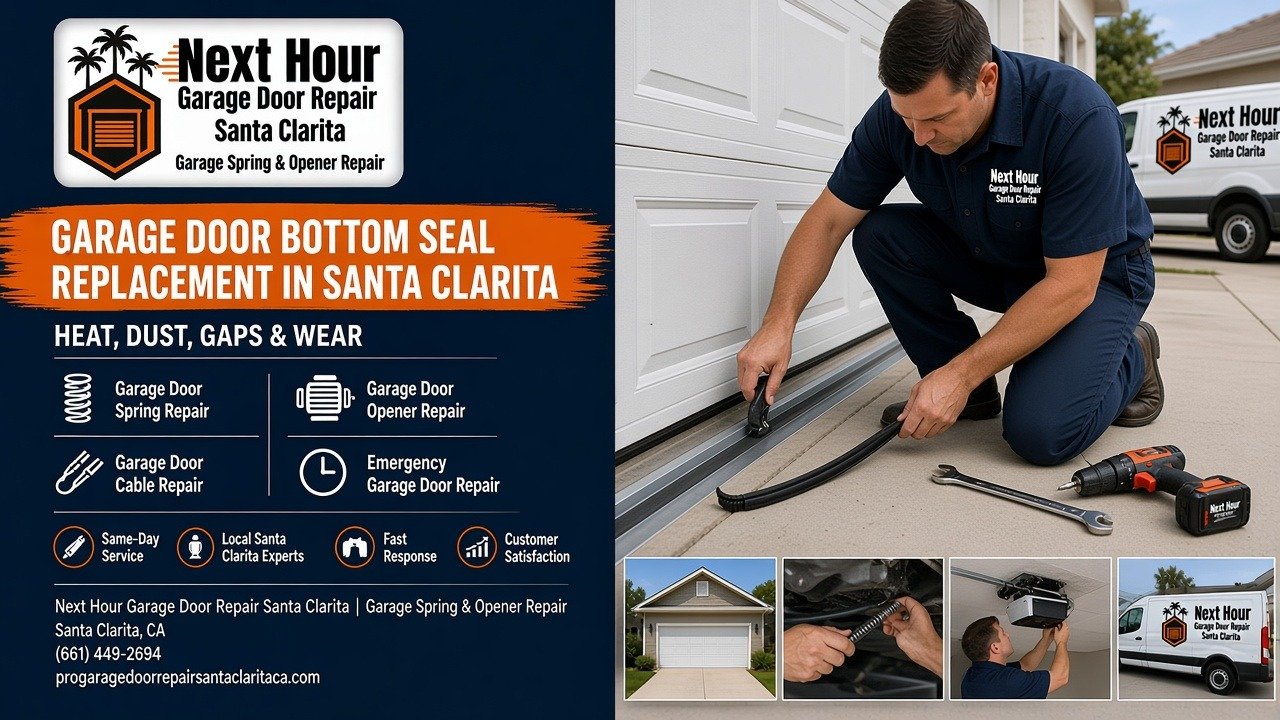
Next Hour Garage Door Repair Santa Clarita · Bottom Seal Guide
Garage Door Bottom Seal Replacement in Santa Clarita: Heat, Dust, Gaps & Wear
Garage door bottom seal replacement is one of the simplest repairs on a door, as long as the right seal goes in. The bottom seal is the rubber or vinyl strip along the door’s lower edge. It keeps out dust, leaves, insects, rodents, and wind-driven rain, and it cushions the door as it lands. In Santa Clarita, summer heat makes cheap seals stiff and cracked, and wind-blown grit wears down the contact edge, so seals here often need replacing before the door itself shows any wear. The key decisions are matching the seal profile to the retainer on your door, choosing a material that handles heat, and checking that the door actually lands level before blaming the seal. This guide covers seal types, how they wear, the signs it’s time, and what a proper replacement includes.
When should a garage door bottom seal be replaced? The short answer
Replace the bottom seal when it’s cracked, hardened, flattened, torn, or pulling out of its retainer, or when light and dust come under the door even though the door closes level. Match the new seal to your door’s retainer type (T-style, bulb, J-type, or nailed-on) and choose a material rated for heat. If the gap is only at one end, check the door’s level first, since a new seal won’t fix a crooked door.
If the gap seems to come from something other than the seal, our guide to why there’s a gap under your garage door walks through floor, track, cable, and balance causes.
Local help: Next Hour Garage Door Repair Santa Clarita replaces bottom seals, retainers, and weatherstripping, and checks door level and balance at the same visit, across Santa Clarita, Valencia, Saugus, Canyon Country, Newhall, Stevenson Ranch, and Castaic. Call (661) 449-2694.
What a Garage Door Bottom Seal Does
The bottom seal closes the space between the door and the floor. That space is never perfectly even, because slabs aren’t perfectly flat, so the seal has to compress more in some places than others. A good seal flexes to fill those low spots. It also takes the impact every time the door lands, and on doors with an opener, it helps the door stop softly at the down limit.
It’s separate from the perimeter weatherstrip (the stop molding along the sides and top of the opening). Both wear out, but they’re replaced differently.
Bottom Seal Types and How to Tell Which You Have
Common on steel doors. The seal has two T-shaped edges that slide into channels in an aluminum retainer.
Rounded beaded edges that slide into a retainer. Looks similar to T-style but the edge profile differs, so they’re not interchangeable.
Hooked edges used in some manufacturers’ retainers.
A hollow round profile that compresses well over uneven floors.
Common on older wood doors: a flat or beveled strip fastened directly to the bottom edge.
A raised strip glued to the floor. It’s a supplement for low spots or water, not a replacement for the door seal.
The surest way to identify yours is to pull one end of the old seal out of its retainer and look at the edge shape, or take a photo of the cut end. Measure the retainer width too. A seal that’s “close” usually won’t slide in, or slides in and falls out later.
Materials: Rubber vs. Vinyl in Santa Clarita Heat
Bottom seals are mostly made of rubber (including EPDM) or vinyl/PVC. Vinyl is common and inexpensive, but it tends to stiffen in heat and can get brittle with UV exposure. Rubber, and EPDM in particular, is known for staying flexible through heat and sun. For a west- or south-facing door in the Santa Clarita Valley, where summer driveway temperatures run high, a rubber seal usually holds its shape and flexibility longer. Check the product’s stated temperature range when choosing.
How Heat, Dust, and Use Wear a Seal Down
- Heat hardening. Seals lose flexibility, stop conforming to the floor, and leave gaps in low spots.
- Cracking and splitting. Hardened seals crack at the folds and ends, often first at the corners.
- Compression set. A seal pressed in the same shape for years stays flat and stops springing back.
- Abrasion. Fine dust and grit from Santa Ana wind days work under the door and wear the contact edge.
- Pulling out. Heat-shrunk seals creep out of the retainer at the ends, leaving open corners.
- Chewing. Rodents chew through worn seals to get into garages.
Signs Your Bottom Seal Needs Replacing
- Daylight under the door with it closed, across a level floor.
- Dust, leaves, or insects collecting just inside the door.
- The seal feels hard or crunchy instead of soft.
- Visible cracks, splits, or flattened sections.
- Ends pulled out of the retainer or seal hanging loose.
- Water getting in during storms.
- The door lands with a bang instead of a cushioned stop.
If the gap is wedge-shaped (big at one end, none at the other), that’s usually not the seal. A door can sit crooked from a cable or spring problem, covered in garage door crooked but still works.
What a Proper Bottom Seal Replacement Involves
- Check the door first. Confirm the door closes level and balanced. If not, the cause gets fixed first.
- Identify the retainer and seal profile. Match type and width.
- Remove the old seal. Slide it out of the retainer (it often needs the door raised a little and secured), or remove fasteners on a nailed-on seal.
- Inspect the retainer. Bent, corroded, or crushed aluminum retainers are replaced; a new seal won’t stay in a damaged one.
- Install the new seal. Slide it through the channels, often with a little soapy water to ease it in, and leave a small overhang at each end to allow for shrinkage.
- Re-set the opener down limit. A new, thicker seal changes where the door lands. The opener should stop when the seal is lightly compressed, not crush it. Then re-test the safety reversal.
Safety: Don’t remove or loosen the bottom brackets at the ends of the door to get the seal out. Those brackets hold the lift cables under spring tension. DASMA garage door safety tips say they should only be adjusted by a trained technician.
DIY or Professional?
On many doors, sliding a matching seal into an intact retainer is a manageable owner job if the door can be held safely partway open and the bottom brackets are left alone. It becomes a technician job when the retainer is damaged, the bottom brackets are in the way, the door is crooked, or the opener needs its limits and force reset afterward. Since a seal problem often turns out to be a level or balance problem, having the door checked during the replacement is worthwhile.
While You’re at It: Side and Top Weatherstrip
The stop molding along the jambs and header seals the sides and top. It ages the same way. Replace it so it touches the door lightly; if it’s nailed tight against the door, it causes rubbing. See garage door rubs or scrapes one side.
Making a New Seal Last
Keep the floor under the door swept so grit doesn’t grind the seal. Wipe the seal occasionally and check the ends haven’t crept out. Make sure the opener isn’t crushing it at the down limit; an over-pushed seal flattens quickly, and that over-push also stresses cables (see cable drum problems). A door that shakes as it lands wears the seal unevenly; see why a garage door shakes when closing.
Bottom Seal Replacement Across the Santa Clarita Valley
Next Hour Garage Door Repair Santa Clarita serves Santa Clarita and the surrounding valley, including Valencia, Saugus, Canyon Country, Newhall, Stevenson Ranch, Castaic, and Hasley Canyon, plus ZIP codes 91321, 91350, 91351, 91354, 91355, 91381, 91384, and 91387. Services include bottom seal and retainer replacement, side and top weatherstripping, door leveling and balancing, and opener limit adjustment.
Call (661) 449-2694 or view Next Hour Garage Door Repair Santa Clarita on Google Maps.
Frequently Asked Questions About Garage Door Bottom Seal Replacement
How do I know what garage door bottom seal I need?
Pull out one end of the old seal and look at the edge profile (T-style, bead, J-type, or bulb), and measure the retainer width. Seals must match the retainer exactly.
How often should a garage door bottom seal be replaced?
When it’s cracked, hard, flattened, torn, or pulling out of the retainer. In hot, dusty areas like Santa Clarita that tends to be sooner than in mild climates.
Is rubber or vinyl better for a garage door bottom seal?
Rubber, especially EPDM, generally stays flexible in heat and sun better than vinyl, which can stiffen and crack. Check the product’s temperature range.
Can I replace a garage door bottom seal myself?
Often, if the retainer is intact and the door can be held partway open safely. Don’t loosen the bottom brackets, which hold the cables under spring tension.
Why does my new bottom seal not touch the floor at one end?
The door or floor may not be level. A cable, drum, or spring problem can tilt the door; a new seal won’t correct that.
Do I need to adjust my opener after replacing the seal?
Usually. A new seal changes where the door lands. The down limit should lightly compress the seal, and the safety reversal should be re-tested.
Will a new bottom seal keep out rodents and dust?
A properly fitted seal closes the gap that pests and dust use, as long as the door also closes level.
Who replaces garage door bottom seals in Santa Clarita?
Next Hour Garage Door Repair Santa Clarita replaces bottom seals and retainers and checks level and balance across the Santa Clarita Valley. Call (661) 449-2694.
Find Next Hour Garage Door Repair Santa Clarita
View Next Hour Garage Door Repair Santa Clarita on Google Maps
Seal Out Heat, Dust, and Pests
If your bottom seal is cracked, flattened, or letting dust in, call Next Hour Garage Door Repair Santa Clarita at (661) 449-2694. We’ll match the right seal to your door and make sure the door lands level.
Serving Santa Clarita, the Santa Clarita Valley & northern Los Angeles County