
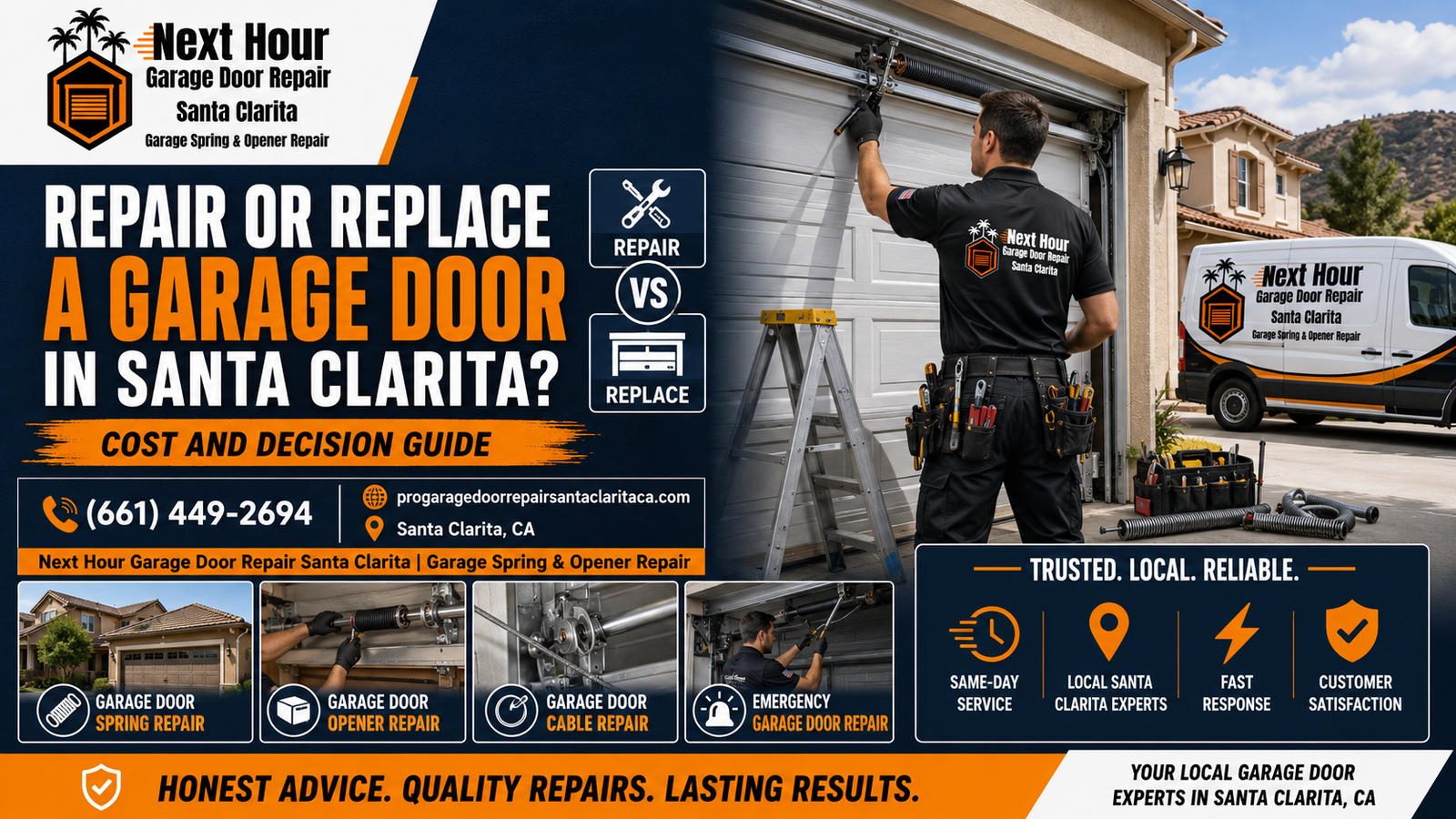
Repair or Replace a Garage Door in Santa Clarita? Cost and Decision Guide
A homeowner decision guide to structural damage, panel replacement, repair scope, new-door cost factors, opener compatibility, permits and when full garage door replacement becomes more practical.
Not sure whether the door is repairable? If the door is crooked, off track, has a broken spring or loose cable, stop operating it until the system is safe. Call (661) 449-2694 to ask Next Hour Garage Door Repair Santa Clarita about current service availability.
Should you repair or replace a garage door in Santa Clarita?
Repair usually makes sense when the door structure is sound and the problem is limited to a spring, cable, roller, opener component, track adjustment or replaceable panel. Replacement becomes more practical when multiple sections are damaged, structural integrity is compromised, compatible parts are unavailable, or several major repairs are needed at once. Compare the full repair scope with the full replacement scope before deciding.
Repair or Replace a Garage Door in Santa Clarita? Start With the Actual Condition
When a garage door starts failing, Santa Clarita homeowners often face the same question: should I repair the garage door or replace it? The right answer depends less on the age printed on an invoice and more on the actual condition of the door system. A broken spring, worn roller, opener problem, damaged cable, sensor issue or single replaceable panel may be repairable without replacing the entire door. By contrast, multiple damaged sections, severe structural distortion, extensive corrosion, unavailable matching panels or repeated failures across an aging system can make full replacement more practical.
The decision also has a cost dimension, but cost should be compared on equal terms. A repair estimate may cover one component while a replacement estimate may include a new door, tracks, springs, rollers, hardware and installation. Those are different scopes. The useful comparison is not simply “Which number is lower?” It is “What does each option correct, what remains old, what risks remain, and how long is the repair likely to solve the actual problem?”
This guide is designed for homeowners in Santa Clarita, California and the surrounding Santa Clarita Valley. It explains the signs that usually favor repair, the conditions that can justify replacement, how panel damage changes the decision, why opener compatibility matters, what to ask about cost, and which safety and permitting questions deserve attention before approving work.
The Fastest Way to Decide: Structure, Safety, Parts and Repeat Failures
A practical repair-versus-replacement decision can be made by looking at four categories: the structural condition of the door, the safety of the moving system, the availability of compatible parts, and the pattern of previous failures.
- Structure: Are the sections straight and sound, or are multiple panels cracked, bowed, rusted, delaminated or torn around hinges?
- Safety: Are the springs, cables, tracks and rollers capable of being restored to safe operation without rebuilding most of the system?
- Parts: Can compatible springs, rollers, panels, hinges and other components still be sourced for the door?
- Repeat failures: Is this one isolated problem, or have several major components required repair in a short period?
When the basic door structure is healthy and one serviceable component has failed, repair is often the logical first option. When the door itself is structurally compromised and several major components also need work, replacement deserves a serious comparison.
Repair vs. Replace: Santa Clarita Decision Table
| Condition | Repair may make sense when… | Replacement may make sense when… |
|---|---|---|
| Broken spring | Door sections, tracks, cables and hardware remain serviceable | Spring failure is one part of widespread structural or mechanical deterioration |
| Damaged panel | One section is damaged and a compatible panel is available | Several sections are damaged, panel style is unavailable, or door structure is compromised |
| Opener failure | Door itself is balanced, safe and mechanically sound | Opener failure is separate; replacing the opener does not normally require replacing a good door |
| Off-track door | Tracks, panels and hardware can be restored without major structural damage | Impact or derailment has badly bent multiple sections/tracks or compromised the door |
| Rust/corrosion | Localized surface condition does not affect strength or hardware | Corrosion is extensive, perforates sections, or affects attachment points |
| Repeated repairs | Failures are isolated and the remaining system is in good condition | Several major components are reaching end-of-service condition together |
| Appearance/energy goals | Existing door still meets functional needs | Homeowner wants a different material, insulation level, window layout or design |
This is a decision framework, not a substitute for inspecting the actual door. A professional recommendation should be tied to observable conditions rather than a blanket statement that an older door must automatically be replaced.
7 Signs Garage Door Repair May Be the Better Choice
- The damage is limited to one component. A broken spring, worn roller, sensor problem, cable issue or opener component can often be repaired without replacing the door.
- The door sections remain straight and structurally sound. If the panels are not badly bowed, cracked or torn around hinges, the door may have many serviceable years left after repair.
- Compatible parts are available. Replacement rollers, springs, hinges, cables or a matching panel can make repair practical.
- The tracks can be restored safely. Minor alignment or hardware problems are different from severe track deformation caused by a major impact.
- The door can be balanced correctly after repair. A working spring-and-cable system is essential for controlled movement.
- The problem is actually the opener, not the door. A failed opener does not automatically mean the garage door needs replacement.
- This is an isolated failure rather than a pattern. One repair on an otherwise healthy system is very different from repeated major failures.
Repair should restore normal function without asking old, damaged structural components to carry loads they can no longer support. The goal is a sound system, not simply the least expensive immediate action.
A Broken Spring Usually Does Not Mean You Need a New Garage Door
A broken spring is one of the clearest examples of a repair that can look dramatic without necessarily requiring full door replacement. Springs counterbalance the door's weight. When one fails, the door can become very heavy, the opener may lift only a few inches, and cables may lose normal tension. Those symptoms can make the entire door appear “dead” even when the panels and tracks remain structurally sound.
If the door sections, tracks, rollers, cables and attachment points are serviceable, the spring system can often be repaired and the door rebalanced. Replacement becomes a separate discussion only if the spring failure occurred alongside broader problems such as severe section damage, corroded hardware, deformed tracks or an overall door condition that is no longer practical to repair.
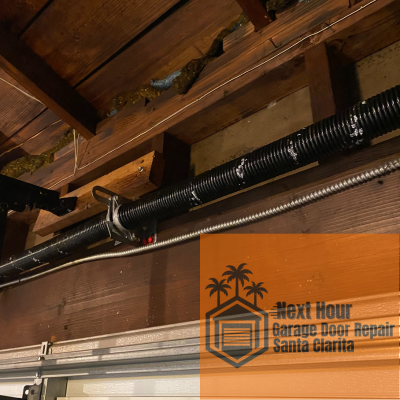
DASMA's garage door safety guidance emphasizes that springs and high-tension components should be handled by trained door-system technicians. Homeowners should not wind torsion springs or adjust cable drums to reduce repair cost.
When a Damaged Garage Door Panel Can Be Repaired or Replaced by Section
Panel damage sits in the middle of the repair-versus-replacement decision. A shallow cosmetic dent may not affect operation. A bent section can interfere with rollers, hinges or tracks. A crack around a hinge or opener attachment can affect structural integrity. The technician should distinguish cosmetic damage from damage that changes how the door carries load.
If only one section is damaged and an exact or compatible replacement panel is available, section replacement may be a practical alternative to replacing the whole door. The rest of the door should be inspected for alignment, hardware damage and color/finish compatibility. Older doors create an additional challenge because panel designs can be discontinued or changed by the manufacturer.
Next Hour has a dedicated garage door panel replacement in Santa Clarita resource that discusses panel damage, hinges, rollers, tracks and when full replacement may deserve review. The key is to base the recommendation on the condition of the entire door rather than the appearance of one dent.
When Multiple Damaged Sections Push the Decision Toward Replacement
Once damage extends across several sections, the economics and structural logic can change. Replacing several individual panels may involve significant parts and labor while leaving older tracks, springs, rollers and hardware in service. If compatible sections are difficult to obtain, the repair can become more complex still.
Multiple damaged sections can result from vehicle impact, long-term corrosion, repeated off-track events, warped materials or deterioration around hinges and reinforcement points. A replacement discussion becomes more reasonable when the door can no longer maintain alignment, panels flex excessively, or major attachment points have lost strength.
Ask the technician to compare the two scopes clearly. A multi-panel repair quote should identify which sections and hardware are being replaced. A full replacement quote should identify what new components are included—door sections, tracks, rollers, hinges, springs, weather seal and related hardware—so you are not comparing unlike projects.
Does an Off-Track Garage Door Need Repair or Replacement?
An off-track door does not automatically need replacement. A roller can leave the track because of a cable problem, track misalignment, loose hardware or impact. If the panels and tracks remain structurally repairable, the door may be restored by correcting the cause, repairing damaged hardware and re-establishing proper alignment.
Replacement becomes more likely after a severe derailment that twists multiple panels, bends both tracks, tears hinges from sections or damages the door so extensively that safe alignment cannot be restored. Vehicle impact is a common example where the visible roller problem may be only one part of the damage.
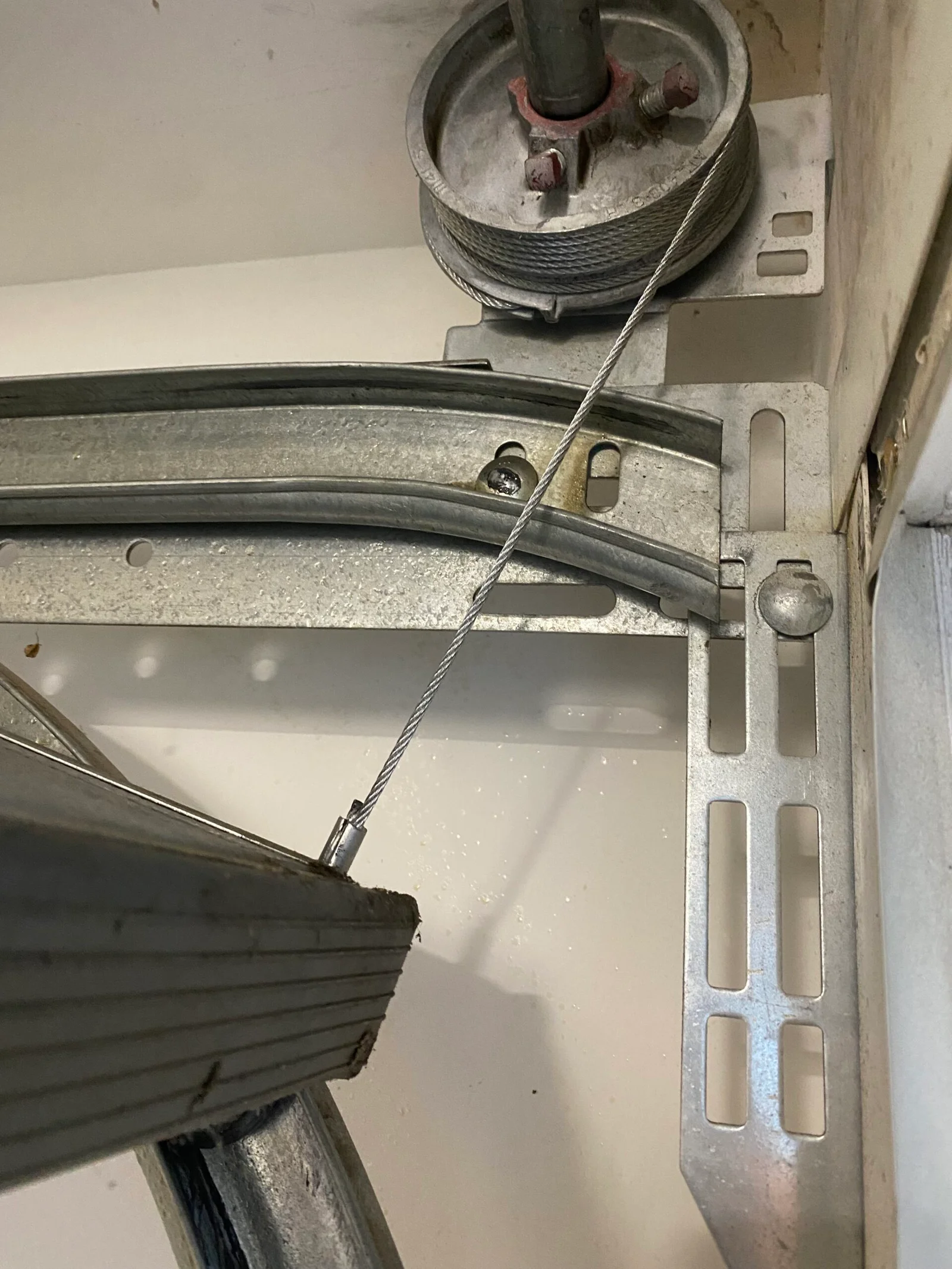
Do not force an off-track door with the opener. Continued operation can turn a repairable track problem into panel, cable and opener damage. The existing off-track garage door repair page provides additional information about restoring alignment.
Do Not Replace the Whole Garage Door for an Opener Problem
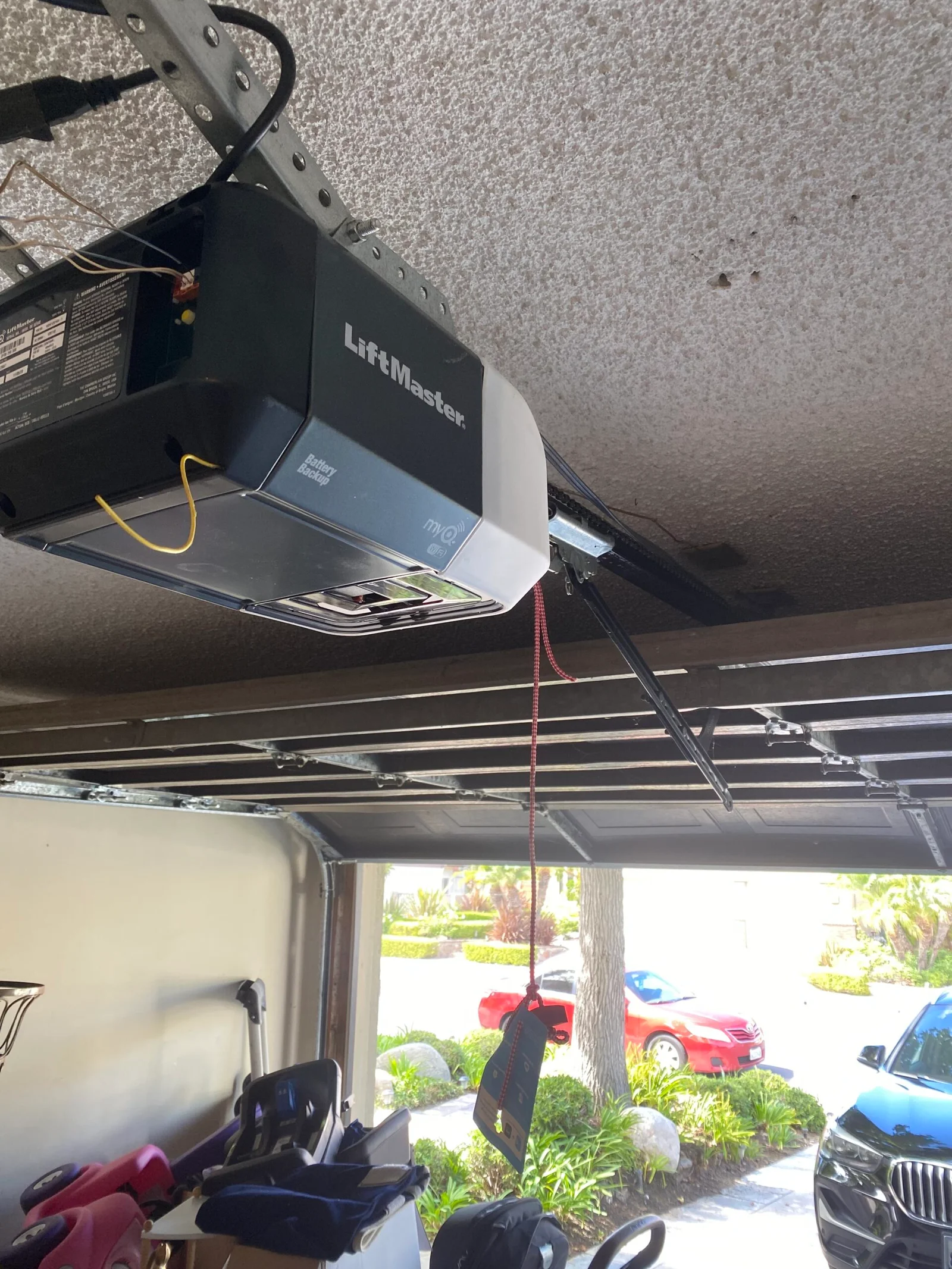
A failed garage door opener is separate from the garage door itself. The opener motor, logic board, trolley, rail, remote controls and safety sensors can fail while the door sections, tracks and spring system remain in good condition. Conversely, a mechanically damaged or unbalanced door can make a working opener appear defective.
Before replacing either the opener or the entire door, confirm whether the mechanical door can be restored to proper balance. If the door is structurally sound, opener repair or opener replacement may be all that is needed. If the opener is serviceable but the door is severely damaged, the door may be the part that needs replacement.
For the detailed diagnostic path, review our garage door opener troubleshooting guide. That distinction helps prevent an expensive whole-door replacement when the actual failure is electrical or control-related.
Does the Age of a Garage Door Determine Whether It Should Be Replaced?
Age is useful context, but it should not be the only reason to replace a garage door. A well-maintained older door with sound sections, compatible parts and safe operation can remain repairable. A newer door can still require replacement after severe impact, structural damage or poor installation.
Instead of asking only “How old is the door?” ask what condition the door is in today. Are the sections straight? Are hinge attachment points solid? Are the tracks compatible and secure? Are replacement panels still available? Is the door free from extensive rust, rot or delamination? Can the spring system balance the door correctly?
Age becomes more influential when it is combined with obsolete or unavailable parts, repeated failures, deteriorating materials and multiple systems reaching the end of their useful condition at the same time.
When Repeated Garage Door Repairs Start to Favor Replacement
One repair does not create a pattern. But if a homeowner has recently replaced springs, repaired cables, corrected an off-track event, reinforced damaged sections and still faces additional structural problems, the cumulative scope deserves review. The important point is not the number of invoices by itself; it is whether the remaining original components are also deteriorating.
Ask the technician to identify which components are still serviceable and which are approaching failure. A repair-focused recommendation may make sense when previous work has already restored major systems and one isolated issue remains. Replacement may make more sense when several major systems require simultaneous work and the door structure itself is weak.
Keep records of repairs. That makes the decision more objective because you can compare recent work with the current diagnosis instead of relying on memory.
How to Compare Garage Door Repair Cost With Replacement Cost
Repair and replacement costs should be compared by scope, not by headline price. A spring repair estimate covers a specific counterbalance problem. A full-door replacement estimate may include new sections, tracks, springs, rollers, hinges and installation. The replacement therefore resets more of the system, but it also involves more materials and labor.
Do not invent a break-even percentage such as “replace the door whenever repair costs half as much as replacement.” There is no universal threshold that accounts for every door, material, panel availability and safety condition. The better comparison includes the condition of what remains after repair.
For repair, ask: What exactly is being replaced? What original components remain? Are those remaining components structurally sound? For replacement, ask: What new components are included? Does the quote include removal of the old door? Are tracks and springs included? Will the opener be reconnected or evaluated for compatibility?
For general cost factors across repair categories, see the Santa Clarita garage door repair cost guide. Actual Next Hour pricing should come from a current quote for the specific project rather than generic web ranges.
What Changes the Cost of a Garage Door Replacement in Santa Clarita?
Replacement cost can vary significantly because garage doors are not all the same. Door width and height, material, insulation, windows, panel design, finish, decorative hardware, spring system, track configuration and installation complexity can all change the project.
A standard steel sectional door is different from a heavy wood or full-view glass door. An insulated door can weigh more than a non-insulated design and may require different spring specifications. Custom dimensions or changes to the opening can add complexity. If framing or structural modifications are required, additional building requirements may apply.
Homeowners should also ask whether the quote includes removal and disposal of the existing door, new tracks, rollers, hinges, springs, weather seal and opener reconnection. A low quote that excludes several of those items may not be directly comparable to a more complete installation quote.
Panel Availability Can Decide Whether Repair Is Practical
A single damaged section can be a strong candidate for repair when a matching panel is readily available. But panel availability changes over time. Manufacturers update product lines, embossing patterns, window options, section thicknesses and colors. A door that is physically repairable may still be difficult to restore if the required section is no longer produced.
Compatibility is about more than appearance. Section dimensions, hinge locations, reinforcement and track geometry must work together. A panel that looks similar from the street may not be structurally compatible with the existing door system.
If a matching panel cannot be sourced, ask whether a safe alternative exists and how it will affect appearance and operation. When several panels are unavailable, full replacement may become the cleaner technical solution.
Replacement Can Also Be a Functional Upgrade Decision
Not every replacement decision begins with a mechanical failure. A homeowner may want improved insulation, a different architectural style, more natural light, different window placement, updated weather seals or a quieter door system. Those are legitimate reasons to consider a new door even when the old one can still be repaired.
Separate those upgrade goals from the repair diagnosis. If the existing door can be repaired safely, the homeowner should understand that option. If replacement provides additional benefits that matter to the household, those can then be compared openly rather than being presented as though repair is impossible.
In HOA communities, exterior design or color changes may require architectural review. Homeowners should confirm any association requirements before ordering a custom appearance or window pattern.
One Failed Part or a Failing Door System?
The decision changes when damage is isolated versus structural. Ask what remains serviceable after repair and what new components are included with replacement.
What a Complete Garage Door Replacement Scope Should Clarify
A replacement proposal should make clear whether the project is a door-only replacement or a full system replacement. Door sections are only one part of the system. Tracks, rollers, hinges, springs, cables, drums, brackets, weather seal and opener attachment all interact with the new door.
Ask which old components will remain. Reusing an opener may be reasonable when it is compatible and serviceable. Reusing tracks may or may not be appropriate depending on the door system. Reusing worn springs with a new door is generally not the same as installing a spring system selected for the new door's actual weight and geometry.
Also ask how the old door will be removed, whether debris or old sections will be hauled away, how the new door will be balanced before opener operation, and how final safety checks will be documented. These details help distinguish a complete replacement scope from a quote that initially appears inexpensive because important work is excluded.
Why a Replacement Door Should Not Automatically Reuse Old Tracks
It can be tempting to reuse existing tracks to reduce replacement cost, but tracks and door sections are designed as a system. Section thickness, door weight, roller geometry, headroom and opener position can affect whether the old track is compatible with the new door.
DASMA specifically cautions that an old track may not fit a replacement door and states that the track and sections work together as a system. Its garage door safety tips recommend using the track designed for the specific door for performance and longevity.
Ask the installer whether the replacement quote includes new tracks and why the proposed track configuration is appropriate. Reusing components should be a technical decision based on compatibility, not simply a shortcut.
Can You Keep the Existing Garage Door Opener With a New Door?
Sometimes. The existing opener may remain usable if it is compatible with the replacement door and is in serviceable condition. Compatibility depends on the new door's weight, balance, travel requirements, rail length, attachment method and opener features.
A new door should be balanced correctly by its spring system so the opener is not expected to lift excessive weight. The installer should confirm that the opener can move the new door through full travel and that the rail, trolley and door arm are properly positioned.
Safety systems also matter. The U.S. Consumer Product Safety Commission provides information on automatic residential garage door operator safety, including federal entrapment-protection requirements. After a door replacement, the opener's sensor and reversal functions should remain correctly configured.
Do not assume a new door requires a new opener, and do not assume an old opener can automatically be reused. Treat opener compatibility as a separate inspection item.
Permits and Building Questions for Garage Door Replacement in Santa Clarita
Routine component repair does not automatically mean a building permit is required. Replacement projects involving structural changes, opening modifications or other construction can raise different questions. The appropriate requirement depends on the actual scope.
The City of Santa Clarita maintains an official Permit Center and residential construction guidance. Homeowners planning a replacement that changes framing, the opening or other structural elements can use the city resource to confirm whether permits or review apply.
Do not let a contractor claim that every garage door repair requires a permit, and do not assume that no replacement project ever requires one. Verify the requirement for the specific scope.
Door Material Can Change Both Repairability and Replacement Value
Steel, wood, composite, aluminum and full-view glass doors behave differently when damaged. A steel panel may dent while retaining most of its structure. Wood can split, rot or delaminate. Glass sections may require exact framing and glazing components. Composite materials have manufacturer-specific repair options.
Material also affects door weight, which in turn affects spring selection and opener compatibility. Replacing a lightweight door with a heavier design requires the complete counterbalance system to be selected for the new load rather than assuming the old springs will work.
For a homeowner who wants improved insulation or a different appearance, material choice can create value beyond repairing the existing door. But those upgrade benefits should be presented separately from the question of whether the old door is technically repairable.
How to Evaluate a Contractor for Repair or Replacement
The repair-versus-replacement decision is easier when the contractor explains both options clearly. A repair quote should identify the failed component and the condition of the remaining door. A replacement quote should identify what new components are included and why replacement is being recommended.
California homeowners can use the official CSLB Check a License tool when contractor licensing is relevant. The CSLB also defines the D-28 Doors, Gates and Activating Devices classification.
This article does not claim a specific Next Hour license number because one was not independently verified and authorized for this article. If any company provides license information, verify it through the state database.
15 Questions to Ask Before Choosing Repair or Replacement
- What exactly is damaged or worn?
- Is the problem limited to one component or is the door structure itself compromised?
- Can the door be restored to correct balance after repair?
- Are the tracks and rollers still serviceable?
- Are matching replacement panels available?
- If a panel is replaced, will it be structurally compatible with the existing door?
- What parts remain old after the proposed repair?
- What new components are included in the replacement quote?
- Does replacement include new tracks, springs, rollers and hardware?
- Can my current opener be safely reused with the new door?
- Will opener sensors and reversal functions be tested after installation?
- Are structural modifications or permit questions involved?
- What service-call, removal or disposal charges are included?
- Will I approve any scope change before additional work begins?
- What written warranty, if any, applies to the quoted work?
The goal is not to pressure the contractor into recommending repair. The goal is to understand why one option is technically and financially more appropriate for the actual door.
Selling or Renovating a Home: Should Curb Appeal Change the Decision?
A homeowner preparing to sell or renovate may place more weight on appearance than someone focused only on function. A door with several mismatched panels, fading, dents or an outdated design can still operate correctly while detracting from the exterior appearance.
That does not mean replacement is mechanically required. It means the decision includes aesthetic value. If the existing door can be repaired safely, ask for the repair option and the replacement option separately so you understand how much of the investment is for function and how much is for appearance or modernization.
For HOA-regulated homes, check architectural requirements before selecting a new style, window pattern or color. Approval requirements can affect project timing and product choice.
Repair-or-Replace Red Flags to Watch For
Be cautious when a contractor recommends full replacement before inspecting the door, refuses to explain why a panel or component cannot be repaired, or uses a generic “too old” statement without discussing actual condition. Replacement can be the correct recommendation, but it should be supported by specific evidence.
Also be cautious of the opposite problem: a repair recommendation that ignores severe structural damage just because it produces a smaller immediate invoice. A badly twisted section, heavily corroded attachment point or severely damaged track system may not be a good candidate for a minimal patch.
Other warning signs include pressure to bypass safety sensors, increase opener force to compensate for poor balance, reuse incompatible tracks without explanation, or authorize additional work without a revised scope and price.
Santa Clarita Factors That Can Matter in a Repair-or-Replace Decision
Santa Clarita's warm, dry environment, direct sun exposure, dust and garage heat can affect how finishes, weather seals, electronics and moving components age. These local conditions should be considered as context, not used as proof that a specific door needs replacement.
Frequent daily use can also influence the decision. A household that uses the garage as the primary vehicle entrance places more cycles on springs, rollers, hinges and opener components. When an older door has accumulated wear across several systems, replacement may become more attractive than continuing to address one component at a time.
Relevant service-area context can include Valencia, Canyon Country, Saugus, Newhall, Stevenson Ranch, Castaic and Hasley Canyon. The dominant geographic entity for this guide remains Santa Clarita, California.
Example Decision Path: One Broken Spring, Sound Door
Imagine a door that is straight, closes securely, has serviceable tracks and panels, but one torsion spring has broken. The opener cannot lift the door normally because the counterbalance system has failed. In this situation, spring repair and a full balance check may be the logical solution. Replacing the entire door simply because the spring broke would not address a structural need.
The technician should still inspect cables, drums, bearings, rollers and opener strain. If those components are serviceable, repair can restore the door without replacing sound sections.
Example Decision Path: Multiple Damaged Panels and Bent Tracks
Now consider a door that was struck by a vehicle. Several sections are bowed, one hinge has torn from the panel, both vertical tracks are distorted and the door has already come off track. Compatible replacement sections are difficult to obtain. In that situation, the cost and complexity of rebuilding several parts of the old system may justify comparing a full replacement.
The homeowner should still receive an explanation of what can be repaired and why replacement is being recommended. The replacement quote should identify the complete system included so the comparison is transparent.
The Middle Ground: Panel Replacement Instead of Full Door Replacement
Many repair-versus-replacement decisions are not truly all-or-nothing. Section replacement can preserve most of a garage door while correcting localized structural damage. This can make sense when one panel is cracked or bent but the other sections, tracks and spring system remain serviceable.
Panel replacement is most practical when the correct section is available and the new panel integrates correctly with the existing door. Color match, section profile, hinge locations and structural reinforcement all matter. A technician should not install an incompatible panel simply because it is visually similar.
This middle-ground option is why homeowners should ask for more than two choices. Sometimes the real comparison is minor repair versus panel replacement versus full door replacement.
Why Consider Next Hour Garage Door Repair Santa Clarita for a Repair-or-Replace Evaluation?
Next Hour Garage Door Repair Santa Clarita | Garage Spring & Opener Repair is a local option for homeowners who need help deciding whether a garage door problem calls for component repair, panel replacement or a new door. The company serves Santa Clarita and relevant Santa Clarita Valley communities.
A useful evaluation should connect the recommendation to the actual door condition: spring balance, panel integrity, tracks, rollers, cables, hardware, opener compatibility and parts availability. Homeowners should understand why repair is sufficient or why replacement is being recommended.
Call (661) 449-2694 to describe the door condition and ask about current service availability, review the company's garage door installation and repair options, or view Next Hour Garage Door Repair Santa Clarita on Google Maps.
Frequently Asked Questions About Repairing or Replacing a Garage Door in Santa Clarita
Is it better to repair or replace a garage door in Santa Clarita?
Repair is often appropriate when the door structure is sound and the problem is limited to a serviceable spring, cable, roller, opener component or single panel. Replacement becomes more practical when several sections are damaged, structural integrity is compromised, compatible parts are unavailable or repeated major repairs are accumulating.
Does a broken garage door spring mean I need a new door?
No. A broken spring can often be repaired without replacing the door when the sections, tracks, cables and hardware remain serviceable. The spring system should be restored and the door balance checked.
Can I replace one damaged garage door panel instead of the whole door?
Often, yes, when a compatible replacement section is available and the rest of the door remains structurally sound. Panel profile, dimensions, hinges, reinforcement and appearance must be compatible.
When should a damaged garage door be replaced?
Replacement deserves consideration when multiple sections are badly damaged, the door is structurally distorted, severe corrosion or rot affects strength, matching panels are unavailable, or several major systems require substantial work at the same time.
Is an off-track garage door automatically a replacement?
No. Many off-track doors can be repaired if the tracks, rollers, cables and panels remain serviceable. Replacement may be more appropriate after severe impact or extensive structural damage.
Do I need a new garage door if the opener fails?
Usually not. The opener is a separate system. A failed motor, logic board, remote or sensor can often be repaired or the opener replaced while keeping a sound garage door.
Can I keep my existing opener with a new garage door?
Sometimes. The opener must be compatible with the new door's weight, balance, travel and attachment. Safety sensors and reversal functions should also be checked after installation.
How do I compare garage door repair cost with replacement cost?
Compare the complete scope. A repair quote should identify what is fixed and what remains old. A replacement quote should identify the new door, tracks, springs, rollers, hardware, removal and other included work.
Does garage door replacement require a permit in Santa Clarita?
Permit requirements depend on the actual project scope. Routine repair does not automatically require a permit, while structural changes or opening modifications can raise different requirements. Check with the City of Santa Clarita Permit Center for the specific project.
What should I ask before approving a new garage door?
Ask what components are included, whether new tracks and springs are part of the installation, whether the existing opener can be reused, whether structural changes are required, what permits may apply, and what written warranty terms apply to the quoted work.
Need a Repair-or-Replace Evaluation in Santa Clarita?
If your garage door has a broken spring, damaged panel, repeated off-track problem, opener issue or multiple worn components, the next step is to understand the actual condition before deciding on repair or replacement.
Ask About Current Garage Door Service Availability
Call Next Hour Garage Door Repair Santa Clarita | Garage Spring & Opener Repair at (661) 449-2694. Describe the damage, whether the door still operates, and which parts have already been repaired so the evaluation can compare realistic options.
9 Responses