Next Hour Garage Door Repair Santa Clarita · Insulation & Door Balance
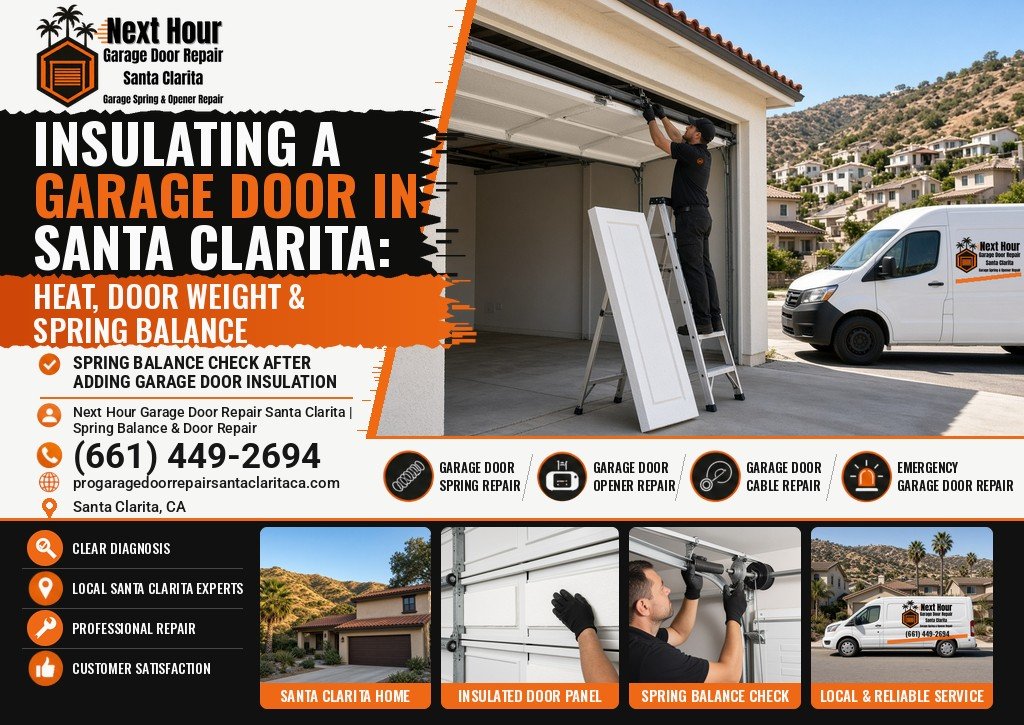
Insulating a Garage Door in Santa Clarita: Heat, Door Weight & Spring Balance
Insulating a garage door in Santa Clarita can make a hot garage noticeably more comfortable, especially behind a west- or south-facing door. But every insulation kit adds weight, and your springs were sized for the door before that weight was added. If the springs no longer match, the door can drift down, strain the opener, and wear out springs faster.
Is it worth insulating a garage door in Santa Clarita? The short answer
Insulating a garage door in Santa Clarita can cut heat through a sun-facing door, but every kit adds weight your springs weren’t sized for. Test the door’s balance afterward. Next Hour Garage Door Repair Santa Clarita checks balance and adjusts springs when an insulated door starts to drift or strain the opener.
For a sun-facing garage that you use as a gym, workshop, or storage for heat-sensitive items, insulating the door can noticeably cut the heat coming through it. Foil kits are the lightest, foam board kits insulate better but weigh more, and a factory-insulated door is the best fit if the door is due for replacement anyway. Whatever you choose, test the door’s balance afterward. If it drops when you lift it halfway with the opener disconnected, the springs need a technician’s adjustment. Don’t keep running the opener on a door that no longer balances.
DASMA warns that added weight can unbalance a door and damage springs and openers; see DASMA TDS 176.
Local help: Next Hour Garage Door Repair Santa Clarita checks door balance and repairs springs, cables, and openers across Santa Clarita, Valencia, Saugus, Canyon Country, Newhall, Stevenson Ranch, and Castaic. Call (661) 449-2694.
Below we explain the realistic options (foil kits, foam board kits, or a factory-insulated door), how to read R-value claims, and the simple balance check that tells you whether your springs still fit the door.
Why Santa Clarita Homeowners Insulate Garage Doors
Most people who ask about garage door insulation here aren’t worried about winter. They’re dealing with a garage that turns into an oven on summer afternoons: a home gym that can’t be used after noon, a second fridge working overtime, a bonus room over the garage that never cools down, or a west-facing door that’s too hot to touch. A single-layer steel door is a thin sheet of metal facing the sun, so it passes a lot of that heat straight into the garage.
Insulation slows that heat transfer. It won’t air-condition a garage, and it won’t fix air leaking around the edges, but it can make the space noticeably more usable. It also tends to make a door a little quieter and stiffer. The tradeoff is weight, and that’s the part most kit instructions skip.
Retrofit Kit or Insulated Door: The Two Real Options
Thin radiant-barrier panels that cut into the door’s recessed sections. The lightest option. Most useful against direct sun on the door face.
Polystyrene panels, often with a vinyl or foil face, pressed into each section. More insulating than foil, and heavier.
Polystyrene or injected polyurethane built into the door, usually with a steel back skin. Springs are sized for the finished weight from the start.
A retrofit kit is added to the door you already have. A factory-insulated door is a replacement. If your current door is in good shape and you mostly want to take the edge off afternoon heat, a kit can make sense. If the door is dented, rusting at the bottom, or already due for replacement, putting a kit on it usually doesn’t pay off.
R-Value vs. U-Factor: Reading the Numbers Correctly
Kit boxes and door brochures usually advertise an R-value. According to DASMA’s technical data sheet on U-factor and R-value for garage doors, a garage door R-value is a calculated number for the insulation in a single door section. It doesn’t account for the joints between sections, the hardware, or the perimeter. U-factor is measured on a complete installed door, and lower is better.
Two practical points come out of that:
- A high R-value on a kit doesn’t mean the whole door performs that well. Heat still moves through section joints, gaps, and the edges of each panel.
- Air leaks often matter as much as the insulation. If daylight shows under the bottom or along the sides, sealing those gaps may do more for comfort than adding thicker foam. Our guides to bottom seal replacement and garage door weather seal replacement cover that side of it.
The Part Most Kits Skip: Added Weight and Spring Balance
Your door’s springs were chosen for the door’s original weight. On a balanced door, the springs carry almost all of it, which is why the door feels light when you lift it by hand with the opener disconnected. Add weight to the sections and the springs are now undersized for the door they’re holding.
DASMA’s technical data sheet “Adding Weight to a Garage Door Assembly” (TDS 176) says this directly: springs are designed for the door’s original intended weight, and added weight can leave the door unbalanced, “possibly even resulting in damaged or broken springs,” and can overwork the opener motor. It also advises checking with the door’s manufacturer before adding anything to the door, since door makers often have their own rules about after-market changes to their doors.
How much weight a kit adds depends on the product and the door size. A foil kit adds very little, while foam board kits on a two-car door add noticeably more. The kit’s box or spec sheet usually lists the weight, so check it before you buy. The safer approach is the same either way: test the door’s balance after the kit goes in.
What an unbalanced door looks like after insulation
- The door drifts down when you lift it halfway by hand with the opener disconnected.
- The opener sounds strained, opens more slowly, or reverses partway up.
- The door closes harder than it used to.
- Cables look slightly slack when the door is open.
These are the same symptoms we cover in why a garage door won’t stay open and why the correct spring size matters. Insulation is just one more way a door can end up heavier than its springs.
How to Check Balance After Insulating
- Close the door fully. Pull the emergency release to disconnect it from the opener.
- Lift the door by hand to about waist height and carefully let go, keeping your hands and feet clear.
- A balanced door stays roughly where you left it, maybe drifting slightly. If it drops toward the floor, the springs no longer match the door’s weight.
- Lower the door, reconnect the opener, and run it once while you watch and listen.
If the door falls, feels very heavy, or slams, stop. Don’t keep running it on the opener, and don’t try to add tension to the springs yourself. Torsion springs store enough energy to cause serious injury, and adjusting them takes the right tools and training. DASMA’s garage door safety tips say the same.
Santa Clarita Factors That Change the Answer
A few local conditions make insulation more or less worthwhile:
- Which way the door faces. West- and south-facing doors take direct afternoon sun. That’s where reflective and foam kits make the most noticeable difference.
- What’s above or beside the garage. Bedrooms over the garage and shared walls with living space benefit most from a cooler garage.
- Heat on the hardware. Hot garages are hard on openers and rollers whether or not the door is insulated. Insulating the door may ease that a little, but it won’t replace basic maintenance. See how Santa Clarita heat affects garage door parts.
- Older, lighter doors. Some older single-layer doors in established neighborhoods were installed with springs at the light end of their range, so even a modest kit can tip the balance.
When to Call Next Hour Garage Door Repair Santa Clarita
Call (661) 449-2694 if your door failed the balance test after adding insulation, the opener has been straining since the kit went on, or you want the springs checked before you insulate. We can check the door’s balance, look at the springs and cables, and tell you whether they still suit the door’s weight.
See our garage door spring repair and garage door opener repair services, or use our contact page to send us details about your door.
Garage Door Repair for Santa Clarita Valley Homes
Next Hour Garage Door Repair Santa Clarita helps homeowners with spring, opener, cable, roller, track, sensor, and off-track repairs throughout the Santa Clarita Valley. Call (661) 449-2694 to ask about current availability.
About the author. This guide was written by Next Hour Garage Door Repair Santa Clarita, a garage door repair company that has served Santa Clarita Valley homeowners for 5 years. See the areas we cover on our service areas page, or follow our work on Instagram and Facebook.
Frequently Asked Questions About Insulating a Garage Door
Does insulating a garage door make it heavier?
Yes. Every kit adds some weight, from a little for reflective foil kits to noticeably more for foam board on a two-car door. Check the weight listed on the kit, and test the door’s balance after installing it, with the opener disconnected, before you go back to using the opener every day.
Will I need new springs after adding insulation?
Not always. If the door still holds roughly in place at waist height with the opener disconnected, the springs may still be adequate. If it drops or the opener strains, the springs need to be adjusted or resized by a technician.
Is R-value the best way to compare garage door insulation?
Not on its own. DASMA explains that a garage door’s R-value is usually calculated for one door section, while U-factor is measured on the whole installed door, including joints and edges. That makes U-factor the more realistic number when you compare two insulated doors or kits.
Will insulation keep my Santa Clarita garage cool in summer?
It can noticeably reduce the heat coming through the door, especially on west- or south-facing doors, but it won’t cool the garage the way air conditioning does. Sealing the gaps at the bottom and sides of the door and venting the garage matter too, because hot air leaks in around a closed door.
Can I adjust the spring tension myself after insulating?
No. Torsion springs are under high tension, and adjusting them without training and the proper winding bars can cause serious injury. Extension springs are dangerous too if a cable or pulley fails. Have a trained technician adjust or resize the springs to match the door’s new weight.
Is it better to insulate my old door or replace it?
If the door is in good condition, a kit can be a reasonable upgrade, as long as the springs are adjusted for the extra weight. If the door is damaged, rusting or already near the end of its life, a factory-insulated door with springs sized for its weight is usually the better long-term choice.
Find Next Hour Garage Door Repair Santa Clarita
Service-area garage door repair for Santa Clarita Valley homeowners. Call (661) 449-2694.
Insulate Without Throwing the Door Off Balance
If your door feels heavier or the opener has been straining since you added insulation, call Next Hour Garage Door Repair Santa Clarita at (661) 449-2694. We’ll check the balance, springs, and cables and explain what we find before any work starts.