
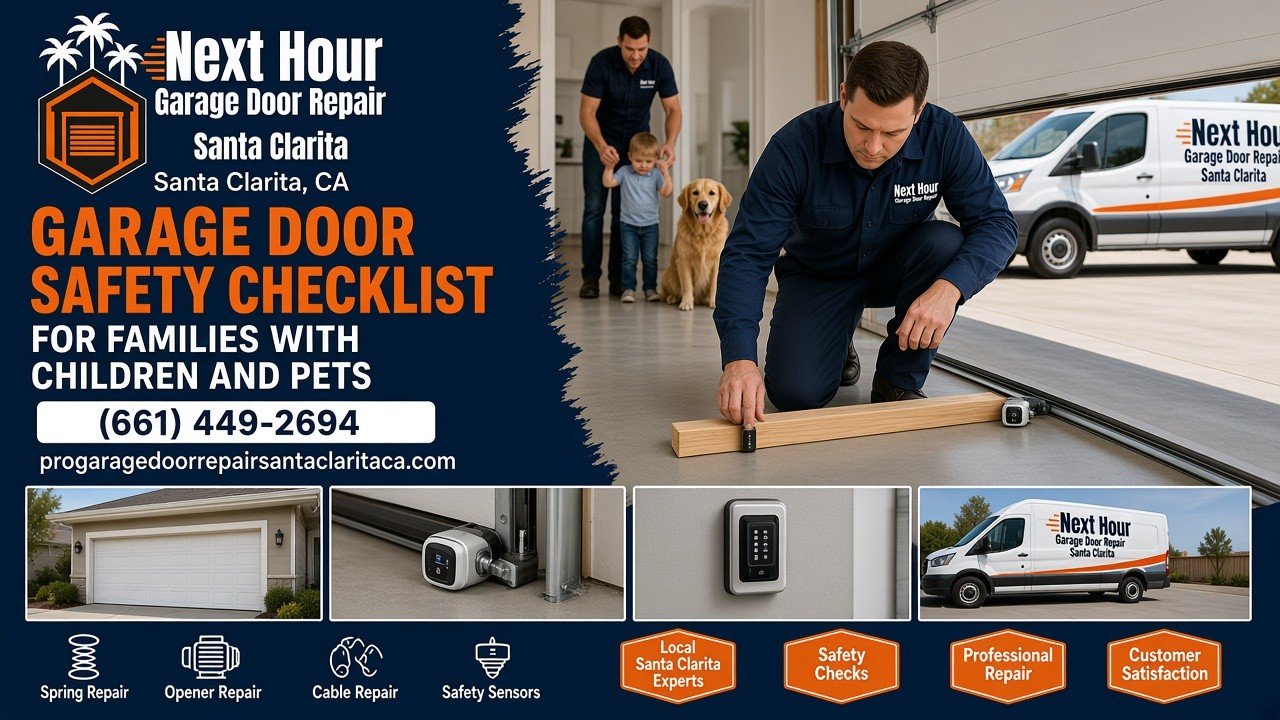
Next Hour Garage Door Repair Santa Clarita · Family Safety Guide
Garage Door Safety Checklist for Families With Children and Pets
A garage door weighs as much as a large piece of furniture and moves on its own with the push of a button. For adults, that is a convenience. For a toddler who wants to press the button, a child who thinks racing under the closing door is a game, or a dog that bolts for the driveway, it is a hazard. Modern openers have safety features designed to stop and reverse the door, but those features only work if they are set up correctly and tested. This checklist covers how garage doors injure kids and pets, the quick monthly tests that keep the safety systems working, the house rules worth teaching, and the signs that mean the door needs a technician before anyone uses it again.
How do you make a garage door safe for children and pets? The short answer
Test the auto-reverse and photo-eye sensors once a month, mount the wall button at least five feet high, keep remotes out of reach, and teach children never to play with, touch, or run under a moving door. Keep pets inside or leashed while the door moves, watch the door until it is fully closed, and never leave a pet shut in a hot garage. If the door doesn’t reverse, moves unevenly, or has a broken spring or loose cable, stop using it until it is repaired.
Springs, cables, and bottom brackets are under high tension and should only be handled by a trained technician. DASMA lists these points in its homeowner guidance; see DASMA garage door safety tips.
Local help: Next Hour Garage Door Repair Santa Clarita tests and adjusts auto-reverse, aligns and replaces safety sensors, and repairs springs, cables, and openers for families across Santa Clarita, Valencia, Saugus, Canyon Country, Newhall, Stevenson Ranch, and Castaic. Call (661) 449-2694.
How Garage Doors Injure Kids and Pets
- Being caught under a closing door. A door without working auto-reverse, or with the force set too high, can pin a child or animal instead of backing off.
- Racing the door. Kids who duck under a closing door, or a dog that chases a car out, can be struck when the timing is off.
- Pinched fingers. The gaps between sections close as the door bends over the track curve, and small fingers fit there easily.
- Hanging on the door or tracks. Kids who grab the bottom of an opening door can be lifted, and climbing on tracks can bend them.
- Springs and cables. A spring that breaks or a cable that snaps releases a lot of energy, and loose parts can fall.
- Heat. A closed garage on a summer afternoon in the Santa Clarita Valley can get much hotter than the house. That is dangerous for a pet left inside.
The good news is that most of these are prevented by a few minutes of testing each month and some simple rules everyone in the house follows.
The Monthly Safety Checks
DASMA recommends homeowners test their door’s safety features regularly. Put these on a monthly reminder, and keep children and pets out of the garage while you do them.
| Check | How to do it | What should happen |
|---|---|---|
| Contact reverse | Lay a 2×4 flat on the floor in the door’s path and close the door with the opener | The door touches the board and reverses |
| Photo-eye sensors | While the door closes, pass an object such as a broom handle or box through the beam (never a person or pet) | The door stops and goes back up |
| Sensor position | Look at both sensors near the floor | Mounted low, aimed at each other, steady indicator lights |
| Springs and cables (look only) | With the door closed, look at the springs above the door and the cables at the bottom corners | No gaps in the springs, no fraying or slack cables |
| Door movement | Watch and listen through a full cycle | Smooth and steady, no jerking, scraping, or loud bangs |
| Wall button and remotes | Check button height and where the remotes are kept | Button out of small children’s reach, remotes put away |
If the door fails the contact reverse test or the sensor test, stop using the opener for that door until it’s fixed. Federal rules in 16 CFR Part 1211 require entrapment protection on residential garage door openers made since 1993, and a door that won’t reverse has lost that protection. Our guide to garage door sensor alignment and testing walks through common sensor problems.
A few times a year, also check balance. With the door closed and the springs and cables looking intact, pull the emergency release, lift the door halfway by hand, and let go carefully. It should stay roughly in place. If it falls or rises, the springs need service. Lower it by hand and reconnect the opener. Skip this test if anything looks broken.
House Rules for Children
- The door is not a toy. No pressing the wall button or remote for fun, and no “beat the door” games.
- Stay clear while it moves. Teach kids to stand back until the door has stopped completely, open or closed.
- Hands off the sections, tracks, springs, and cables. Explain pinch points simply: the cracks between sections can close on fingers.
- Never hang on the door. No grabbing the bottom edge or riding it up.
- Know how to stop it. Older kids can learn that pressing the wall button again stops or reverses most openers.
Mount the wall button at least five feet off the floor, out of reach of small children, and keep remotes in a drawer or on a key hook instead of in a toy bin or loose in the car. If you use a keypad outside, choose a code kids don’t watch you type, and change it if it gets shared. See garage door keypad troubleshooting for help reprogramming one.
House Rules for Pets
Pets don’t understand a moving door, so the safety has to come from you.
- Keep pets inside or leashed while the door opens or closes, especially dogs that like to run for the driveway.
- Watch the door until it’s fully closed. Don’t press the remote and drive off; a pet can slip out or run back under at the last second.
- Don’t rely on the sensors alone. The beam sits a few inches above the floor. A misaligned sensor or a sensor blinded by sun may not see a small animal.
- Check before closing. Cats and small dogs like to explore garages. Look around, and under the car, before the door comes down.
- Never leave a pet in a closed garage on a hot day. Santa Clarita summers regularly push garage temperatures well above the rest of the house.
- Store chemicals high. Antifreeze, garage door lubricant, fertilizer, and pest bait often live in the garage and should be out of reach.
If your garage faces west and the door sometimes refuses to close, or reverses for no reason, in the late afternoon, sun on the sensors is a common cause. Our guide to garage door won’t close in afternoon sun explains the fixes.
Opener Features That Help Families
- Working auto-reverse and photo-eyes. These are the core protections, and they need to be adjusted correctly to work.
- Lock or vacation mode on the wall control. Many wall controls can disable the remotes, which is useful when kids get hold of one.
- Smart alerts. A smart opener can notify you when the door opens or has been left open; see smart garage door opener Wi-Fi problems if the app is unreliable.
- Timer-to-close, used with care. Some openers can close the door automatically after a set time and warn with lights and beeps first. It is handy if the door gets left open, but only with working sensors, and it should be turned off if kids play in the garage.
- Battery backup. California has required it on new and replacement openers since 2019, so you can still open the door during an outage. See garage door opener battery backup in California.
- Motion-sensing lights. A lit garage makes it easier to see a child or pet before the door moves.
If your opener is old enough that it lacks working reversal or has no sensors at all, it is time to replace it. Our guide on how long a garage door opener lasts covers the other signs.
Parts Families Should Never Touch
Springs, lift cables, and the bottom brackets where the cables attach hold the tension that lifts the door. A torsion spring that is wound or unwound wrong, or a bracket that is loosened, can release that energy suddenly. That is why DASMA tells homeowners to leave these parts to trained technicians.
Lubricating rollers, hinges, and springs with a garage door lubricant, wiping the sensor lenses, and tightening loose hinge screws on an upper section with the door closed are reasonable homeowner tasks. Anything involving springs, cables, or bottom brackets is not.
If a spring breaks, keep everyone, including pets, out of the garage, leave the door where it is, and don’t try to lift it with the opener or by hand.
When to Stop Using the Door and Call
- The door doesn’t reverse on the 2×4 test or when the sensor beam is blocked.
- A torsion spring has a visible gap, or an extension spring is stretched or missing its safety cable. See garage door spring wear signs.
- A cable is frayed, slack, or off its drum. See garage door cable broke or came off.
- The door drops fast, slams, or closes harder than it used to. See garage door slams shut or drops too fast.
- The door hangs crooked, or a roller has come out of the track. See garage door off track.
- The door opens or closes by itself. See garage door opens by itself.
In any of these cases, keep kids and pets away from the door until it has been inspected and repaired.
Garage Door Safety Service Across the Santa Clarita Valley
Next Hour Garage Door Repair Santa Clarita serves Santa Clarita and the surrounding valley, including Valencia, Saugus, Canyon Country, Newhall, Stevenson Ranch, Castaic, and Hasley Canyon, plus ZIP codes 91321, 91350, 91351, 91354, 91355, 91381, 91384, and 91387. Services include auto-reverse testing and adjustment, safety sensor alignment and replacement, spring and cable repair, roller and track repair, and opener repair and replacement.
Call (661) 449-2694 or view Next Hour Garage Door Repair Santa Clarita on Google Maps.
Frequently Asked Questions About Garage Door Safety for Children and Pets
How often should I test my garage door’s auto-reverse?
Once a month. Lay a 2×4 flat in the door’s path and close the door; it should reverse after touching the board. Then block the sensor beam with an object while it closes; it should stop and reverse.
How high should the garage door wall button be?
At least five feet off the floor, out of reach of small children.
Can garage door sensors detect a small pet?
Usually, if they are aligned and working, but the beam sits a few inches above the floor, and a misaligned or sun-blinded sensor may miss a small animal. Watch the door until it is fully closed.
Is it safe to leave a dog in the garage?
Not on warm days. A closed garage can get much hotter than the house during Santa Clarita summers, and it often holds chemicals that are toxic to pets.
What should I do if my garage door doesn’t reverse?
Stop using the opener for that door and keep kids and pets clear until a technician checks the sensors, force settings, and door balance.
Is timer-to-close safe with kids?
Only with working sensors and reversal, and it is best turned off when children play in or near the garage.
Can I fix a broken garage door spring myself?
No. Springs, cables, and bottom brackets hold high tension. Keep everyone away from the door and call a technician.
Who checks garage door safety in Santa Clarita?
Next Hour Garage Door Repair Santa Clarita tests auto-reverse, aligns sensors, and repairs springs, cables, and openers across the Santa Clarita Valley. Call (661) 449-2694.
Find Next Hour Garage Door Repair Santa Clarita
View Next Hour Garage Door Repair Santa Clarita on Google Maps
Make the Garage Door Safe for Everyone at Home
If your door failed a reverse test, the sensors act up, or a spring or cable looks worn, call Next Hour Garage Door Repair Santa Clarita at (661) 449-2694. We’ll test the safety systems, fix what’s wrong, and show you how to keep checking it.
Serving Santa Clarita, the Santa Clarita Valley & northern Los Angeles County