Next Hour Garage Door Repair Santa Clarita · Hinge Inspection Guide
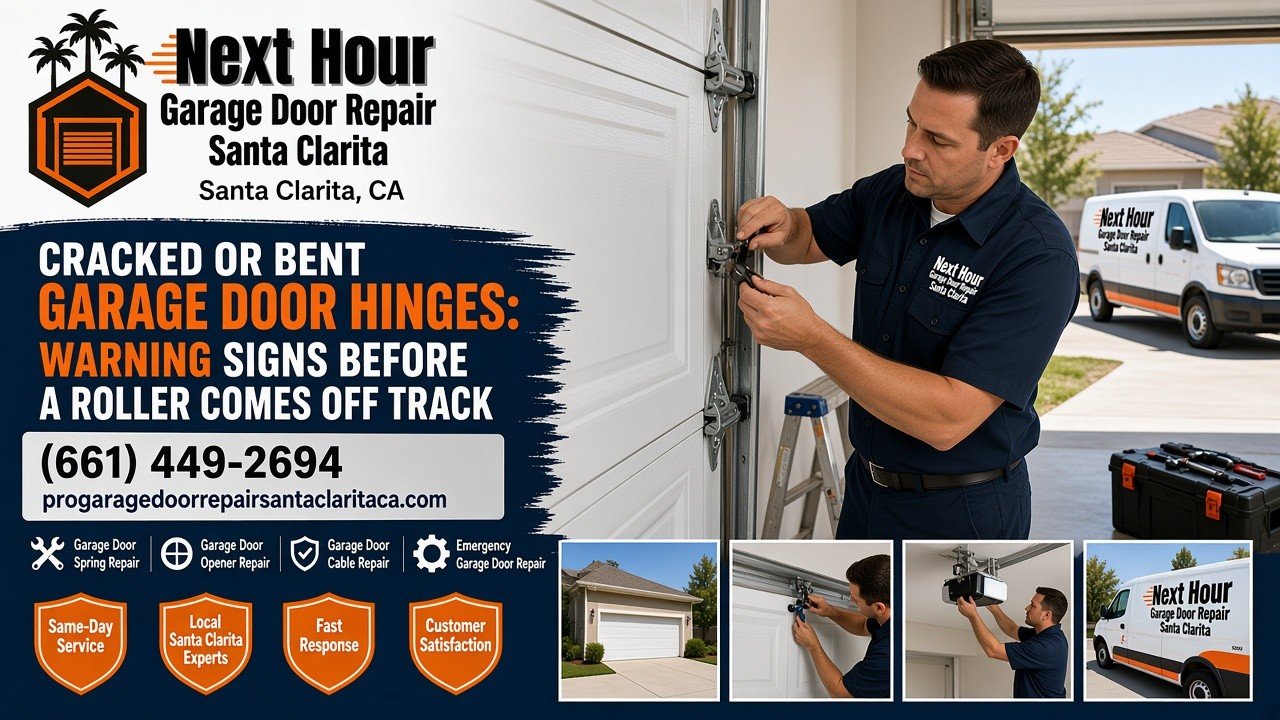
Cracked or Bent Garage Door Hinges: Warning Signs Before a Roller Comes Off Track
Hinges are the small steel brackets that join each section of a sectional garage door and, on the ends, hold the roller stems. Every time the door opens, each hinge bends as its section rolls over the curve of the track. Over years of that flexing, a hinge can crack at the knuckle, bend out of shape, or tear the screw holes in the panel. Because the end hinges hold the rollers, a damaged hinge changes the angle a roller sits at in the track. That’s how a small part turns into a roller popping out and a door hanging crooked. This guide covers what hinge damage looks like, the order to check things in, which hinge problems are fine to handle yourself, and which ones aren’t.
What do cracked or bent garage door hinges lead to? The short answer
A cracked or bent end hinge lets its roller sit crooked or loose in the track. Warning signs are a section that bulges or gaps at a seam, a roller that tilts or rides toward the edge of the track, a pop or click at the same point in travel, and fresh rust lines or shiny metal at a hinge knuckle. Replace a cracked hinge before the door is used much more. If a roller is already out of the track, stop using the door.
The bottom hinges and brackets sit next to the lift cables and are under spring tension, so leave those to a technician. DASMA advises homeowners not to adjust springs, cables, or bottom brackets; see DASMA garage door safety tips.
Local help: Next Hour Garage Door Repair Santa Clarita inspects and replaces hinges, rollers, and tracks, and resets doors that have come off track, across Santa Clarita, Valencia, Saugus, Canyon Country, Newhall, Stevenson Ranch, and Castaic. Call (661) 449-2694.
How Garage Door Hinges Work
A typical sectional door has a row of hinges along every seam between sections: one at each end and one or more in the middle. The end hinges are “graduated,” usually stamped with a number. The higher up the door, the higher the number, because each step moves the roller a little farther from the door so the door seals against the jamb as it closes. Center hinges have no roller; they only join the sections.
That numbering matters when you replace one. Putting a No. 1 hinge where a No. 3 belongs moves the roller out of position, and the section can bind or rub the jamb. Check the stamp on the old hinge before you buy a replacement.
Hinges come in different gauges, too. Heavier doors, insulated doors, and wide double doors usually use heavier hinges. A thin hinge on a heavy door is more likely to crack.
Warning Signs of a Cracked or Bent Hinge
| Sign | What it points to | How urgent |
|---|---|---|
| Hairline crack at the knuckle or along a leaf | Metal fatigue; the crack will grow | Replace soon |
| Hinge leaf bent or twisted | Impact, binding, or a wrong-number hinge | Replace soon |
| Roller tilted in the track, or riding at the edge | End hinge bent or loose | Stop and fix before use |
| Seam between sections gaps or bulges as the door moves | Center hinge cracked or screws pulled out | Replace soon |
| Loud pop or click at one spot in travel | Hinge flexing past its limit, or a roller catching | Inspect now |
| Rust streaks or bright metal at a hinge | Movement where there shouldn’t be any | Inspect now |
| Torn or enlarged screw holes in the panel | Panel end stile is failing at the hinge | Needs repair, may need section |
Hinge cracks are easy to miss. Look with a flashlight while someone else runs the door slowly, and watch each hinge as its section goes over the curve. Movement at the knuckle that looks like a “wobble” instead of a clean pivot is a sign the pin or knuckle is worn.
How a Bad Hinge Pushes a Roller Off Track
The roller stem slides into a tube on the end hinge. When that hinge bends, the stem points at a slightly wrong angle, so the roller wheel leans against one side of the track instead of riding in the middle. It may still work for a while, but every cycle wears the roller and the track lip at that spot. On the curve, where the track turns from vertical to horizontal, the roller is pushed hardest, and that’s where it usually jumps out.
A cracked hinge does something similar but less predictably. Under load, the crack opens, the roller shifts, and then it snaps back. That’s often the pop people hear. Once the crack goes all the way through, the roller can drop out of the track entirely, and the section starts to hang from the hinges around it. That twisting is also how one bad hinge can crack its neighbors.
A roller off the track is a stop-using-it situation. The door can bind and drop, and running the opener against it can bend the track or the sections. See crooked garage door: is it safe to keep using? for why a door that “still works” can still be unsafe.
What Cracks and Bends Hinges
- Age and metal fatigue. Thousands of cycles flexing over the track curve eventually crack thin hinges.
- Worn rollers. A roller that sticks or wobbles forces its hinge to absorb the jolt. See roller wear signs.
- Binding tracks. A bent or misaligned track makes the roller fight the hinge. See bent garage door track.
- Impacts. A car bump can bend the lower hinges in one hit. See garage door panel damaged by a car.
- Poor balance. Weak springs make the opener drag the door, which stresses every hinge.
- Wrong hinge number or loose screws. Either one sets the roller at the wrong position from day one.
- Heat and dust. Santa Clarita summers and windy, dusty days dry out lubrication at the hinge pins, so they wear faster.
A Safe Hinge Check, Step by Step
- Close the door and unplug the opener so it can’t be started while you’re near the door.
- With a flashlight, look at every hinge from inside: cracks, bends, rust lines, and loose or missing screws.
- Look at each end roller. It should sit in the center of the track, and the stem should go straight into the hinge.
- Plug the opener back in, stand clear, and have someone run the door while you watch the seams. Note any gaps, pops, or rollers that tilt.
- Check the bottom corners last, from a distance. Don’t touch the bottom brackets or cables.
Don’t remove a hinge with the door open, and don’t loosen the bottom brackets. If a roller has already left the track, keep the door still and keep people clear.
What You Can Do Yourself, and What You Shouldn’t
Tightening a loose hinge screw is usually fine with the door closed and the opener unplugged. If the screw just spins, the hole is stripped; a slightly larger screw rated for the job may hold, but a torn panel stile needs more than that. Replacing a center hinge on an upper seam is also within reach for some homeowners, one at a time, with the door closed.
End hinges are different because they carry rollers, and anything near the bottom brackets is under spring tension. If a roller is out, an end hinge is cracked through, or the door is crooked, have a technician handle it. Light lubrication of hinge pivots with a garage door lubricant (not grease) helps them last; see the maintenance notes in why a garage door shakes when closing.
Replace One Hinge or All of Them?
If one hinge cracked from an impact or a bad roller and the others look clean, replacing just that hinge (and fixing what caused it) is reasonable. If several hinges show cracks, the door is older, and the hinges are the original thin ones, replacing the full set at once often makes sense, since the others have seen the same number of cycles. Rollers are often replaced at the same visit, because a worn roller is a common reason hinges crack. See nylon vs. steel rollers if you’re choosing new rollers.
Whatever is replaced, the door should be checked for balance and the opener’s reversal tested afterward.
Garage Door Hinge Repair Across the Santa Clarita Valley
Next Hour Garage Door Repair Santa Clarita serves Santa Clarita and the surrounding valley, including Valencia, Saugus, Canyon Country, Newhall, Stevenson Ranch, Castaic, and Hasley Canyon, plus ZIP codes 91321, 91350, 91351, 91354, 91355, 91381, 91384, and 91387. Services include hinge replacement, roller replacement, track repair and alignment, off-track door repair, and spring and cable repair.
Call (661) 449-2694 or view Next Hour Garage Door Repair Santa Clarita on Google Maps.
Frequently Asked Questions About Cracked or Bent Garage Door Hinges
Can a cracked hinge make a garage door come off track?
Yes. End hinges hold the roller stems. A cracked or bent end hinge lets the roller tilt or drop out, most often at the curve of the track.
Is it safe to use a garage door with a cracked hinge?
Use it as little as possible until it’s replaced. If a roller is tilted or out of the track, or the door hangs crooked, stop using it.
What do the numbers on garage door hinges mean?
End hinges are graduated. Higher numbers sit higher on the door and hold the roller farther out so the door seals as it closes. Match the number when replacing.
Why does my garage door pop at one spot?
Often a hinge flexing too far or a roller catching on a worn or bent spot in the track. Watch the hinges while the door runs to find it.
Can I replace a garage door hinge myself?
An upper center hinge, one at a time with the door closed, is manageable for some homeowners. End hinges near the bottom and anything by the bottom brackets should go to a technician.
Should I replace all the hinges at once?
If several are cracked or the door is old with original hinges, a full set is often worth it. A single hinge damaged by an impact can be swapped on its own.
What causes garage door hinges to crack?
Metal fatigue, worn rollers, binding tracks, impacts, poor spring balance, wrong hinge numbers, and loose screws.
Who repairs garage door hinges in Santa Clarita?
Next Hour Garage Door Repair Santa Clarita replaces hinges and rollers and fixes off-track doors across the Santa Clarita Valley. Call (661) 449-2694.
Find Next Hour Garage Door Repair Santa Clarita
View Next Hour Garage Door Repair Santa Clarita on Google Maps
Catch the Hinge Before the Roller Goes
If you’ve spotted a cracked or bent hinge or a roller riding crooked, call Next Hour Garage Door Repair Santa Clarita at (661) 449-2694. We’ll replace the damaged hinges, check the rollers and tracks, and make sure the door runs straight.
Serving Santa Clarita, the Santa Clarita Valley & northern Los Angeles County
One Response