Next Hour Garage Door Repair Santa Clarita · Impact Damage Guide
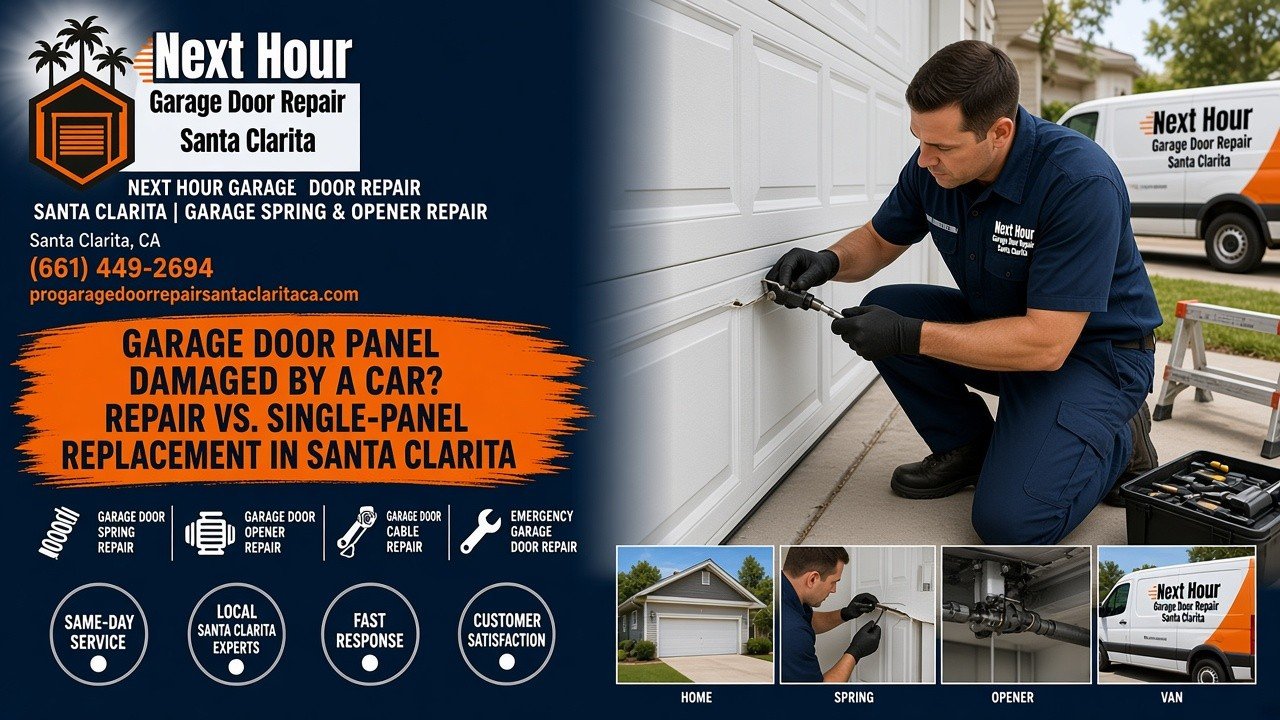
Garage Door Panel Damaged by a Car? Repair vs. Single-Panel Replacement in Santa Clarita
Backing into a closed garage door, or pulling in a little too far, is one of the most common ways a door gets hurt. What happens next depends on three things: how deep the damage goes, which section took the hit, and whether a matching replacement panel still exists for your door. A shallow dent on a steel panel that still rolls smoothly is often something you can live with or have repaired. A creased, split, or buckled section usually needs to be replaced. And if the impact bent the tracks, pulled a cable, or knocked rollers out, the panel is the smaller problem. This guide walks through how to size up the damage safely, what a single-section replacement involves, and when replacing the whole door makes more sense.
Repair or replace a garage door panel hit by a car? The short answer
Small dents with no creases, where the door still opens and closes smoothly, can usually be repaired or left alone. Creased, cracked, or buckled sections, or a section whose hinges and stiffening strut pulled loose, should be replaced. One section can be swapped on its own if the manufacturer still makes that model, style, and color. If the door is jammed, off track, or a cable is slack, don’t run the opener: the springs are still holding tension.
Keep in mind that the springs on a sectional door are balanced to the weight of the whole door. A new section that weighs differently, or extra reinforcement added during a repair, can change that balance, which is why section work is paired with a balance check.
Local help: Next Hour Garage Door Repair Santa Clarita inspects impact-damaged doors, replaces single sections when a match is available, and repairs the tracks, rollers, and cables that often get hurt in the same hit, across Santa Clarita, Valencia, Saugus, Canyon Country, Newhall, Stevenson Ranch, and Castaic. Call (661) 449-2694.
First Steps Right After the Hit
Before you judge the panel, check whether the door is safe to move at all. An impact from a bumper pushes the door inward, and the force doesn’t stop at the panel. It travels into the rollers, the hinges between sections, and the vertical tracks on each side.
- Don’t press the wall button or remote to “test” it. If the door is bent or a roller is out of the track, the opener can pull it further out of line.
- Look at both sides from inside the garage. Are all the rollers still seated in the tracks? Is either track bowed inward?
- Check both lift cables near the bottom corners. A cable that’s loose or hanging off its drum means the door can drop unevenly.
- Look at the springs above the door. A broken spring after an impact is less common but does happen when the door was already old.
- If the door is stuck partway, leave it where it is and keep people and pets clear.
Don’t pull the emergency release on a door that’s off track or has a slack cable. Releasing it can let a heavy, unbalanced door fall.
If the door still runs smoothly, with no scraping, jerking, or new noise, you have time to think about the panel. If it doesn’t, the hardware comes first.
Types of Panel Damage and What Each Means
| What you see | What it usually means | Typical path |
|---|---|---|
| Shallow, rounded dent, paint intact | Cosmetic; panel structure is fine | Leave it, or cosmetic repair |
| Dent with a sharp crease or fold | Steel skin has stretched; it won’t pop back flat | Section replacement |
| Cracked or split panel (wood, fiberglass, thin steel) | Panel has lost strength along the crack | Section replacement |
| Section bowed inward across its width | Section bent; may bind as it rolls over the curve | Section replacement, check strut |
| Hinges bent or pulled from the panel | Mounting points damaged; can tear further in use | Repair if the metal is sound, else replace section |
| Several sections damaged, door out of square | Door frame of sections is compromised | Usually full door replacement |
Insulated steel doors add one more thing to check. Many have a foam core bonded to the steel skin. A hard hit can separate the skin from the foam, so the panel sounds hollow or flexes when you press it. That separation won’t come back on its own.
When Repair Makes Sense
Repair is realistic when the damage is mostly cosmetic and the section still keeps its shape. That covers rounded dents in a single-skin or insulated steel panel, small scrapes, and hinges that bent but didn’t tear their screw holes. A bent hinge can be replaced on its own, and a stiffening strut that bowed can sometimes be straightened or swapped.
What repair can’t do well is fix a crease. Once steel has folded, it’s been stretched, and pushing it back out usually leaves a wavy area or cracks the paint. Wood panels that split along the grain and fiberglass that cracked through are also poor candidates for patching on a door that flexes every time it opens.
A repaired dent also needs to roll. Each section bends around the curve at the top of the track. If a dent sits near a hinge line, it can rub the next section or catch a roller, so a repair that looks fine with the door closed can still cause trouble in motion.
Single-Panel Replacement: How It Works
On a sectional door, each horizontal section can usually be removed and replaced. The new section has to match the old door in several ways for this to work:
- Manufacturer and model. Sections from different brands rarely line up, even if they look similar.
- Height and width. Section heights vary, and the width has to match the opening.
- Design. Raised panel, flush, carriage-house, or ribbed patterns all have to line up with the sections above and below.
- Color and finish. A new white panel next to one that’s faded for years in the Santa Clarita sun may look a shade off.
- Construction. Insulated and non-insulated sections differ in thickness and weight.
The model information is often on a sticker on the inside edge of a section or on the end stile. If you can find it, take a photo before calling. If the door is older and the line has been discontinued, a matching section may not exist, and that’s often what tips the decision toward a new door.
The work itself means taking the door’s weight off the section being swapped, which involves the springs, cables, and bottom brackets when it’s the bottom section. That’s the section cars hit most, and it’s also the one connected directly to the lift cables. DASMA’s safety guidance warns homeowners not to adjust springs, cables, or bottom brackets on their own; see DASMA garage door safety tips.
When Replacing the Whole Door Makes More Sense
A full replacement is the better call when two or more sections are creased or split, when the door is out of square after the hit, or when no matching section is available. It’s also worth considering if the door was already near the end of its life, with worn rollers, tired springs, and a faded or chipped finish. Putting one new section in an old door leaves you with a door that’s mostly old.
If you’re weighing that, our guide to garage door replacement in Santa Clarita covers what a new door changes for security and curb appeal, and when to replace a garage door looks at timing.
Preventing the Next Bump
Most garage door impacts happen when someone is backing out while the door is still coming up, or pulling in and misjudging the distance. A few cheap habits help: wait until the door has fully stopped before moving, hang a tennis ball or use a parking stop so you know where to stop inside, and keep the opener’s safety sensors aligned and clean so the door doesn’t reverse partway and catch someone off guard. Teen drivers and anyone using an unfamiliar car are the most likely to misjudge it.
Also, never drive under a door that’s still moving. If the door stops short or reverses for no clear reason, have the sensors and limits checked rather than timing your exit around it.
Documenting the Damage
Before anything is fixed, take clear photos of the outside and inside of the damaged section, the tracks on both sides, the cables at the bottom corners, and the model sticker if you can find it. Photos help whoever repairs the door confirm a match for the section.
Garage Door Panel Repair Across the Santa Clarita Valley
Next Hour Garage Door Repair Santa Clarita serves Santa Clarita and the surrounding valley, including Valencia, Saugus, Canyon Country, Newhall, Stevenson Ranch, Castaic, and Hasley Canyon, plus ZIP codes 91321, 91350, 91351, 91354, 91355, 91381, 91384, and 91387. Services include single-section replacement when a match is available, hinge and strut repair, track and roller repair, cable and spring repair, and full door replacement.
Call (661) 449-2694 or view Next Hour Garage Door Repair Santa Clarita on Google Maps.
Frequently Asked Questions About Car-Damaged Garage Door Panels
Can you replace just one garage door panel?
Usually, yes, if the manufacturer still makes a section in the same model, size, design, and color. If the line is discontinued, a full door may be the only clean option.
Is it safe to use my garage door after hitting it with my car?
Only if it still opens and closes smoothly with every roller in the track and both cables tight. If it scrapes, sticks, or tilts, stop using the opener.
Can a dent in a garage door be fixed?
Shallow, rounded dents in steel often can. Creased steel, cracked wood or fiberglass, and dents near hinge lines usually need the section replaced.
Why does the new panel look a different color?
Older doors fade in strong sun. A new section in the same factory color can look slightly brighter until it weathers.
Is the bottom panel harder to replace?
It involves more steps, because the lift cables attach at the bottom brackets, which are under spring tension. That part should be done by a trained technician.
What else gets damaged when a car hits a garage door?
Tracks, rollers, hinges, cables, the bottom seal retainer, and the safety sensors are all commonly affected along with the panel.
Should I replace the whole door instead?
Consider it if two or more sections are creased, the door is out of square, no matching section exists, or the door was already worn.
Who repairs car-damaged garage doors in Santa Clarita?
Next Hour Garage Door Repair Santa Clarita inspects impact damage and repairs or replaces sections and hardware across the Santa Clarita Valley. Call (661) 449-2694.
Find Next Hour Garage Door Repair Santa Clarita
View Next Hour Garage Door Repair Santa Clarita on Google Maps
Get the Damage Sized Up Before It Gets Worse
If a car hit your garage door, call Next Hour Garage Door Repair Santa Clarita at (661) 449-2694. We’ll check the hardware, tell you whether the section can be repaired or matched, and fix what the impact damaged.
Serving Santa Clarita, the Santa Clarita Valley & northern Los Angeles County