
Garage Door Slams Shut or Drops Too Fast? Causes, Safety Risks & What to Do
A homeowner guide to spring counterbalance, cables, drums, door weight, opener limitations and the safety risks of a garage door that falls too quickly.
Door falling, crooked or difficult to hold? Stop repeated operation if the door is unstable, shows a broken spring or has a loose cable. Call (661) 449-2694 to ask Next Hour Garage Door Repair Santa Clarita about current service availability.
Why does a garage door slam shut or drop too fast?
A garage door can slam shut or drop too fast when the spring counterbalance is broken, weak, incorrectly sized or improperly adjusted; when lift cables or drums are not sharing load correctly; or when added door weight overwhelms the spring setup. If the door falls rapidly, will not stay open or becomes crooked, stop operating it until the balance system is inspected.
A Garage Door That Drops Too Fast Is Primarily a Balance and Safety Problem
A residential garage door should not behave like a free-falling panel. When the counterbalance system is working correctly, the springs offset much of the door's weight so the door can move in a controlled way. If the door suddenly slams shut, drops rapidly from a partly open position, becomes hard to hold, or falls faster than the person operating it expects, something in that counterbalance system may no longer be doing its job.
The most common areas to investigate are the springs, spring sizing or tension, lift cables, cable drums, door weight and overall balance. Rollers, tracks and hinges can contribute when a door binds and then suddenly releases, but a true “door falls down” symptom deserves a spring-and-counterbalance-first diagnosis. The garage door opener should not be treated as the component responsible for holding up an improperly balanced door.
This matters because a dropping garage door can create an impact and crush hazard. It can also damage bottom sections, rollers, tracks, cables, opener hardware, vehicles and objects in the opening. The danger is greater if someone pulls the emergency release on a door that is already partly open and the springs are not supporting the weight.
This guide is written for Santa Clarita homeowners who want to understand what a slamming or fast-dropping door may mean, what can safely be observed without touching high-tension hardware, when the opener may be part of the symptom, and when the safest response is to stop using the door and arrange professional garage door repair.
Why Does a Garage Door Slam Shut or Drop Too Fast?
A garage door can slam shut or drop too fast when the spring counterbalance is broken, weak, incorrectly sized or improperly adjusted; when lift cables or drums are not sharing load correctly; or when added door weight overwhelms the existing spring setup. A door that falls rapidly, will not stay open or becomes crooked should not be operated until the balance system is inspected.
If the Door Is Dropping Now, Treat It as a Safety Issue First
If the door is currently unstable, do not keep testing it to see how fast it falls. Keep people, pets, vehicles and stored items away from the opening. Do not stand beneath the door. Do not try to catch a falling door with your hands, shoulders or a piece of lumber. Do not repeatedly cycle the opener in an attempt to make the door “relearn” the problem.
A door that cannot support itself may become less predictable after each movement. Cables can lose tension, rollers can be pulled sideways in the tracks, and a partially open door can change position unexpectedly when the opener is disconnected.
If the door is closed and stable, leave it closed until it can be evaluated. If it is partly open and visibly unstable, avoid working around the opening and do not pull the emergency release simply to test the door.
What Should a Properly Balanced Garage Door Do?
Garage door springs are designed to counteract the weight of the door. In practical terms, a balanced door should move with controlled effort rather than behaving as if the full door weight is trying to fall toward the floor.
DASMA's 2025 technical discussion on proper garage door balance explains that a manually operated door should open and close with minimal effort, gently rest on the floor when closed, stay up when fully open, and remain in place when positioned roughly three to four feet above the floor. The same article explains that rapid falling can be a dangerous consequence of improper balance.
That gives homeowners a useful concept: a door that aggressively drops from a partially open position is not merely “closing fast.” It may be showing that the spring system is no longer carrying the share of the door weight it was designed to carry.
Does the Door Slam Only Manually, or Also Under Power?
The distinction between manual movement and automatic movement can help narrow the diagnosis, but only when the door is safe enough to observe. If the door drops rapidly when disconnected from the opener, the counterbalance system is a primary concern. The opener is no longer attached to help control travel, so poor spring balance becomes obvious.
If the door seems controlled manually but closes abnormally under powered operation, the opener, rail, trolley, drive system or travel controls may deserve more attention. Even then, the mechanical door should be confirmed to be properly balanced first.
If the door is partly open, crooked, has a broken spring or has a loose cable, do not disconnect the opener to perform a test. A door that appears to be “held” by the opener can drop when that connection is released.
Cause #1: A Broken Torsion Spring Has Removed Counterbalance
A broken torsion spring is one of the clearest reasons a garage door can become dangerously heavy. Torsion springs are normally mounted on a shaft above the door. When a spring breaks, the system loses some or all of the torque that was counterbalancing the door.
On a single-spring door, one broken spring can remove essentially the entire spring contribution. On a two-spring door, the unbroken spring may still provide some counterbalance, but the system is no longer balanced as designed. The door can become much heavier and can drop faster than expected when released.
From the floor, a broken torsion spring often shows a visible separation or gap in the coil. Do not touch the spring, winding cone or center anchor to confirm the break. Visual confirmation is enough reason to stop operating the door.
If the door also showed rough movement before it began dropping, our previous guide to jerking or uneven garage door movement explains how rollers, tracks, cables and balance problems can overlap.
Cause #2: Springs Are Intact but No Longer Providing Enough Counterbalance
A spring does not have to be visibly broken for the door to be out of balance. Springs can lose effective performance over time, and a door can become increasingly heavy before a complete spring fracture occurs.
That change may first show up as a door that will not remain open, a door that drifts downward from a partially open position, or an opener that sounds as though it is working harder. Eventually, the door may descend faster than the homeowner expects when the opener is disconnected.
The important distinction is between a controlled tendency to settle and a door that rapidly falls. A door that drops hard or cannot be held safely should not be used while waiting for a complete spring break.
Cause #3: Spring Torque or Spring Sizing Is Wrong for the Door
Even a new spring can create a dangerous balance problem if it is not matched correctly to the door. Torsion springs have to provide the right torque for the door's weight and hardware. Too little torque leaves the door heavy. Too much torque can make the door rise aggressively or resist closing.
DASMA Technical Data Sheet #190 specifically warns that insufficient torsion-spring torque can cause a garage door to drift downward from the open position, while applying the wrong spring to a door can create safety and operating problems. That is why a replacement should be based on the actual door and manufacturer's requirements rather than on appearance alone.
If a door started dropping too fast immediately after spring replacement, the new spring setup should be checked for correct sizing, number of turns, spring pairing, cable drum setup and final balance.
Cause #4: An Extension Spring Has Broken, Stretched or Become Uneven
Extension springs are usually mounted along the horizontal tracks, one on each side of the door. They stretch as the door closes and contract as the door opens. If one spring breaks or the two sides no longer behave evenly, the door can become heavy, crooked or unstable.
An extension-spring problem can be especially noticeable when one side of the door drops faster than the other. The opposite spring may still be contributing force, so the door twists instead of descending evenly.
Extension systems should also have appropriate containment safety cables through the springs. A broken extension spring can release energy suddenly, so homeowners should not handle or reconnect the spring, pulley or cable system.
Cause #5: Lift Cables or Cable Drums Are Not Controlling Both Sides Evenly
Springs and lift cables work together. On a torsion system, the spring turns the shaft and the cable drums wind or unwind the lift cables attached near the bottom of the door. If one cable slips, frays, loses tension or comes off a drum, one side of the door can descend faster than the other.
A cable problem can turn a simple “door drops” complaint into a crooked-door problem very quickly. Watch the bottom edge from a safe distance. If one corner falls first, the door twists or a cable is visibly slack, stop operation.
Do not attempt to level the door by loosening a cable drum. Drum set screws, lift cables and bottom brackets are part of the high-tension counterbalance system.
Cause #6: The Door Became Heavier but the Spring System Was Never Recalculated
Garage door weight can change after installation. Added insulation, decorative overlays, windows, reinforcement, replacement sections and hardware can increase the total weight that the springs must counterbalance.
If the spring system was selected for the original door and the door later became heavier, it may no longer stay suspended the way it once did. The door can drift down or drop faster because the springs are now undersized for the current weight.
This is particularly important when a door began behaving differently after a remodeling project or panel replacement. The correct repair may involve recalculating the counterbalance requirement rather than simply adjusting the opener.
Cause #7: The Door Binds, Then Suddenly Releases Downward
Not every fast drop begins with a pure spring problem. A roller can bind in a damaged track, a hinge can catch, or a panel can flex at a joint. If the door is descending and resistance temporarily holds it, the door may suddenly jump downward when the binding point releases.
This pattern usually looks different from a consistently heavy door. The door may pause at the same location and then drop several inches. There may be scraping, popping or visible movement in a roller or hinge.
Binding plus poor spring balance is a particularly bad combination because the stored weight can be released suddenly. Diagnosis should identify both the resistance point and the counterbalance condition.
Door Balance Problems Exist on a Spectrum
Not every balance problem begins as an obvious free-fall. A door may first feel slightly heavier, then begin drifting from the open position, then require more opener effort, and eventually become difficult to control manually. The progression depends on the spring system and what is failing.
This is why “it still opens” does not prove that the counterbalance is healthy. An automatic opener can mask a developing balance problem because the motor continues moving the door. The problem becomes much more obvious during a safe manual evaluation—or suddenly when the opener is disconnected.
Homeowners should pay attention to changes in how the door behaves, not just whether it completes the cycle.
Cause #8: One Spring Failed in a Two-Spring System
Two-spring torsion systems share the required counterbalance between springs. If one breaks, the remaining spring may keep the door from feeling completely “dead,” but the system is still missing a substantial portion of its intended torque.
This can mislead homeowners into thinking the door is still safe because it can be moved. In reality, the remaining spring may only be masking how much balance has been lost.
A two-spring door with one broken spring should not be operated normally. The remaining spring, cables, drums and overall balance should be inspected before deciding whether one spring or both should be replaced.
Cause #9: The Emergency Release Was Pulled on an Unbalanced Door
The red emergency-release handle disconnects many ceiling-mounted openers from the door so the door can be moved manually. That release does not repair or replace the spring system. If the springs are broken or weak, pulling the release can expose the full weight problem instantly.
A partly open door is the dangerous scenario. The opener may be helping hold the door in position. Once disconnected, an unbalanced door can move quickly under gravity.
For that reason, do not pull the emergency release on a partly open, visibly damaged or suspiciously heavy door just to “see what happens.” If manual operation is necessary, follow the opener manufacturer's instructions and only do so when the door is in a safe, stable condition.
Cause #10: An Opener or Trolley Problem Can Affect Powered Closing—but It Should Not Be Holding an Unbalanced Door Up
When the door slams only during automatic operation, the opener rail, trolley, drive components or travel system may be part of the problem. But the mechanical door still has to be properly balanced. The opener should not be relied upon as the device that prevents the door from falling under its own weight.
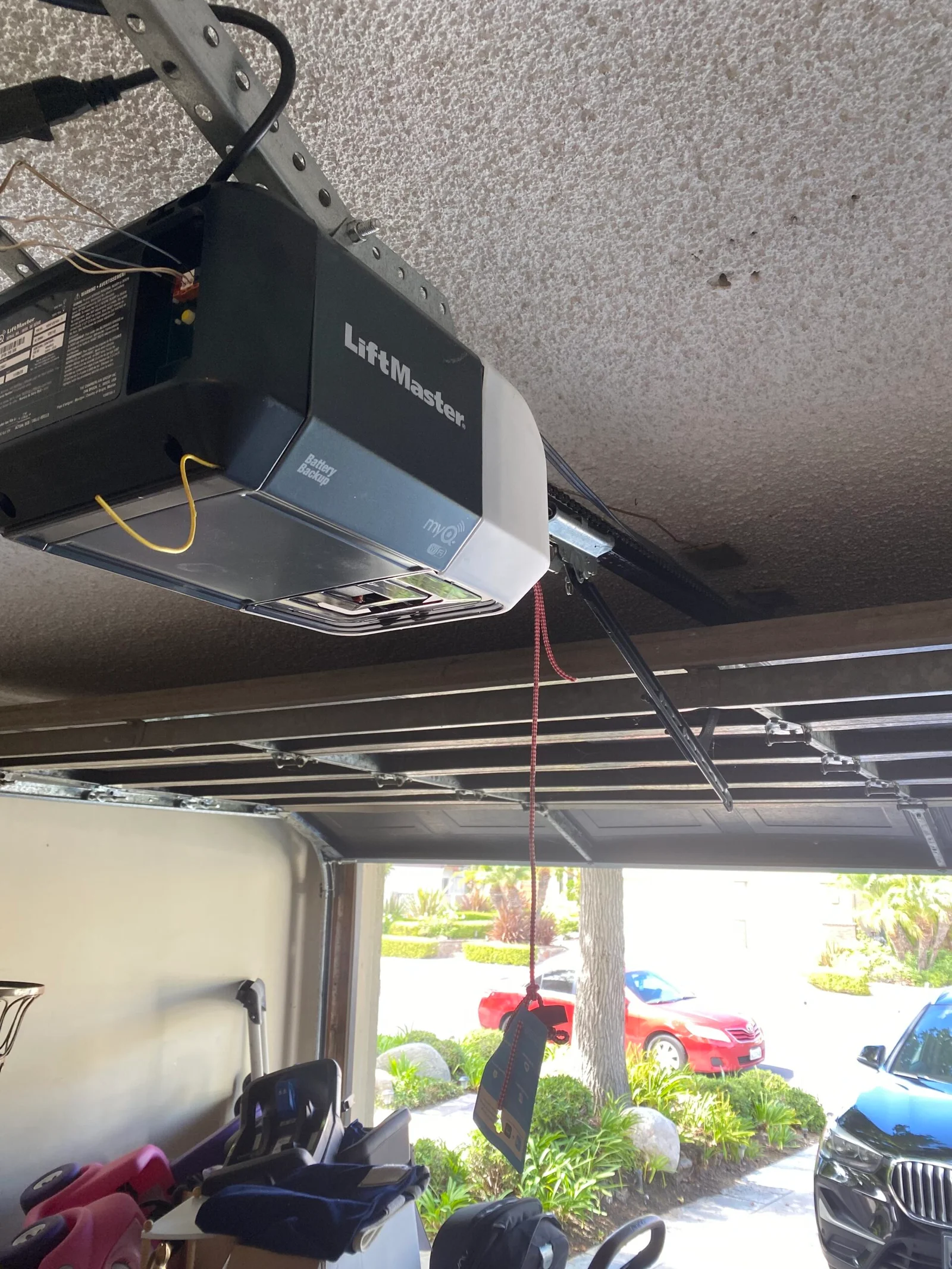
If the door is balanced manually but powered closing is unusually abrupt, model-specific opener diagnosis is appropriate. If the door drops rapidly when disconnected, the spring and counterbalance system should be corrected before opener settings are blamed.
What the Door's Behavior Can Tell You
| What you observe | More likely areas to inspect | Safety significance |
|---|---|---|
| Door drops rapidly from halfway open | Spring balance, broken/weak springs, added door weight | High—do not stand beneath or keep testing |
| One side drops before the other | Lift cable, cable drum, extension spring, roller/track problem | High—door can become crooked or off track |
| Door drifts down slowly but does not slam | Spring balance, spring torque, weight mismatch | Needs diagnosis; may worsen |
| Door pauses, then jumps downward | Binding roller, track, hinge or panel plus possible balance issue | Stop if movement is severe or unpredictable |
| Door is stable manually but closes hard under power | Opener travel/drive/trolley condition | Mechanical balance should still be verified first |
| Door drops only after emergency release | Counterbalance failure exposed when opener disconnects | High—do not repeat the test |
| Door falls after recent spring repair | Spring sizing, turns, pairing, drum/cable setup | Requires prompt re-evaluation |
| Door slams only in last few inches | Balance near floor, track/roller behavior, opener close travel | Should not hit floor violently |
The same symptom can have more than one cause. Diagnosis should identify the mechanical reason before springs, opener settings or cables are adjusted.
A Garage Door Should Not Move Faster Than the Force Applied to It
DASMA's residential door and operator checklist gives homeowners a practical safety benchmark. During controlled manual operation, the checklist asks whether the door moves freely without difficulty and not more quickly than the force applied, whether the rollers stay in the tracks, and whether the door can remain in a partially open position three to four feet above the floor.
That standard is directly relevant to a slamming door. If you gently control the door and it wants to accelerate downward on its own, the counterbalance system should be evaluated.
This does not mean homeowners should perform repeated manual balance tests on a damaged door. The checklist assumes the door can be operated safely. A visibly broken spring, loose cable or crooked door changes the situation.
Broken Spring vs. Under-Counterbalanced Door: The Symptoms Can Overlap
A visibly broken spring is straightforward. An under-counterbalanced door can be more subtle. The springs may look intact while the door still drifts or falls because the spring torque is inadequate for the current weight.
That can happen after an incorrect replacement, a door-weight change, loss of spring performance or an installation that was never properly balanced. The symptom may look similar to a partial spring failure even though no coil is separated.
The correct diagnosis therefore includes both visual spring condition and actual door balance.
Safety Risk #1: Impact and Crush Injuries
The most obvious risk from a fast-dropping garage door is impact. Residential doors can be heavy, and the bottom section can move quickly enough to injure a person or animal, damage a vehicle or crush objects left in the opening.
Do not rely on being able to “catch” the door. If the springs are not supporting the weight, the effective load can be far greater than a person expects.
Keep the opening clear until the door is stable and repaired. Children should not be allowed near a door that has shown unpredictable movement.
Safety Risk #2: Cable, Drum and Bottom-Bracket Tension
When the door loses balance, cable tension can change. A cable may become slack, jump grooves on the drum or pull unevenly. Bottom brackets are connected to the lift cables and can be under substantial tension.
A homeowner may see a loose cable and assume it simply needs to be put back on. That is not a safe DIY correction. Reconnecting a lift cable can require controlling spring tension and drum position.
Leave cable drums, bottom brackets, winding cones and spring anchors untouched.
Door Will Not Stay Open?
That is a counterbalance warning sign. Springs, door weight, cables and drums should be checked before the opener is expected to keep moving the door.
Safety Risk #3: A Crooked Door Can Damage Rollers and Tracks
If one side drops faster than the other, the door can rack diagonally in the opening. Rollers then press against the track at angles they were not designed to carry. A roller can climb the edge of the track or a track bracket can be pulled out of alignment.
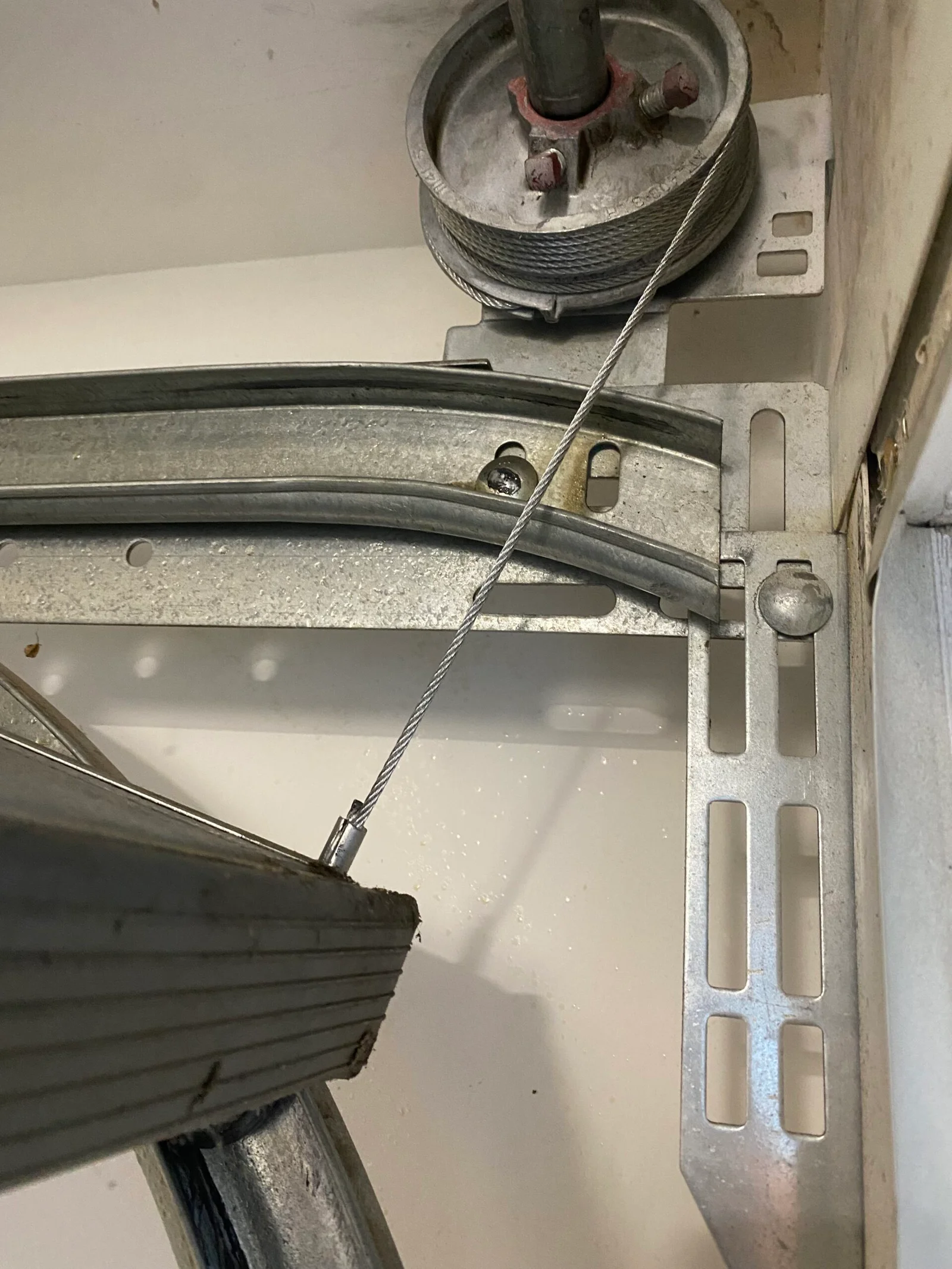
A crooked or partly off-track door should not be forced closed with the opener. The apparent goal of “getting it shut” can create panel, track and cable damage.
Safety Risk #4: The Opener Can Be Overloaded by a Heavy Door
If the springs are not counterbalancing the door, the opener may be asked to lift far more weight than intended during the next opening cycle. The motor, trolley, rail, drive components and top door section can all experience extra stress.
Increasing opener force is not a repair for failed springs. The mechanical door has to be balanced first.
If the opener was repeatedly used while the door was dropping or unusually heavy, opener condition can be checked after the spring and door problems are corrected.
Safe Visual Checks Santa Clarita Homeowners Can Make
Use these checks only from a safe position and only when the door is stable enough to observe. Do not touch moving or high-tension parts.
- Look at the torsion spring. Is there a visible gap or separation in the coil?
- Look at both lift cables. Is either cable slack, frayed, hanging or off the drum?
- Watch the bottom edge. Does one corner drop faster?
- Look at the rollers. Are they inside the tracks and reasonably aligned?
- Look at the tracks. Is there a severe dent, twist or loose bracket?
- Look at the panels. Is a section bent, creased or folding abnormally?
- Think about recent changes. Was insulation, glass, reinforcement or a panel added?
- Recall recent spring work. Did the dropping begin after spring replacement or adjustment?
- Observe powered vs. manual behavior only if safe. Do not disconnect a partly open or unstable door.
- Listen for a prior loud bang. A bang followed by a heavy door often points toward spring failure.
These observations help describe the problem. They are not instructions to adjust the system yourself.
What if the Door Closes Too Fast Only With the Automatic Opener?
If the door is mechanically balanced but powered closing is still abrupt, the opener becomes more relevant. Possible areas include the trolley, rail, drive system, close travel or model-specific control behavior.
The important order is mechanical door first, opener second. A technician should not try to “tune” the opener around a door that is falling under its own weight.
If the powered door hits the floor hard, reverses unpredictably or behaves differently from normal operation, stop repeated cycling until both the door and opener are evaluated.
What Not to Do With a Door That Slams Shut
- Do not stand under the door while testing it.
- Do not keep raising the door to see how fast it falls.
- Do not wind or unwind torsion springs.
- Do not loosen winding cones or spring anchors.
- Do not loosen cable-drum set screws.
- Do not reconnect a lift cable under tension.
- Do not remove bottom brackets connected to lift cables.
- Do not force a crooked or off-track door with the opener.
- Do not increase opener force to compensate for poor balance.
- Do not pull the emergency release on a partly open, unstable door.
If the door is already closed and stable, the safest short-term condition is often to leave it closed until it can be inspected.
What if the Door Drops From Halfway Open?
A door that cannot stay around halfway open is showing one of the clearest balance symptoms. At that point in travel, a properly matched counterbalance system should carry most of the door's weight in a controlled way.
If the door slowly drifts downward, spring torque may be low or door weight may exceed the current spring setup. If the door rapidly accelerates downward, treat the condition as more urgent.
Do not repeat the test if the first attempt shows an uncontrolled drop. The purpose of diagnosis is not to prove the door is dangerous multiple times.
What if Only One Side Drops?
Uneven descent points toward a left-right lifting problem. Lift cables, cable drums, extension springs, rollers and track condition become especially important.
One side can also appear to fall faster when a roller binds on the opposite side and then releases. The door may twist, shake or become diagonal in the opening.
If the bottom edge is visibly out of level, stop operation. A crooked door can pull rollers out of the tracks and damage panel joints.
A Fast-Dropping Door Can Also Create Property and Security Problems
Beyond injury risk, a dropping door can damage the bottom section, weather seal, floor contact points, rollers and opener connection. A crooked door may also fail to close evenly, leaving a gap that affects security and weather sealing.
If the garage is an attached part of the home or is used for daily vehicle access, the disruption can be significant. The priority is still safety: secure the area without forcing a damaged door through repeated cycles.
Do not place temporary objects under an unstable door as a long-term “support.” Improvised blocking can shift or create another impact point.
What if the Door Slams Only Near the Floor?
Garage doors are typically designed to settle onto the floor, and a slight “heavy” tendency near the closed position can help the bottom seal make contact. That is very different from a door that accelerates and hits the floor violently.
If the last foot of closing is the only abnormal part, inspect balance, bottom roller travel, track geometry and opener close travel. On a powered door, the opener may also need model-specific travel or drive diagnosis after the mechanical door is confirmed to be healthy.
Do not assume a hard floor impact is normal simply because the door fully closes afterward.
What if the Door Started Dropping After Spring Replacement?
A new fast-drop symptom after spring work should be re-evaluated. Possible issues include the spring not matching the current door weight, incorrect torsion turns, an incompatible spring pair, cable drum setup or a separate cable/track problem that became more obvious after the repair.
The repair should not be judged by whether the new spring looks similar to the old one. The finished door should be properly balanced through its travel.
Tell the service provider exactly when the change began and whether the door drops evenly or one side leads.
What if the Door Became Heavier After Insulation or Panel Work?
Added weight changes the counterbalance requirement. Even if the door still opens with the automatic opener, it may no longer stay where it should when operated manually.
If the door started drifting or falling after insulation, new glass, reinforcement or panel changes, the spring system should be evaluated for the new weight.
Increasing opener force does not restore spring balance. The door should be counterbalanced for the door that exists now.
Fast-Dropping Garage Door Diagnostic Checklist
Before requesting service, organize what you observed. This information can help identify whether the problem is primarily spring balance, left-right cable behavior or automatic opener operation.
- Did the door begin dropping suddenly or gradually?
- Does it fall manually, automatically, or both?
- Does it drop from fully open, halfway open or only near the floor?
- Does one side descend faster than the other?
- Was there a loud bang before the symptom began?
- Is a torsion spring visibly separated?
- Is an extension spring visibly broken or stretched?
- Is either lift cable slack, frayed or off a drum?
- Did the issue begin after spring replacement?
- Was insulation, glass or a panel recently added?
- Does the door also jerk, shake or bind?
- Did the opener motor sound strained before the problem appeared?
These observations are useful precisely because they do not require touching high-tension hardware.
Spring Problem or Opener Problem? Use the Counterbalance Principle
The simplest conceptual test is this: the spring system should support the door; the opener should move the supported door. When the opener becomes the only thing preventing the door from falling, the mechanical system is not doing its job.
If the door drops when safely disconnected, investigate springs, weight, cables and balance. If the door remains controlled manually but the powered close is abrupt, the opener drive and travel system become more likely.
Do not use this distinction as a reason to disconnect a damaged door. It is a diagnostic principle, not a universal DIY test.
Santa Clarita Conditions: Frequent Use Can Expose Spring and Balance Problems Sooner
Santa Clarita garages can see frequent daily use from commuter schedules, school trips, deliveries and households that use the garage as a primary entrance. More cycles mean the spring system, cables, rollers and opener all accumulate wear more quickly.
Warm, dry garage conditions and dust can also make maintenance more important, but climate alone does not explain a door that falls rapidly. A fast drop is fundamentally a mechanical balance and safety symptom that deserves direct diagnosis.
Whether the home is in Valencia, Canyon Country, Saugus, Newhall, Stevenson Ranch, Castaic or another Santa Clarita Valley community, the same principle applies: the spring system should counterbalance the actual door weight.
What Affects the Cost to Repair a Door That Drops Too Fast?
There is no responsible fixed price without diagnosis because the symptom can involve different parts. A broken torsion spring is a different repair from a cable and drum problem, extension-spring replacement, track correction or a spring-sizing problem after added door weight.
Repair cost can vary with diagnosis, failed component, parts, labor, door dimensions, door weight, door material, spring system, number of springs, cable damage, drum condition, track damage, roller condition, opener condition, installation complexity and scheduling.
This article does not publish fixed Next Hour Garage Door Repair pricing or promise free estimates. Ask what caused the fast drop, which parts are being replaced or adjusted, and how the final door balance will be verified.
12 Questions to Ask Before Approving Repair
- Is the door dropping because of spring balance, a cable problem or something else?
- Is any torsion or extension spring actually broken?
- Does the spring system match the current door weight?
- If there are two springs, are both contributing correctly?
- Are the lift cables seated correctly on the drums?
- Is either cable frayed, stretched or damaged?
- Are the rollers still properly inside the tracks?
- Did added insulation, glass or panel work change the door weight?
- Did the opener suffer strain while the door was unbalanced?
- Will the finished door be checked for controlled balance?
- What parts and labor are included in the recommendation?
- Is the door safe to operate before the repair is completed?
California homeowners who want to verify current contractor information can use the official California Contractors State License Board Check a License tool. This article does not claim a specific Next Hour license number or classification.
What a Professional Diagnosis Should Include
A professional inspection should begin with the door in a controlled position. The technician should identify the spring system, inspect spring condition, verify whether the door is correctly counterbalanced, check lift cables and cable drums, inspect rollers and tracks, and note whether any door sections are damaged.
If the springs are intact, the technician should still consider whether the spring setup is appropriate for the door weight. If one side is dropping faster, left-right cable and drum behavior deserves special attention.
After the mechanical door is corrected, the opener can be tested under normal load. The final result should be controlled movement, not merely an opener strong enough to force the door through the cycle.
Why Consider Next Hour Garage Door Repair Santa Clarita for a Fast-Dropping Door?
Next Hour Garage Door Repair Santa Clarita | Garage Spring & Opener Repair is a local option for homeowners dealing with broken springs, heavy doors, counterbalance problems, lift-cable issues and related opener strain.
A useful recommendation should explain why the door is falling, which part of the counterbalance system has failed or become mismatched, and how the repair will restore controlled movement. The focus should be diagnosis before parts replacement.
For current service availability, call (661) 449-2694, review the verified garage door spring repair service in Santa Clarita, or view Next Hour Garage Door Repair Santa Clarita on Google Maps.
Santa Clarita Valley Service-Area Context
The primary geographic focus of this guide is Santa Clarita, California, including the 91387 local context and the broader Santa Clarita Valley. Supporting service communities can include Valencia, Canyon Country, Saugus, Newhall, Stevenson Ranch, Castaic and Hasley Canyon when relevant.
These are service-area references only and do not imply separate public offices. A slamming or fast-dropping garage door should be diagnosed from its springs, counterbalance, cables, drums, door weight, tracks and opener condition.
Frequently Asked Questions About Garage Doors That Slam Shut or Drop Too Fast
Why does my garage door slam shut when I lower it?
A garage door usually slams shut because the spring counterbalance is not supporting the door correctly. Broken or weak springs, incorrect spring sizing, added door weight, or cable and drum problems can all cause the door to descend too quickly.
Why does my garage door drop when I pull the emergency release?
The opener may have been helping hold an unbalanced door. If the springs are broken or weak, disconnecting the opener can expose the full door weight and the door can drop. Do not repeat the test on an unstable door.
Should a garage door stay open halfway?
A properly balanced residential garage door should generally remain controlled when positioned partway open. If it rapidly falls from a halfway position, the counterbalance system should be inspected.
Can a broken torsion spring make the garage door fall?
Yes. A torsion spring counterbalances door weight. When it breaks, the door can become much heavier and may drop rapidly if it is moved or disconnected from the opener.
Can one broken spring cause a two-spring garage door to drop?
Yes. The remaining spring may provide some support, but the system is no longer balanced as designed. The door can become heavy, uneven or difficult to control.
Can a loose garage door cable make one side drop faster?
Yes. A slack, displaced or damaged lift cable can make one side of the door descend differently from the other. Do not adjust cable drums or reconnect a loaded cable yourself.
Is it safe to use the opener if the door drops too fast manually?
No. The opener should not be relied on to compensate for a failed counterbalance system. The mechanical door should be repaired and balanced before normal opener use continues.
Can added insulation make a garage door drop faster?
It can. Added insulation or other modifications increase door weight. If the spring system is not recalculated for the added weight, the door may become under-counterbalanced and drift or fall.
What should I do if my garage door slams to the floor?
Stop operating the door, keep the opening clear, do not stand beneath it, and avoid touching springs, cables, drums or bottom brackets. Have the spring and counterbalance system inspected.
When should I call for garage door repair in Santa Clarita?
Request service when the door drops rapidly, will not stay open, becomes crooked, shows a broken spring or loose cable, or started falling after spring work or a change in door weight.
A Door That Drops Too Fast Should Be Rebalanced Before Normal Use Continues
If your garage door slams shut, falls from a partly open position, drops faster on one side or suddenly became much heavier, treat the symptom as a counterbalance and safety problem first. Springs, cables, drums, door weight and balance should be checked before the opener is asked to keep moving the door.
Ask About Current Garage Door Repair Availability
Call Next Hour Garage Door Repair Santa Clarita | Garage Spring & Opener Repair at (661) 449-2694. Describe whether the door drops manually or under power, whether one side falls first, and whether you see a broken spring or loose cable.
One Response