

Garage Door Jerks or Shakes When Opening? What Santa Clarita Homeowners Should Check
A homeowner guide to rollers, tracks, springs, cables, hinges, panels and opener causes behind jerking, shaking or uneven opening.
Door shaking, crooked or jumping in the tracks? If you see a broken spring, loose cable, off-track roller or unstable panel, stop operating it. Call (661) 449-2694 to ask Next Hour Garage Door Repair Santa Clarita about current service availability.
Why does a garage door jerk or shake when opening?
A garage door may jerk or shake because rollers are binding, tracks are bent or misaligned, hinges are loose, springs are not balancing the door correctly, cables or drums are lifting unevenly, panels are flexing, or the opener drive is moving irregularly. If the door becomes crooked, off track or visibly unstable, stop operating it.
Jerking and Shaking Are Clues About How the Door Is Moving
A garage door that jerks, shudders or shakes while opening is telling you that something in the system is not moving smoothly. The problem may be as simple as a roller that is dragging through the track, but it can also involve a spring-balance problem, a cable that is not winding evenly, loose hinge hardware, a bent track, a damaged panel, or an opener that is sensing unusual resistance.
The first goal is not to make the door move faster or quieter. The first goal is to identify where the movement becomes uneven and whether the door is still mechanically stable. A door that vibrates slightly because of a chain-drive opener is very different from a door that jumps several inches, twists from side to side, pauses at the same track location or lifts one corner ahead of the other.
For Santa Clarita homeowners, the safest way to troubleshoot is to watch the entire door system rather than focusing only on the motor. Springs counterbalance the weight. Cables and drums transfer lifting force. Rollers guide the sections through the tracks. Hinges allow the sections to bend through the radius. The opener moves the balanced door through the rail and trolley. A problem in any one of those areas can show up as shaking or jerking.
This guide explains what different movement patterns can mean, what you can safely check from the floor, which problems commonly involve rollers, tracks, springs, cables or opener components, and which warning signs mean you should stop operating the door until it is inspected.
Why Does a Garage Door Jerk or Shake When Opening?
A garage door may jerk or shake when opening because rollers are binding, tracks are bent or misaligned, hinges are loose, springs are not balancing the door correctly, cables or drums are lifting unevenly, panels are flexing, or the opener rail, trolley or drive system is moving irregularly. If the door is crooked, off track, visibly damaged or has a loose cable, stop using it.
Some Vibration Is Normal—Repeated Jerking Is Not
Garage door systems are mechanical, so a small amount of vibration is normal. A chain-drive opener can transmit more vibration into the ceiling and rail than a belt-drive system. Metal rollers can also sound and feel different from nylon rollers. The key question is whether the movement has changed or become uneven.
Normal vibration tends to be consistent and mild. Abnormal jerking usually looks more like a sudden jump, hesitation, shake or twist that repeats at a certain part of travel. You may see the top section snap backward, one roller stall and then release, the door vibrate through the curved track, or one side rise before the other catches up.
If the door has recently started shaking more than usual, treat that change as useful diagnostic information rather than assuming it is harmless noise.
The Movement Pattern Helps Narrow the Cause
| What you see | Common possibilities | What to notice next |
|---|---|---|
| Door jerks at the same height every time | Roller, hinge, track deformation, panel joint or opener rail resistance | Watch which roller and hinge are entering the curved track |
| Whole door shakes throughout opening | Multiple worn rollers, loose hardware, opener vibration, poor balance | Listen for whether the noise comes from door or opener |
| One side rises first | Cable, drum, roller, track or spring-balance issue | Stop if the door becomes visibly crooked |
| Door starts smoothly then jerks near the top | Horizontal track, roller transition, opener rail/trolley or travel sensing | See whether the mechanical door binds at that height |
| Door jerks only with opener attached | Opener drive, rail, trolley, RPM/travel sensing | Mechanical door may be smoother than automatic movement |
| Door jerks after spring replacement | Balance, spring sizing, cable/drum setup or another unresolved issue | Confirm door was balance-tested after repair |
| Door shakes after a roller or track impact | Bent track, damaged roller, hinge or panel alignment issue | Look for rubbing, dents and rollers sitting at an angle |
These patterns are not exact diagnoses. More than one problem can be present at the same time, and a damaged mechanical door can make the opener behave abnormally.
Cause #1: Worn or Binding Rollers
Rollers are one of the most common places to look when a garage door shakes or jerks. Each roller has to move through the vertical track, curve through the radius and continue into the horizontal track. If a wheel is cracked, a bearing drags, the stem binds or the roller sits at the wrong angle, the door can pause and then release suddenly.
That release often feels like a jerk. If several rollers are worn, the entire door can vibrate or rattle through the opening cycle. From a safe position, look for wheels that wobble dramatically, appear chipped, scrape the track or fail to rotate normally.
Chamberlain Group's maintenance guidance specifically tells homeowners to watch for sticking, jerking or uneven garage door movement and to stop using the door if it binds or moves unevenly. That is a useful standard: jerking is not simply a cosmetic noise issue when it reflects abnormal movement.
For more detail on roller-related repair, see the verified garage door roller service in Santa Clarita page.
Cause #2: Bent, Loose or Misaligned Tracks
Tracks guide the rollers. A small dent or twist can create a tight spot that catches the roller. A loose track bracket can also let the track move slightly as the door passes, creating a shake that repeats at the same height.
Look down the vertical track from a safe distance for obvious dents, spreading, twisting or brackets that appear loose. Also check the horizontal track for objects resting against it or storage that may have pushed it out of position.
Do not loosen track brackets or hammer a loaded track back into shape while the door is under spring and cable tension. If the door is already crooked, a roller has left the track or the track is badly deformed, continued opener use can make the problem worse.
If the door is beginning to leave the track or move at a severe angle, the verified off-track garage door repair information explains why rollers, cables and track alignment should be evaluated together.
Cause #3: Loose or Binding Hinges
Sectional garage doors depend on hinges to let the panels pivot as they move through the curved track. If hinge hardware is loose, a hinge is bent, or a roller stem binds inside the hinge carrier, the panels can move in a stop-and-release pattern.
That movement can create a visible shake in the door face. It can also sound like popping or metal snapping even though the spring is intact.
From inside the garage, watch the hinge line as the door opens. A hinge that shifts dramatically, flexes away from the panel or causes the panel joint to jump deserves inspection.
Ordinary loose fasteners on non-tension hardware can sometimes be visible, but homeowners should not remove bottom brackets or other hardware connected to lift cables. Those components can be under significant tension.
Cause #4: The Spring System Is Not Balancing the Door Correctly
Springs counterbalance garage door weight. If the spring system is broken, fatigued, incorrectly sized or no longer matched to the current door weight, the door can move unevenly and the opener may pull harder through some parts of travel than others.

A visible gap in a torsion spring is a clear stop-and-call sign. But balance problems are not limited to fully broken springs. A spring that was incorrectly selected after a previous repair can leave the door heavy or overly strong.
If the door both jerks and opens slowly, our guide to slow-opening garage door causes explains how spring balance, rollers, tracks, cables and opener resistance overlap.
Do not try to smooth out jerking by winding or unwinding torsion springs. Spring adjustment is not a homeowner tuning procedure.
Cause #5: Lift Cables or Cable Drums Are Not Sharing the Load Evenly
On a torsion-spring system, lift cables run from the bottom of the door to cable drums at the ends of the torsion shaft. Both sides should lift in a coordinated way. If a cable is frayed, slack, displaced or winding incorrectly on a drum, one side can jump or lag.
That can make the door shake from side to side. In more serious cases, one bottom corner rises while the other remains lower, creating a visibly crooked door.
Never try to reseat a cable on a drum while the system is under tension. Do not loosen drum set screws or remove bottom fixtures. A loose cable is a reason to stop normal operation and have the lifting system inspected.
Cause #6: A Bent or Flexing Panel Is Distorting Door Movement
Garage door sections are structural parts of the moving system. A bent section, cracked stile or damaged panel joint can flex as the door changes direction through the curved track. That flex can feel like a shake or sudden jump.
Panel damage is especially relevant after a vehicle bump, impact from stored items or previous off-track event. Look across the inside face of the door for buckling, creases, separation around hinges or a section that bows differently from the others.
Do not keep cycling a door if a panel is folding abnormally. Continued movement can transfer stress to hinges, rollers and track hardware.
Cause #7: Loose Non-Tension Hardware Is Letting the Door Rattle and Shift
Garage doors experience vibration every time they operate. Over time, ordinary fasteners on hinges, struts or track supports can loosen. That may create rattling and visible shaking even when the rollers themselves are still serviceable.
Loose hardware should be distinguished from high-tension hardware. Homeowners should not loosen or adjust spring anchors, winding cones, cable drums or bottom brackets.
If a track bracket or structural attachment is visibly loose, stop if the track is moving substantially under load. The goal is not merely to tighten something; the track must remain correctly aligned after the repair.
Cause #8: The Opener Rail, Trolley, Belt or Chain Is Moving Irregularly
If the mechanical door is smooth but automatic operation creates the jerking, the opener becomes more likely. The rail can flex, the trolley can bind, a chain or belt can move irregularly, or worn internal drive components can transmit vibration into the door.
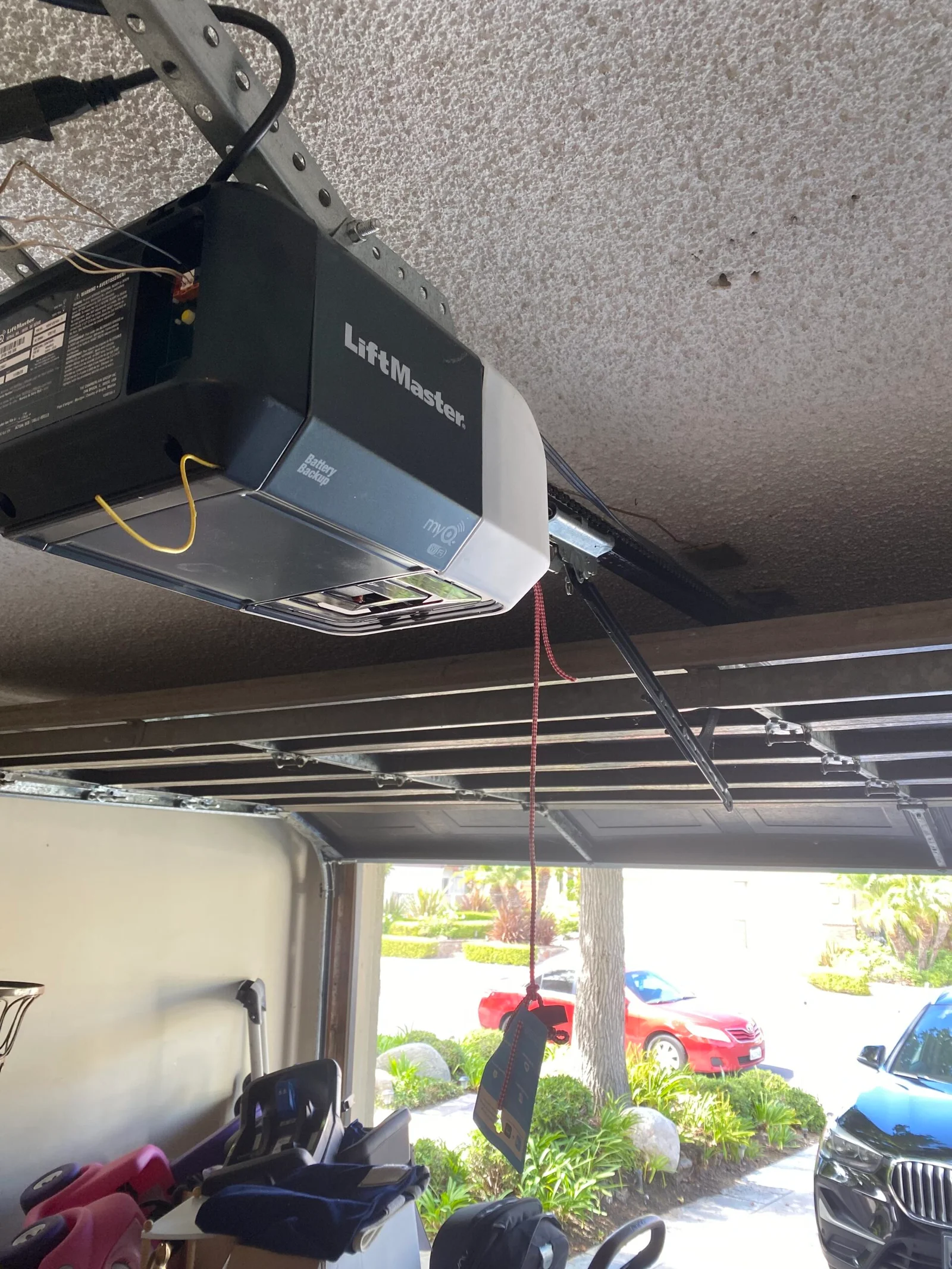
Watch the opener rail while the door moves. Excessive bouncing, a trolley that hesitates, or a belt or chain that moves unevenly can help locate the problem.
Do not over-tighten a chain or belt in an attempt to remove all vibration. Opener drive tension should follow the manufacturer's model-specific instructions.
Cause #9: The Opener Is Detecting Unexpected Resistance
Modern openers can monitor motor speed and resistance. Chamberlain Group's diagnostic guidance explains that some systems stop or change operation when they detect unexpected resistance or a drop in motor RPM during opening.
If the door jerks, pauses and then stops, check for a diagnostic light pattern before resetting the opener. A resistance code can point back toward a mechanical issue such as rollers, tracks or poor balance, while other codes may point toward the travel module, RPM sensing or internal opener components.
The code is a clue, not permission to increase force. Mechanical resistance should still be checked first.
Cause #10: The Door Is Jerking Through the Curved Track Transition
The transition from vertical track to horizontal track is a common place to see shaking because multiple rollers are changing direction and the sections are pivoting through their hinges.
If the door jerks only during that transition, inspect the curved track area for dents, roller wear, hinge binding or a panel joint that is not articulating smoothly.
A small amount of movement is normal because the panels are changing orientation. A repeatable hard jump, scraping sound or visible flex is not something to ignore.
Jerking, Shaking, Rattling and Bouncing Do Not Always Mean the Same Thing
Homeowners often use these words interchangeably, but the movement can point to different parts of the system. A jerk is usually a sudden change in speed or position. A shake is repeated side-to-side or front-to-back movement. A rattle often points toward loose hardware or panels. A bounce can involve opener rail flex, panel movement or a roller moving through a damaged track area.
Describe what you see rather than trying to name the failed part. “The left side jumps when the third roller reaches the curve” is more useful than “the opener is bad.” The exact movement pattern helps narrow the inspection.
Video can also be useful if it can be recorded safely from well outside the door's path. Do not stand under the door or near a loose cable to capture footage.
Cause #11: Dry Bearings, Hinges or Rollers Are Increasing Friction
Appropriate lubrication can help healthy moving parts operate smoothly, but it should be applied according to the garage door or component manufacturer's guidance. Dry bearings or hinges can contribute to rough movement and noise.
Tracks themselves should generally be kept clean so rollers can travel without debris or sticky buildup. Heavy grease inside the track can attract dirt and create more resistance.
If lubrication does not change the jerking pattern, stop adding product and investigate mechanical alignment, roller condition, spring balance or opener behavior instead.
Cause #12: The Door Weight Changed but the Spring System Did Not
Added insulation, decorative hardware, replacement panels or glass can change the door's weight. If the spring system was not recalculated, the door may no longer move with the same balance.
The opener may then pull harder during the first part of travel, making existing roller or track resistance more obvious. The result can feel like jerking or shuddering rather than simply a slow door.
If the shaking began after a door modification, mention that history during diagnosis.
Safe Checks Santa Clarita Homeowners Can Do From the Floor
You can collect useful information without adjusting high-tension components. Only perform visual checks when the door is stable and there is no obvious broken spring, loose cable or off-track condition.
- Watch both bottom corners. Do they rise together?
- Watch the rollers at the point where the shake happens. Does one hesitate or wobble?
- Look for dents or rubbing marks in the track. A shiny scrape can reveal a repeated contact point.
- Listen for the source. Is the sound at the door, track or opener rail?
- Look at hinges and panel joints. Is one flexing or shifting more than the others?
- Look at the torsion spring from a safe distance. A visible gap means stop operating the door.
- Look at the lift cables without touching them. Slack or fraying is a stop-and-call symptom.
- Record opener diagnostic lights. Do this before resetting or unplugging the unit.
- Note the exact height where the door jerks. Repeatability is diagnostically useful.
- Remember recent work or impacts. Spring replacement, roller work, insulation or a track collision may be relevant.
Does the Door Shake at the Same Spot Every Time?
That pattern can help locate a binding roller, track defect, hinge problem, panel flex point or opener-rail resistance. Avoid forcing the door through the bind.
What Homeowners Should Not Adjust on a Shaking Garage Door
- Do not wind or unwind torsion springs.
- Do not loosen winding cones or spring anchors.
- Do not loosen cable drums.
- Do not reconnect a loose lift cable under tension.
- Do not remove bottom brackets connected to lift cables.
- Do not force an off-track roller back into place while the door is loaded.
- Do not stand beneath a visibly unstable door.
- Do not keep increasing opener force to overpower binding.
- Do not repeatedly operate a crooked or twisting door.
The door can still look mostly functional while high-tension parts are in an unsafe condition. Visual diagnosis is safer than hardware adjustment.
When a Manual Door Test Is Helpful—and When It Is Not
A manual test can help separate a door problem from an opener problem, but only when the door is fully closed, stable and free of visible spring, cable or track damage. If the opener manufacturer provides a safe disconnect procedure, the mechanical door can be evaluated for smooth movement.
If the door moves smoothly by hand but jerks only under automatic operation, attention shifts toward the opener rail, trolley, drive components and sensing. If the door itself binds or shakes by hand, the problem is more likely in the mechanical door.
Do not disconnect an open or partially open door that may have a broken spring or loose cable. It can drop unexpectedly when the opener is released.
If the Door Jerks Right at the Start of Opening
A hard jerk from the fully closed position can come from a door that is sticking at the bottom seal, a heavy or poorly balanced door, a roller binding low in the track, or an opener trolley applying force unevenly.
Listen to whether the motor strains before the door breaks free. Watch whether both bottom corners begin moving together. If one side remains planted while the other lifts, stop the door and inspect for cable or track issues.
Do not use extra opener force to yank the door free from a severe bind.
If the Door Jerks in the Middle of Travel
Mid-travel jerking often points toward a repeatable roller, track, hinge or panel issue. Mark the approximate height and watch which rollers are passing through the problem area.
If the shake happens at exactly the same place on every opening, that repeatability is valuable. A bent track or damaged roller can create a localized resistance point.
If the opener itself also pauses or changes sound at that location, it may be reacting to the mechanical resistance rather than creating it.
Chain, Belt and Wall-Mount Openers Can Transmit Vibration Differently
A chain-drive opener can transmit more mechanical vibration through the rail than a belt-drive opener, while a wall-mounted opener transfers motion at the torsion shaft rather than through a ceiling rail. That does not mean one opener type should make the door jerk.
If the movement changed recently, look for a new fault rather than blaming the opener category. A chain that is out of adjustment, a belt with abnormal movement, a loose rail attachment or a jackshaft door-balance problem can all change how vibration is felt.
Model-specific manufacturer instructions should guide opener adjustments. Do not use generic belt or chain tension advice across every opener.
If the Door Shakes Near the Top of the Opening Cycle
Near the top, most of the door is horizontal and the opener trolley is approaching its open travel limit. Shaking at this point can involve the horizontal tracks, upper rollers, opener rail, trolley, belt or chain, or travel sensing.
Watch whether the door shakes independently of the opener rail. If the rail itself flexes strongly, the opener mounting and drive system deserve inspection. If a specific roller catches in the horizontal track, the mechanical door deserves attention.
Do not change travel limits simply to push through a bind.
If One Side of the Door Jerks More Than the Other
Side-to-side difference is more serious than uniform vibration because it can indicate uneven lift. The likely areas include cables, drums, rollers, tracks or spring balance.
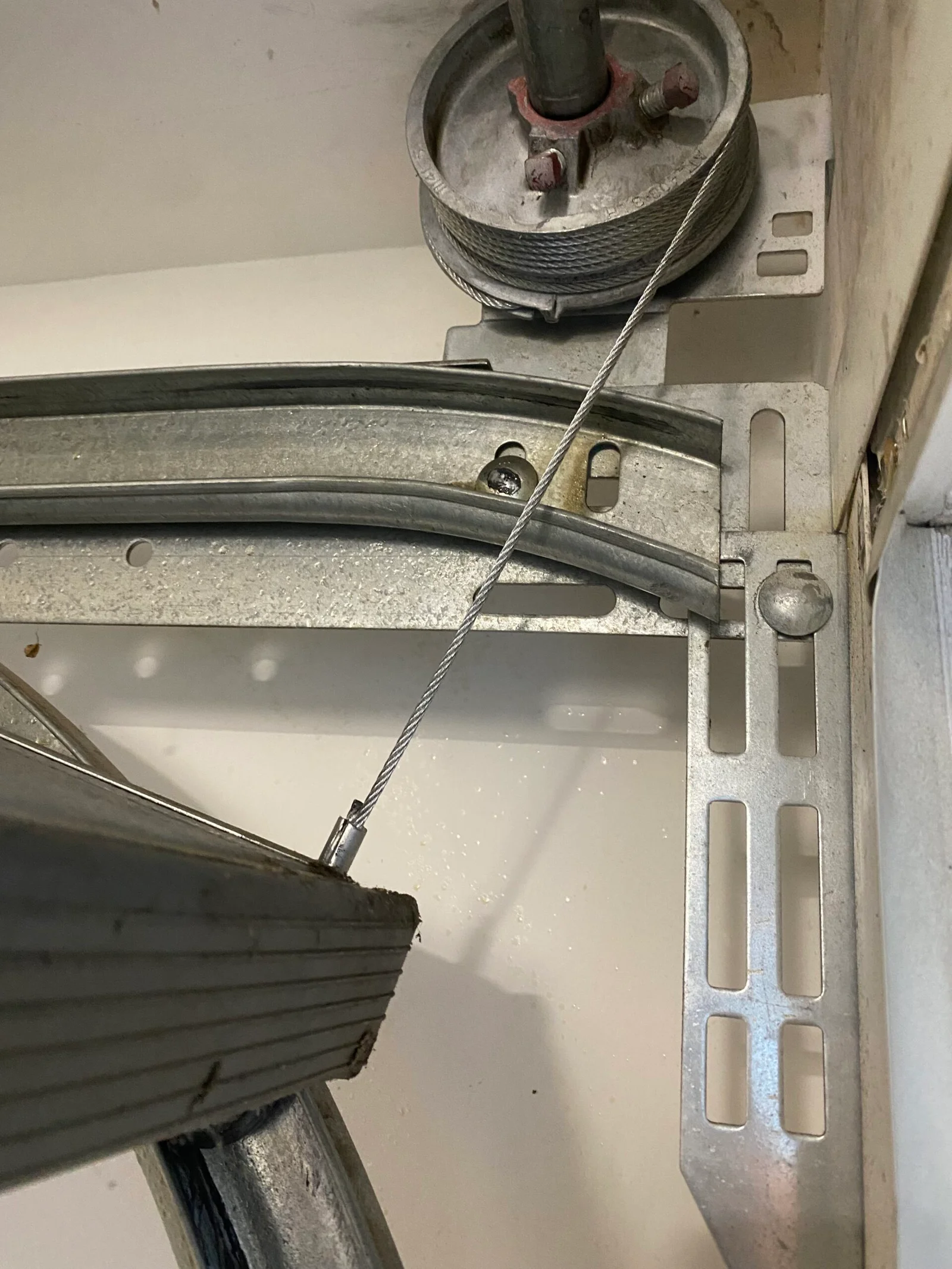
If one bottom corner rises noticeably before the other, stop repeated operation. A crooked door can load rollers and tracks in ways they were not designed to handle.
Do not attempt to level the door by adjusting a cable drum yourself.
If the Door Shakes Only When the Opener Is Connected
This pattern is useful because it suggests the mechanical door may be smoother than the automatic drive system. Possible causes include a rail that flexes, a trolley that binds, drive tension that is incorrect, worn gears, motor-speed irregularity or travel-sensing problems.
Model-specific troubleshooting becomes important. Belt-drive, chain-drive and wall-mounted openers do not all use the same drive layout or adjustments.
If the opener shows a diagnostic code, record it. If the opener makes a grinding or repeated clicking sound while the door itself moves smoothly, internal opener service may be more relevant than door hardware repair.
Why a Repeatable Jerking Point Is Especially Useful
If the door jerks at exactly the same height on every opening, the cause is often linked to a component that reaches the same physical position each time. That can include a roller passing a dent, a hinge entering the track curve, a panel joint flexing, or the opener trolley encountering resistance at a particular rail position.
Mark the approximate height mentally rather than touching moving components. During service, the technician can move the door through that position while watching the corresponding rollers, track and opener hardware.
A repeatable point is usually more diagnostically useful than a shake that happens randomly.
If the Jerking Started After a Recent Repair
A new movement problem after spring, roller, track or opener work should be evaluated in the context of that repair. The new part may be correct but another component may have been marginal. Or the system may need an adjustment to restore smooth travel.
After spring work, door balance and cable seating matter. After roller replacement, track alignment and hinge condition matter. After opener work, rail alignment, trolley travel and drive tension matter.
The safest approach is to explain exactly when the shaking began rather than treating it as an unrelated new problem.
Can Routine Maintenance Prevent Jerking and Shaking?
Maintenance can reduce avoidable friction and help identify wear before movement becomes severe. Visual inspection of rollers, tracks, hinges, cables and springs can reveal changes early. Appropriate lubrication at manufacturer-approved points can also help healthy moving parts work more smoothly.
Maintenance cannot repair a broken spring, a frayed cable, a bent track, a cracked panel or a failing opener. If a clear defect is present, the correct action is repair rather than repeated lubrication.
A door that has begun jerking deserves diagnosis even if it still opens fully.
Santa Clarita Conditions: Heat, Dust and Frequent Use Can Make Wear More Noticeable
Santa Clarita garages can experience warm interior temperatures, direct sun and dusty conditions. Those factors can make dry hinges, dirty moving parts or aging opener components more noticeable, but they do not replace mechanical diagnosis.
Frequent daily garage use can be more significant because every cycle moves the rollers, hinges, springs, cables and opener. A household using the garage as a primary entrance may accumulate wear faster than a garage that opens only occasionally.
If shaking appears during a hot period, look for the actual source of resistance or vibration rather than assuming temperature alone caused the problem.
How a Small Shake Can Progress Into a Larger Door Problem
A small amount of abnormal movement can create secondary wear if it continues. A binding roller can load a hinge. A crooked door can place side pressure on the track. A loose track can allow a roller to approach the edge of the channel. A weak spring can make the opener pull harder on the top section.
This does not mean every rattle will become an emergency. It means repeated abnormal movement deserves attention because garage door components work as one system.
Early repair can sometimes be limited to the worn component and alignment issue. Waiting until a roller leaves the track or a cable loses tension can increase the repair scope.
What Affects the Cost to Repair a Jerking or Shaking Garage Door?
There is no single repair price because the symptom can come from several components. Roller replacement is different from track repair, cable and drum work, spring correction, hinge repair, panel reinforcement or opener service.
Cost can vary with diagnosis, failed components, parts, labor, door dimensions, door weight, number of rollers, spring system, cable condition, track damage, opener condition, installation complexity and scheduling.
This article does not publish fixed Next Hour Garage Door Repair pricing or promise free estimates. Ask what component is creating the jerking and whether any related parts were damaged by continued operation.
12 Questions to Ask Before Approving Repair
- Is the jerking coming from the mechanical door or the opener?
- Which roller, hinge or track location is binding?
- Is the door lifting evenly on both sides?
- Are the lift cables and cable drums in good condition?
- Is the spring system correctly balancing the door?
- Is any panel or stile flexing abnormally?
- Does the opener rail or trolley move smoothly?
- Is belt or chain tension within the manufacturer's specification?
- Does the opener show a diagnostic code?
- Will the door be checked for smooth movement after repair?
- Are there any safety red flags that mean the door should not be used now?
- What parts and labor are included in the proposed repair?
California homeowners who want to verify current contractor information can use the official California Contractors State License Board Check a License tool. This article does not claim a specific Next Hour license number or classification.
Why Consider Next Hour Garage Door Repair Santa Clarita for Jerking or Shaking Movement?
Next Hour Garage Door Repair Santa Clarita | Garage Spring & Opener Repair is a local option for homeowners dealing with uneven garage door movement involving rollers, tracks, springs, cables or opener components.
A useful diagnosis should identify where the door changes movement and whether the mechanical door or opener is responsible. That means looking at spring balance, roller travel, track alignment, cable tension, panel movement and opener behavior before recommending parts.
For current service availability, call (661) 449-2694, review garage door services in Santa Clarita, or view Next Hour Garage Door Repair Santa Clarita on Google Maps.
Santa Clarita Valley Service-Area Context
The primary geographic focus of this guide is Santa Clarita, California, including the 91387 local context and the broader Santa Clarita Valley. Supporting service communities can include Valencia, Canyon Country, Saugus, Newhall, Stevenson Ranch, Castaic and Hasley Canyon where relevant.
These community references describe service geography only. They do not imply separate public offices. A jerking or shaking garage door should be diagnosed from its actual springs, rollers, tracks, cables, panels and opener condition.
Frequently Asked Questions About Garage Doors That Jerk or Shake When Opening
Why does my garage door jerk when it starts opening?
A hard jerk at startup can come from poor spring balance, a sticking bottom seal, a binding roller, track resistance, uneven cable tension or an opener trolley applying force against a heavy door.
Why does my garage door shake while going up?
Shaking during the opening cycle often points to worn rollers, loose hinges, track alignment, spring balance, cable/drum problems or opener rail and drive vibration.
Can bad rollers make a garage door shake?
Yes. A roller that binds, wobbles or drags can make the door hesitate and release suddenly. Multiple worn rollers can create vibration through much of the opening cycle.
Can a bent track cause jerking?
Yes. A dent, twist or misalignment can catch a roller at the same point each cycle, causing a repeatable jump or shake.
Can a broken or weak spring cause the door to jerk?
Yes. Springs counterbalance the door. If the spring system is broken or improperly matched, the opener may pull a heavier or unevenly balanced door, creating rough movement.
Why does one side of my garage door shake more than the other?
Uneven side-to-side movement can involve a lift cable, cable drum, roller, track or spring-balance problem. Stop using the door if it becomes visibly crooked.
Why does the door jerk only when the opener is connected?
That pattern can point toward the opener rail, trolley, belt or chain, drive components, motor-speed sensing or travel system, especially if the mechanical door moves smoothly on its own.
Should I increase opener force to stop the jerking?
No. Force settings should not be used to overpower mechanical binding. Springs, rollers, tracks, cables and door balance should be checked first.
Is it safe to keep using a garage door that shakes?
Mild consistent vibration can be normal, but new jerking, twisting, crooked movement, a broken spring, loose cable or off-track roller is a reason to stop and have the door inspected.
When should I call for garage door repair in Santa Clarita?
Request service when the jerking is new or worsening, the door moves unevenly, a roller or track is damaged, a cable is loose, the spring is broken, or the opener repeatedly stalls or shows resistance-related diagnostic codes.
Garage Door Still Jerking or Shaking? Find the Binding Point Before It Gets Worse
A garage door that jerks or shakes can still finish opening while a roller, track, spring, cable or opener problem is developing. If the movement is new, repeatable or getting worse, diagnosis is more useful than simply increasing opener force or adding more lubricant.
Ask About Current Garage Door Repair Availability
Call Next Hour Garage Door Repair Santa Clarita | Garage Spring & Opener Repair at (661) 449-2694. Describe where the shake occurs, whether both sides move together, what noises you hear and whether any roller, track, spring or cable looks abnormal.