
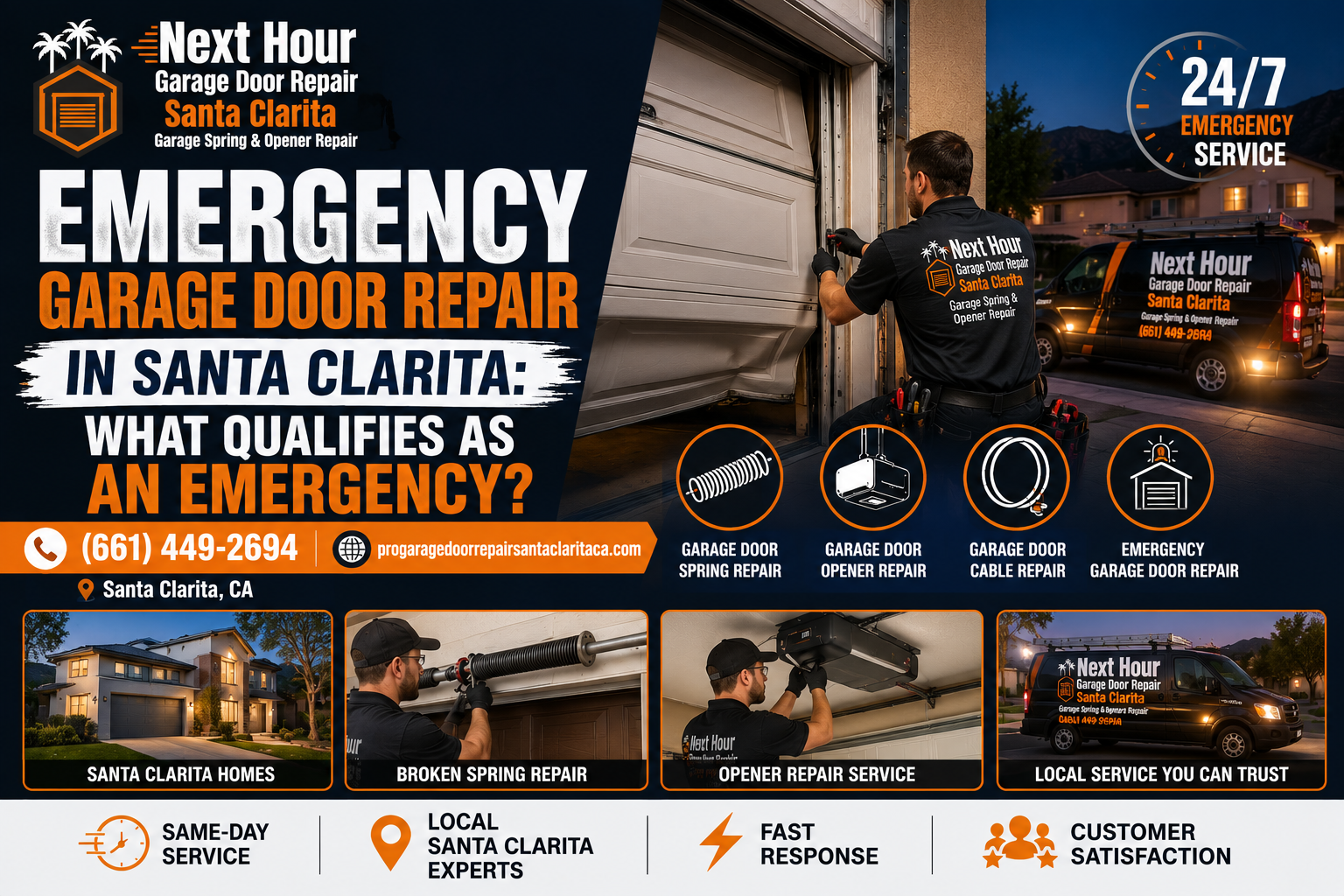
Emergency Garage Door Repair in Santa Clarita: What Qualifies as an Emergency?
A safety-first guide to broken springs, loose cables, off-track doors, doors stuck open, trapped vehicles, opener failures and the difference between urgent and routine garage door problems.
Door off track, cable hanging, spring broken or garage stuck open? Stop operating the system if continued use could make the condition worse. Call (661) 449-2694 to ask Next Hour Garage Door Repair Santa Clarita about current emergency availability.
What qualifies as an emergency garage door repair in Santa Clarita?
A garage door problem is generally an emergency when it creates an immediate safety, security, access or escalating-damage risk. Examples include a door hanging off track, a broken or loose cable, a broken spring with an unstable door, a door stuck open, uncontrolled movement or a trapped vehicle. Stop using an unstable door and do not attempt spring, cable or off-track repairs yourself.
What Counts as a Garage Door Emergency in Santa Clarita?
An emergency garage door repair in Santa Clarita is usually a situation where the door creates an immediate safety, security, access, or property-damage concern that should not be treated like routine maintenance. A broken spring that leaves the door extremely heavy, a cable hanging loose, a door that has come off track, a door stuck open so the home cannot be secured, or a door hanging unevenly are stronger emergency signals than a squeak, cosmetic dent, or remote-control battery problem.
The key question is not simply whether the door is inconvenient. It is whether continued operation could cause injury, additional damage, loss of access, or loss of security. A vehicle trapped inside before work may create practical urgency even when the door is closed. A door stuck open at night can create a home-security problem. A crooked door with a loose cable can be mechanically unstable. A broken spring can make the full weight of the door difficult to control.
This guide explains which situations deserve urgent attention, which problems can often wait for a routine appointment, what homeowners can safely observe, and what not to do while arranging service. If the immediate issue is that your door refuses to close, our related guide on garage door won’t close problems goes deeper into sensors, tracks, opener settings and other closing causes.
A Practical Definition of a Garage Door Emergency
A useful way to decide whether a garage door problem is an emergency is to evaluate four categories: safety, security, access and escalating damage.
- Safety: Could the door fall, drop, move unpredictably, or expose someone to high-tension springs or cables?
- Security: Is the garage stuck open so the home, vehicle, tools or stored property cannot be secured?
- Access: Is a vehicle trapped inside, or is the garage the primary accessible entrance for someone who needs to leave or enter?
- Escalating damage: Will continued operation likely bend tracks, tear panels, damage the opener or pull cables farther out of position?
If the answer to one or more of those questions is yes, the problem should generally be treated with greater urgency. That does not mean every urgent problem requires a technician at a specific clock time, and it does not justify unsafe DIY work. It means you should stop operating the door when appropriate, secure the area, and ask a garage door repair company about current emergency availability.
Emergency vs. Routine: Quick Decision Guide
| Garage door problem | Usually urgent? | Why | What to do first |
|---|---|---|---|
| Door hanging off track | Yes | Unstable door can fall or suffer more damage | Stop using the opener and keep people clear |
| Loose or broken lift cable | Yes | Cable and spring system may be unstable | Do not touch cable or drum; stop operation |
| Broken spring with very heavy door | Often | Door may be unsafe to lift and opener may be overloaded | Stop opener use; leave door in safest stable position |
| Door stuck open and home cannot be secured | Yes | Security exposure | Keep area clear and ask about urgent service |
| Vehicle trapped behind a closed door | Often | Access problem may be time-sensitive | Describe spring/cable/track symptoms when calling |
| Door reverses because sensor is blocked | Usually not, if safely resolved | May be a simple obstruction | Clear doorway and inspect sensor area |
| Remote battery is dead | No | Control issue only if wall control still works | Use wall control and replace/test remote battery |
| Minor squeak with smooth operation | No | Usually maintenance-related | Schedule routine inspection if needed |
| Cosmetic panel dent with normal movement | Usually not | No immediate mechanical or security issue | Schedule evaluation if appearance or structure is a concern |
| Door drops, slams or moves unpredictably | Yes | Potential loss of counterbalance or control | Stop operation and keep people away |
This table is a general triage guide. The actual urgency can change depending on door position, household needs, property security, visible damage and whether the system remains mechanically stable.
1. A Garage Door Hanging Off Track Is an Emergency
A garage door that has come off track is one of the clearest reasons to stop using the system immediately. One or more rollers may be outside the track, the door may lean to one side, a cable may have lost tension, or a track may be bent. The door is no longer traveling through its intended path and may be supported unevenly.
Do not press the opener repeatedly to “pull it back into place.” The opener can apply force to the top section while the lower part of the door is mechanically jammed. That can bend panels, damage hinges, tear rollers from tracks, pull cables farther out of position or twist the opener rail.
Do not try to push the roller back into the track while the spring and cable system is still loaded. If the door is partly open, keep people and vehicles away from the opening. Our off-track garage door repair resource explains why a complete inspection should include tracks, rollers, cables, drums, springs and door balance.
2. A Broken or Hanging Lift Cable Needs Urgent Attention
Lift cables work with the garage door spring and cable-drum system. They are not simple ropes that can be tied back into place. A cable can become frayed, snap, jump off the drum or hang loose after another mechanical failure. The door may sit crooked or one side may move before the other.
If a cable is visibly hanging, do not pull it, cut it, rewind it or try to place it back on the drum. Spring tension may still be present elsewhere in the system. A loose cable can also be a sign of a broken spring, damaged drum, off-track roller or door-balance problem.
Urgency increases when the cable problem leaves the door partly open, crooked or unsupported. Stop operating the opener and keep people clear of the door path until the system can be evaluated.
3. A Broken Garage Door Spring Can Become an Emergency
A broken spring does not create exactly the same risk in every situation, but it often deserves urgent attention because the counterbalance system has failed. A closed door may remain stable but become extremely heavy. A partly open door may be more concerning because the spring no longer supports the door normally. A loose cable or crooked door makes the situation more urgent.
Common signs include a loud bang, a visible gap in a torsion spring, an opener that lifts the door only a few inches, a door that feels dramatically heavier, or cables that have gone slack. Do not keep operating the opener to compensate. The opener is designed to move a properly balanced door, not replace a failed spring system.
For spring-specific warning signs and repair-cost factors, see our broken garage door spring guide and the dedicated Santa Clarita garage door spring repair service information.
4. A Garage Door Stuck Open Can Be a Security Emergency
A garage door stuck open is not only a mechanical inconvenience. For many Santa Clarita homes, the garage connects directly to the house and contains vehicles, tools, bicycles, storage and other property. If the door cannot close, the home may be more exposed than usual.
Do not attempt to force the door down if it is crooked, off track, supported by a broken spring, or has a loose cable. The desire to secure the property should not lead to a dangerous manual movement. Instead, keep the area monitored, move portable valuables out of easy reach when that can be done safely, and ask a repair company about current emergency availability.
If the door is mechanically stable and the problem appears limited to the opener or power, a technician may determine whether the door can be secured manually. Homeowners should not pull the emergency release automatically when the door condition is unknown.
5. A Vehicle Trapped Inside Can Create Practical Urgency
A garage door that will not open may not be mechanically dangerous if the door is closed and stable, but the situation can still be urgent when a vehicle is trapped inside. This is especially important when the vehicle is needed for work, medical appointments, school transportation or another time-sensitive obligation.
Before trying to lift the door manually, identify whether a broken spring is present. A door that suddenly feels extremely heavy or has a visible spring gap should not be treated like a simple opener outage. Pulling the emergency release disconnects the opener; it does not repair the counterbalance system.
When you call, say that the vehicle is trapped and describe the door symptoms: whether the opener hums, the door lifts a few inches, a spring is visibly broken, a cable is loose or the door is crooked. That helps the company understand both the mechanical problem and the practical urgency.
6. A Door That Won’t Close Becomes an Emergency When Security or Stability Is at Risk
Not every garage door that refuses to close is an emergency. A blocked photo-eye sensor may be resolved safely by clearing an object. A dirty lens can sometimes be cleaned. But if the door will not close and remains open to the outside, the situation becomes more urgent because the property cannot be secured.
Urgency increases further if the closing problem includes crooked movement, scraping, a loose cable, an off-track roller or repeated reversal caused by mechanical resistance. Do not bypass safety sensors or increase opener force just to get the door down.
If the door is stable but the sensors or opener controls are malfunctioning, the repair may still deserve prompt service because the garage cannot be secured normally. The previous guide on garage door won’t close problems explains sensor, track, opener and power causes in more detail.
7. A Door That Drops, Slams or Moves Unpredictably Is an Emergency
A properly functioning garage door should move in a controlled way. If the door suddenly drops, slams to the floor, accelerates unexpectedly or will not remain controlled, stop using it. These symptoms can indicate loss of counterbalance, cable problems, spring failure, track issues or other mechanical damage.
Do not stand beneath the door to test whether it will stay up. Do not ask another person to hold the door while you adjust hardware. The door can carry significant weight, and spring or cable failures can change how that weight is distributed.
If the door is currently open and appears unstable, keep people and vehicles away from the opening. Ask a professional how the area should be managed until the door can be stabilized.
8. Vehicle Impact or Major Panel Damage Can Become an Emergency
If a vehicle strikes the garage door, visible panel damage may be only part of the problem. The impact can bend tracks, dislodge rollers, loosen hinges, damage the opener arm, distort the top section or affect cable movement. A door that looks dented but still moves can become jammed during the next cycle.
Do not operate the door immediately after a significant impact without checking whether the tracks, rollers and panels remain aligned. If the door is crooked, a track is bent or a roller has left the track, treat the condition as urgent.
Cosmetic dents that do not affect operation are different. The emergency decision depends on structural stability, movement, security and whether continued operation is likely to create additional damage.
9. When a Garage Door Opener Failure Is an Emergency—and When It Is Not
An opener failure by itself is not always an emergency. If the door is closed, secure and mechanically sound, a failed remote, wall control or opener motor can often wait for a routine repair appointment. The urgency changes when the opener failure leaves the door stuck open, traps a vehicle, or is combined with a mechanical problem.
If the opener makes unusual electrical noises, smells overheated or shows evidence of an electrical fault, stop using it and disconnect power only when that can be done safely. Do not open the motor housing or handle line-voltage components unless you are qualified.
For verified Next Hour service information, the company has a dedicated emergency garage door service page and a separate garage door opener repair page. Ask about current availability rather than assuming a specific arrival time.
When Is It Safe to Use the Garage Door Emergency Release?
The emergency-release cord is designed to disconnect the opener trolley from the garage door. That can be useful when the opener has failed or power is unavailable, but it is only safe when the garage door itself is mechanically stable and properly counterbalanced.
If the spring is broken, the door may be far heavier than expected. If a cable is loose, the door may be supported unevenly. If the door is off track, disconnecting the opener may remove one of the few components currently limiting movement. An open or partially open door can descend suddenly after the trolley is released.
For that reason, do not treat the red release cord as a universal emergency solution. Before using it, consider door position, spring condition, cable condition, track alignment and whether the door can be safely controlled manually. When those conditions are uncertain, ask the repair company for guidance.
If the issue is only a power outage and the door is closed, level and mechanically sound, the manufacturer’s manual may describe how to use the release and reconnect the trolley. Follow model-specific instructions. Do not improvise with a damaged door.
10. Power Outage: Emergency Garage Door Problem or Electrical Issue?
A power outage can make an automatic garage door opener unavailable even when the door itself is mechanically sound. Some openers have battery backup; others do not. If the garage door is closed and the spring system is working normally, the outage may be an access inconvenience rather than a mechanical emergency.
If the door is open and you need to secure the garage, the situation can become more urgent. Before using the emergency release, consider the mechanical condition of the door. Do not disconnect the opener from a door that is crooked, off track, supported by a broken spring or showing a loose cable.
Southern California Edison maintains an official outage center for customers to check outage information. Use that resource when power interruption may explain why the opener is not responding. Do not assume a current outage unless official information confirms it.
Not Sure if Your Problem Is an Emergency?
Describe the door position, visible spring or cable damage, whether the door is off track, whether the home can be secured and whether a vehicle is trapped.
Problems That Usually Do Not Qualify as a Garage Door Emergency
Some garage door problems are inconvenient but can often be scheduled as routine service when the door remains secure and mechanically stable. Examples can include a noisy roller on an otherwise smooth door, a remote that needs a battery, a keypad programming issue, a cosmetic dent that does not affect movement, a light bulb problem in the opener, or minor maintenance needs.
A sensor problem may also be non-emergency if the door is closed and secure or if an obvious obstruction can be removed safely. However, a sensor problem becomes more urgent when it leaves the door stuck open and the home cannot be secured.
The distinction is practical, not absolute. Household circumstances matter. The same mechanical problem can be routine in one situation and urgent in another depending on door position, vehicle access, security and whether the system is stable.
How to Reduce Risk While a Garage Door Is Stuck Open
If the garage door is stuck open but the door itself is unstable, safety comes before trying to secure the opening by force. Keep people away from the door path. Do not place ladders, furniture or vehicles under a hanging door. Do not attempt to brace a heavy door with improvised objects.
If it can be done without approaching the damaged door, move portable valuables away from the open garage and close the interior door between the garage and the living area. Check that other exterior doors and windows are secured. Keep the garage area illuminated if that improves visibility and discourages entry.
If you use a connected garage opener app or home-security system, review its status, but do not repeatedly send close commands to a mechanically damaged door. Technology can confirm that the opening is unsecured, but it cannot stabilize a broken spring, loose cable or off-track door.
Tell the service company that the garage cannot be secured. That information can be more useful than simply saying you need “emergency service” because it explains the immediate practical risk.
Safe Triage: What to Check Before You Call
- Look at the door position. Is it fully closed, fully open, partly open or crooked?
- Check for a visible broken spring. Look from a safe distance; do not touch spring hardware.
- Look for loose or hanging cables. Do not pull or reconnect them.
- Check whether any rollers are outside the tracks. Stop operation if the door is off track.
- Notice whether the opener is powered. An outage or unplugged unit may explain an opener problem.
- Identify whether the home can be secured. A door stuck open raises the urgency.
- Identify whether a vehicle is trapped. Mention that when calling.
- Listen for unusual sounds. A loud bang, grinding, popping or straining sound can help diagnosis.
- Do not repeat the test if the door appears unstable. One observation is enough.
- Take a photo from a safe position if useful. Do not climb a ladder or approach high-tension components.
What NOT to Do During a Garage Door Emergency
- Do not stand beneath a hanging or unstable garage door.
- Do not wind or unwind torsion springs.
- Do not loosen winding cones or spring brackets.
- Do not adjust cable drums.
- Do not reconnect lift cables under tension.
- Do not force an off-track door with the opener.
- Do not bypass safety sensors to make a door close.
- Do not increase opener force to overcome a heavy or binding door.
- Do not pull the emergency release on an open or unstable door without understanding the risk.
- Do not let children or pets near a damaged door.
The U.S. Consumer Product Safety Commission explains safety requirements for automatic residential garage door operators, including entrapment-protection concepts. Safety systems should remain functional during and after repair.
Night, Weekend or Holiday Failure: What Changes and What Does Not
A garage door failure at night or on a weekend can feel more urgent because there are fewer alternatives for transportation, security or routine scheduling. The safety rules do not change. Do not force a damaged door, bypass sensors or attempt high-tension spring and cable work because the failure occurred outside normal business hours.
Ask the company about current availability and any scheduling charges before authorizing service. Avoid assuming that an emergency article or service page guarantees a specific arrival time for every address and situation. Actual availability can change with technician workload, travel conditions and the nature of the problem.
If the door is closed and secure, the safest choice may sometimes be to leave it closed until service is available. If the door is stuck open, off track or mechanically unstable, the need for prompt assessment is greater because security and physical safety are involved.
What a Professional Emergency Garage Door Diagnosis Should Cover
An emergency repair should begin by stabilizing the situation, not by replacing the first damaged part that is visible. The technician should identify whether the door is safely supported, whether spring tension is normal, whether cables remain on the drums, whether rollers are inside the tracks, and whether the opener has been applying force to a mechanically damaged door.
For an off-track door, the inspection may include tracks, rollers, hinges, cables, drums, springs, panels and opener attachment. For a broken spring, the technician should evaluate the spring system, cables, drums, bearings and door balance. For a door stuck open, the diagnosis should determine whether the problem is mechanical, opener-related, sensor-related or electrical.
The repair recommendation should explain what failed, what created the emergency condition, what must be corrected before normal operation resumes, and what final safety tests will be completed. A door that simply moves once is not necessarily fully repaired.
Does Emergency Garage Door Repair Cost More?
Emergency garage door repair pricing varies by company and by the actual repair. The final cost can depend on the failed component, parts, labor, door size and weight, spring system, cable or track damage, opener condition, scheduling, and whether the door requires stabilization before normal repair work can begin.
Do not assume that every company charges the same weekend, evening or urgent-service fee. Ask about service-call and scheduling policies before authorizing the visit when possible. Ask for the repair price before work begins and request approval before additional work is added.
This article does not present a fixed Next Hour emergency price, a guaranteed no-fee policy, or a specific response-time promise. For broader pricing education, see the 2026 Santa Clarita garage door repair cost guide.
12 Questions to Ask During an Emergency Garage Door Service Call
- Is the door safe to leave in its current position until the technician arrives?
- Should I disconnect power to the opener, or should I leave the system untouched?
- What information or photos would help you understand the problem?
- Do you currently provide emergency garage door service in my part of Santa Clarita?
- What service-call or urgent-scheduling charges apply?
- Will I receive the repair price before the work is authorized?
- If the door is off track, will the cables, springs, rollers and tracks all be inspected?
- If the spring is broken, will the door balance and opener be checked after repair?
- If a cable is loose, will the cause of the lost tension be identified?
- If the door is stuck open, can it be secured safely before a full repair if parts are not immediately available?
- Will I approve any additional work before it is performed?
- What final safety and operation checks will be completed?
How to Verify a California Garage Door Contractor
California homeowners can use the California Contractors State License Board when contractor licensing is relevant to the work being considered. The CSLB provides an official Check a License tool and describes the D-28 Doors, Gates and Activating Devices classification.
If a company gives you a license number or makes a licensing claim, verify the information through the official state database. This article does not claim a specific Next Hour Garage Door Repair license number because one has not been independently verified and explicitly authorized for use here.
In an urgent situation, do not let pressure eliminate basic due diligence. You should still understand who is performing the work, what the repair includes, what the quoted price covers and what additional work requires approval.
Santa Clarita Conditions That Can Affect Emergency Garage Door Situations
Santa Clarita homeowners often use the garage as a primary vehicle entrance, so a failed door can quickly become an access problem. Warm weather, dry conditions, dust, direct sun and garage heat are part of the local operating environment, although they do not prove the cause of any specific failure.
Frequent daily cycling can increase normal wear on springs, rollers, hinges and opener components. A home with multiple drivers may accumulate more door cycles than a garage used only occasionally. That affects how quickly parts reach normal wear limits, but it should not be turned into a fabricated claim about a specific neighborhood or household.
Relevant Santa Clarita Valley service-area context can include Valencia, Canyon Country, Saugus, Newhall, Stevenson Ranch, Castaic and Hasley Canyon. These are service-area references, not claims that Next Hour operates separate public storefronts in each location.
What Should Be Tested After an Emergency Repair?
After an emergency repair, the technician should confirm that the door is mechanically stable and that the original emergency condition has been corrected. An off-track door should travel smoothly with rollers fully engaged. A repaired cable system should remain correctly seated on the drums. A spring repair should restore appropriate door balance. A door that was stuck open should close securely without binding.
The opener should be tested only after the mechanical door is functioning properly. Safety sensors and reversal functions should remain operational. If the opener was strained during the failure, the technician should determine whether actual damage occurred instead of assuming the opener must be replaced.
Ask what caused the emergency and whether any maintenance or follow-up work is recommended. Separate immediate safety repairs from optional upgrades so you understand what was necessary to restore safe operation.
Why Consider Next Hour Garage Door Repair Santa Clarita for an Emergency?
Next Hour Garage Door Repair Santa Clarita | Garage Spring & Opener Repair is a local garage door repair option serving Santa Clarita and relevant Santa Clarita Valley communities. The company has a dedicated emergency garage door service page for urgent spring, off-track, opener and related garage door problems.
For an emergency call, describe the door position and the specific hazard rather than simply saying “my garage door is broken.” Mention a visible broken spring, loose cable, off-track roller, crooked door, trapped vehicle, door stuck open, or inability to secure the home. Those details help the service conversation focus on safety and access first.
Call (661) 449-2694 to ask about current emergency availability, visit the emergency garage door service page, or view Next Hour Garage Door Repair Santa Clarita on Google Maps.
Frequently Asked Questions About Emergency Garage Door Repair in Santa Clarita
What qualifies as a garage door emergency in Santa Clarita?
A garage door problem is generally urgent when it creates an immediate safety, security, access or escalating-damage concern. Examples include a door hanging off track, a loose lift cable, a broken spring with an unstable door, a door stuck open, uncontrolled movement or a trapped vehicle.
Is a broken garage door spring always an emergency?
Not always, but it often deserves urgent attention. A closed door may remain stable while becoming extremely heavy. A partly open door, loose cable, crooked door or trapped vehicle increases the urgency.
Is a garage door stuck open an emergency?
It can be. A door stuck open may create a home-security problem, especially when the garage connects to the house or contains vehicles and valuables. Do not force the door closed if it is mechanically unstable.
What should I do if my garage door is off track?
Stop using the opener and keep people away from the door. Do not push rollers back into the track or pull on cables. An off-track door can be unstable and should be professionally inspected.
Is a loose garage door cable an emergency?
A loose or hanging lift cable should be treated seriously because the cable works with the spring and drum system. Stop operating the door and do not attempt to reconnect or rewind the cable yourself.
What if my car is trapped inside the garage?
Tell the repair company that a vehicle is trapped and describe whether the door is heavy, crooked, off track or has a visible broken spring. Do not use the emergency release if the door is mechanically unstable.
Does a garage door that won’t close always need emergency service?
No. A simple blocked sensor may be resolved safely. The problem becomes more urgent when the door remains stuck open, the property cannot be secured, the door is crooked or other mechanical damage is visible.
Can I pull the emergency release during a garage door emergency?
Not automatically. The release disconnects the opener from the door, so an open or unbalanced door can move unexpectedly. Do not pull it when the door has a broken spring, loose cable, off-track condition or uncertain stability.
How much does emergency garage door repair cost?
The cost depends on the diagnosis, failed component, parts, labor, door size and weight, spring or cable damage, opener condition and scheduling. Ask about service-call policies and the final repair price before authorizing work.
Who should I call for emergency garage door repair in Santa Clarita?
Choose a garage door repair provider that clearly serves Santa Clarita, can discuss the immediate safety issue, explains current availability, provides a diagnosis before repair and gives you the price before work is authorized.
Need Emergency Garage Door Help in Santa Clarita?
If the door is hanging off track, a cable is loose, a spring is broken, the door is stuck open, the door moves unpredictably or a vehicle is trapped, stop operating the system when continued use could make the condition worse.
Ask About Current Emergency Garage Door Service Availability
Call Next Hour Garage Door Repair Santa Clarita | Garage Spring & Opener Repair at (661) 449-2694. Describe the exact door position, visible damage, access problem and security concern so the call starts with the highest-priority issue.
3 Responses