Next Hour Garage Door Repair Santa Clarita · Roller Comparison Guide
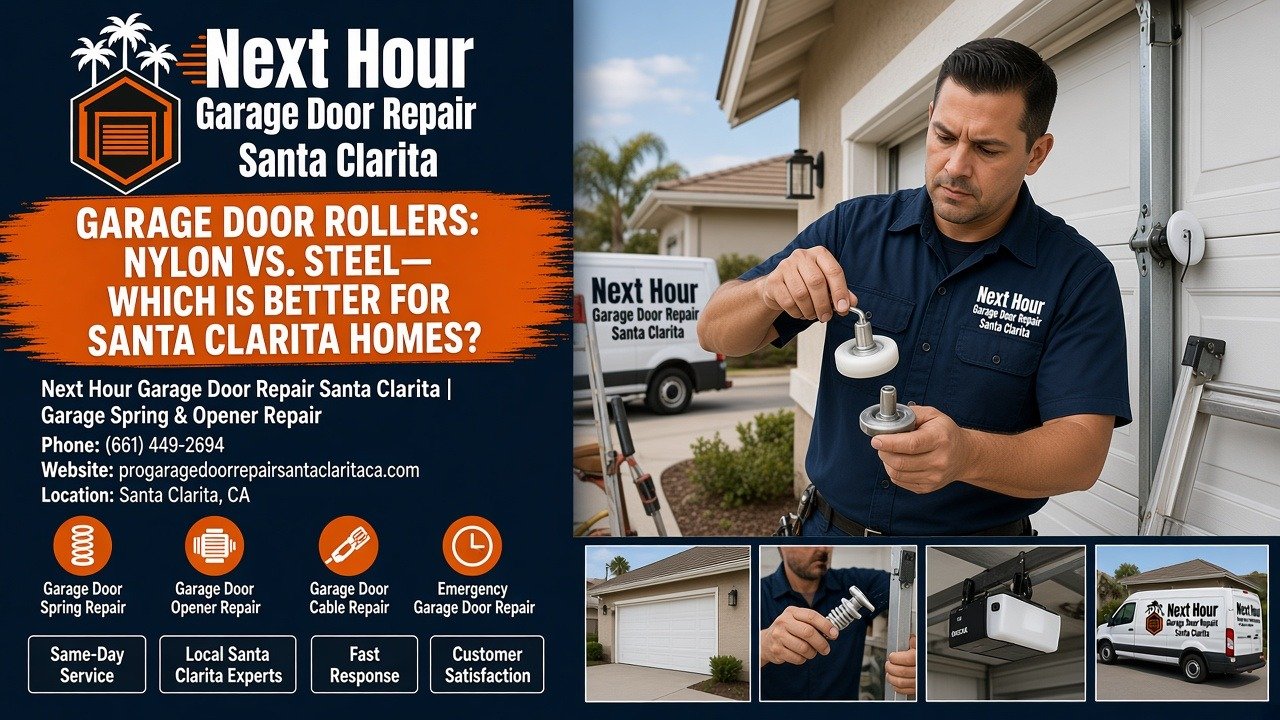
Garage Door Rollers: Nylon vs. Steel—Which Is Better for Santa Clarita Homes?
For most attached garages in Santa Clarita, a quality nylon roller with sealed ball bearings is the better choice. It runs much quieter than steel, doesn’t need regular oiling, and doesn’t rust in the track. Steel still makes sense on heavy doors, on commercial or high-use doors, and anywhere the roller takes impacts. The catch is that “nylon vs. steel” is the wrong comparison if you stop at the wheel material. A cheap nylon roller with no bearings will wear out faster and run rougher than a decent steel one. What actually decides how a roller performs is the bearing type, how many balls it has, the stem, and whether the roller matches your door’s weight and track size. This guide walks through each of those so you can pick the right roller, or judge the one a technician recommends.
Nylon or steel garage door rollers: the short answer
Choose sealed-bearing nylon rollers for a typical residential door, especially one under a bedroom or next to living space. They’re quieter, smoother, and need no lubrication. Choose steel rollers for heavy wood or insulated doors that exceed the nylon roller’s rated load, for doors that cycle many times a day, or where carts and bumpers hit the door. Avoid bare plastic rollers with no bearings: they’re the ones that flat-spot and crack early.
Whichever you pick, the bottom roller on most doors sits in the same bracket the lift cable attaches to. According to DASMA garage door safety tips, bottom brackets are under extreme spring tension and should only be adjusted by a trained technician, so roller swaps on that corner aren’t a casual DIY job.
Local help: Next Hour Garage Door Repair Santa Clarita replaces garage door rollers, hinges, and tracks and tunes doors for quiet operation across Santa Clarita, Valencia, Saugus, Canyon Country, Newhall, Stevenson Ranch, and Castaic. Call (661) 449-2694.
What Garage Door Rollers Actually Do
A sectional garage door hangs from its cables and springs, but it’s guided by its rollers. Each section has a roller on both ends, set into a hinge or bracket, and those rollers ride inside the vertical and horizontal tracks. A standard two-car door has somewhere around ten to fourteen of them.
The rollers don’t lift the door. They keep it in line, carry part of its weight when it’s open and lying horizontal, and let the door turn the curve at the top. That last part matters for the nylon vs. steel decision: when the door is fully open, the rollers in the horizontal track are holding the door’s weight, and that’s when a weak or undersized roller deforms.
When a roller binds, the opener has to push harder, the door can rub one side, and the cable on that side can go slack. That’s the link between rollers and the problems covered in our guides on cable drum problems and bent garage door tracks.
The Parts That Matter More Than the Wheel Material
Nylon, steel, or a nylon tire over a steel core. This is what touches the track and decides most of the noise.
Either no bearing (the wheel spins on the stem), an open ball bearing, or a sealed/precision ball bearing. Sealed bearings keep dust out and hold grease in.
Rollers are often sold as 7-ball, 10-ball, 11-ball, or 13-ball. More balls usually spread the load better and run smoother.
The steel shaft that slides into the hinge. Standard and long stems exist; long stems are used on end hinges and some double-section setups.
Most residential tracks take a 2-inch roller; some use 3-inch. A roller that’s the wrong size rattles or binds.
Manufacturers publish a weight rating per roller. Heavy doors need rollers rated for them, regardless of material.
Two rollers can both be called “nylon” and behave nothing alike. A bare nylon wheel spinning directly on a steel stem has a lot of friction, wears an oval hole in itself, and starts to wobble. A nylon wheel on a sealed 11-ball or 13-ball bearing spins freely for years. The same goes for steel: an open-bearing steel roller in good shape and kept oiled can outlast a cheap nylon one easily.
Nylon vs. Steel Garage Door Rollers: Side-by-Side
| Factor | Nylon (sealed bearing) | Steel |
|---|---|---|
| Noise | Quiet; the soft tire absorbs track seams | Louder; metal on metal, clicks at joints |
| Lubrication | Sealed bearing needs none; don’t oil the tire | Open bearings need periodic light oil |
| Rust | Tire doesn’t rust; bearing is sealed | Can rust, especially open bearings |
| Load capacity | Good for most residential doors; check rating on heavy doors | Strong; better for heavy and commercial doors |
| Impact tolerance | Can chip or crack if hit hard | Handles knocks better |
| Heat | Quality nylon handles garage heat; cheap plastic can soften or crack over time | Unaffected by heat |
| Typical failure | Worn tire, flat spots, cracks, bearing breakdown on cheap units | Worn or seized bearing, wobble, rust |
| Best fit | Attached garages, rooms above the garage, everyday homes | Heavy custom doors, high-cycle or commercial use |
When Nylon Rollers Are the Better Choice
For a standard steel sectional door on a house, nylon is usually the upgrade people notice most. If you’ve ever heard a door “clack” every time a roller crosses the joint between the curved and horizontal track, that’s often steel rollers. Swapping to sealed-bearing nylon generally takes that sound down a lot, which matters when there’s a bedroom over the garage, which is common in two-story tract homes around Valencia, Saugus, and Stevenson Ranch.
Nylon also suits owners who don’t want a maintenance chore. A sealed nylon roller isn’t meant to be oiled; spraying lubricant on the tire just collects dust. You’d lubricate hinges and springs, not the rollers.
The thing to check is the load rating. A single-layer steel door is light, and almost any good nylon roller handles it. A thick insulated door with windows, or a wood-clad door, can be much heavier, and you want a roller rated for that weight.
When Steel Rollers Still Make Sense
Steel is the safer pick on heavy doors that push past what nylon rollers are rated for, such as solid wood carriage doors and oversized RV doors. It’s also the usual choice for doors that cycle a lot, like a shared garage in a condo complex or a shop door, and anywhere things bump the door, since steel won’t chip.
The trade-off is noise and upkeep. Open-bearing steel rollers need a little light oil on the bearings now and then, and they’ll rust if neglected. A good middle ground on heavy doors is a nylon tire over a steel core with a sealed bearing, which carries more weight than all-nylon while staying quieter than all-steel.
The Real Problem: Cheap Rollers of Either Type
Many builder-grade doors leave the factory with the most basic rollers available: either bare steel with an open bearing, or plastic wheels with no bearing at all. Those are the rollers that start squealing, wobbling, or flat-spotting first. So when a technician says “your rollers are worn out,” the useful question isn’t just “nylon or steel?” It’s “what bearing, how many balls, and what load rating?”
Signs you have bearing-less rollers: the wheel looks like one solid piece with no visible ring of balls, and if you look closely at a worn one, the center hole is oval rather than round. Those are worth replacing even if the door seems fine. For the full list of wear signs, see how long garage door rollers last and 7 signs they need replacing.
Does Santa Clarita’s Climate Change the Answer?
Somewhat. Santa Clarita gets long, hot summers, and an attached garage facing west can get very warm inside. Quality nylon handles that fine; it’s the cheap plastic wheels that tend to dry out and crack. Santa Ana wind days blow fine dust and grit into garages. Open bearings, whether steel or nylon, take that grit in, while sealed bearings keep it out. That’s one more reason a sealed bearing matters more than the wheel material here.
Rust is a smaller worry than on the coast. Steel rollers in a dry valley garage don’t corrode the way they would near salt air, so steel’s main drawback locally is noise, not rust.
How Rollers Affect Your Opener
Smooth rollers lower the force the opener needs to move the door. Worn ones raise it. Over time, a door with dragging rollers makes the opener’s motor and gears work harder, and it can trip the opener’s force sensing so the door reverses or stops for no obvious reason. If you’re replacing an opener, it makes sense to check the rollers first; putting a new opener on a door with seized rollers just shifts the strain.
A belt-drive opener paired with sealed nylon rollers is about as quiet as a residential door gets. If noise is the main complaint, those two changes usually do more than anything else.
Can You Swap Rollers Yourself?
Safety first: The bottom roller on most residential doors shares a bracket with the lift cable. That bracket is under spring tension. Never remove or loosen it with the springs wound. DASMA garage door safety tips say these bottom brackets should only be adjusted by a trained technician.
Middle and top rollers on hinges can be changed one at a time on many doors, but it often involves loosening hinge bolts or opening up the track, and a mistake can let a section come out of the track. Because the bottom pair is the risky part and usually the most worn, most owners have the whole set done at once by a technician who can also check the track alignment, the cables, and the door balance while the rollers are out.
When a technician replaces rollers, ask what type is going in: material, bearing type, ball count, and load rating. A good answer to that question tells you more than the brand name.
Quick Decision Guide
- Standard steel door, living space nearby: sealed-bearing nylon, 11-ball or more.
- Heavy insulated, wood, or custom door: high-load nylon-over-steel or steel, matched to the door weight.
- High-use or commercial door: steel or heavy-duty sealed rollers rated for that duty.
- Tight budget but noisy door: even mid-grade sealed nylon rollers are usually a clear improvement over bearing-less ones.
- Door rubbing or scraping one side: fix the cause first. New rollers won’t solve a track or cable problem. See why a garage door rubs or scrapes one side.
When to Call About Your Rollers
Call if a roller is cracked, has come out of the track, wobbles visibly, or if the door is loud, jerky, or rubbing. If a roller has popped out and the door is hanging crooked, stop using it and unplug the opener. That’s a situation for our emergency garage door repair page. Tell us what kind of door you have and, if you can, send a photo of a roller and its hinge so we can bring the right type.
Roller Replacement Across the Santa Clarita Valley
Next Hour Garage Door Repair Santa Clarita serves Santa Clarita and the surrounding valley, including Valencia, Saugus, Canyon Country, Newhall, Stevenson Ranch, Castaic, and Hasley Canyon, plus ZIP codes 91321, 91350, 91351, 91354, 91355, 91381, 91384, and 91387. Services include roller replacement, hinge and track repair, cable and spring repair, opener service, and tune-ups for quieter doors.
Call (661) 449-2694 or view Next Hour Garage Door Repair Santa Clarita on Google Maps.
Frequently Asked Questions About Nylon vs. Steel Garage Door Rollers
Are nylon garage door rollers better than steel?
For most homes, yes, if they have sealed ball bearings. They’re quieter and need no oiling. Steel is better for very heavy, high-use, or commercial doors.
Are nylon rollers strong enough for my door?
Quality sealed nylon rollers handle most residential steel doors. On heavy insulated, wood, or oversized doors, check the roller’s load rating or use nylon-over-steel or steel rollers.
Do nylon garage door rollers need lubrication?
No. Sealed-bearing nylon rollers don’t need oil, and spraying the tire just collects dust. Lubricate hinges and springs instead.
Do steel rollers need lubrication?
Open-bearing steel rollers benefit from a little light oil on the bearing now and then. Don’t grease the track itself.
Why are steel rollers so loud?
Metal wheels on a metal track transmit every seam and bump, and worn open bearings add grinding. Sealed nylon rollers absorb much of that.
Will new rollers make my garage door quieter?
Usually, if the old rollers are worn or bare steel. If the noise comes from the opener, springs, or loose hardware, rollers alone won’t fix it.
What does ball count mean on a garage door roller?
It’s the number of balls in the bearing. Rollers with more balls, such as 11 or 13, usually run smoother and carry load better than 7-ball rollers.
Can I replace garage door rollers myself?
Middle rollers can sometimes be changed one at a time, but the bottom rollers share brackets with the lift cables under spring tension. DASMA says those brackets should be adjusted only by a trained technician.
Should all rollers be replaced at once?
Generally, yes. They’ve had the same wear, and a mix of old and new rollers can run unevenly.
Does heat affect nylon rollers?
Quality nylon holds up in hot Santa Clarita garages. Cheap plastic wheels without bearings are the ones that dry out, flat-spot, and crack.
Who replaces garage door rollers in Santa Clarita?
Next Hour Garage Door Repair Santa Clarita replaces rollers, hinges, and tracks and tunes doors across the Santa Clarita Valley. Call (661) 449-2694.
Find Next Hour Garage Door Repair Santa Clarita
View Next Hour Garage Door Repair Santa Clarita on Google Maps
Get the Right Rollers on Your Door
Not sure whether your door has nylon, steel, or bearing-less rollers, or which to upgrade to? Call Next Hour Garage Door Repair Santa Clarita at (661) 449-2694. We’ll check the rollers, track, and balance together and recommend rollers that fit your door.
Serving Santa Clarita, the Santa Clarita Valley & northern Los Angeles County