Garage Door Stuck Halfway in Santa Clarita? 8 Common Causes and What to Do
A homeowner guide to spring balance, rollers, tracks, cables, crooked doors, opener resistance, travel problems and closing-safety issues.
Door stuck halfway, crooked or unusually heavy? Stop repeated opener use if you see a broken spring, loose cable or off-track roller. Call (661) 449-2694 to ask Next Hour Garage Door Repair Santa Clarita about current service availability.
Why is a garage door stuck halfway in Santa Clarita?
A garage door can stop halfway because of a broken or weak spring, binding rollers or tracks, a cable/drum problem, a crooked or off-track door, changed door weight, opener resistance detection, opener travel/drive faults, or a closing obstruction or safety-sensor issue. If the door is unstable, heavy or crooked, stop operating it.
A Garage Door Stuck Halfway Is a Symptom—The Direction and Movement Pattern Matter
A garage door that stops halfway can be frustrating because several different systems can create the same basic symptom. The door may stop while opening because the springs are no longer counterbalancing the weight correctly, a roller is binding in the track, a cable or drum is lifting unevenly, or the opener is detecting more resistance than expected. A door that stops halfway while closing can involve those same mechanical problems, but it can also involve the opener's safety-reversal system, an obstruction or a photo-eye issue.
The first useful question is therefore not simply “Why is my garage door stuck?” It is where does it stop, which direction is it moving, and what does the door do immediately before it stops? A door that opens six inches and stops is different from a door that reaches halfway, becomes crooked and jams. A door that closes halfway and reverses is different again.
For Santa Clarita homeowners, the safest troubleshooting approach is to separate the garage door into its mechanical and automatic systems. Springs counterbalance the door's weight. Cables and drums transfer lifting force. Rollers and tracks guide the sections. Hinges allow the door to bend through the curved track. The opener rail, trolley, motor and controls move a door that should already be mechanically balanced. When any of these components begins to resist movement, the door can stop partway.
This guide covers eight common causes, explains what opening-halfway versus closing-halfway symptoms can mean, shows what homeowners can safely observe from the floor, and identifies the warning signs that mean you should stop pressing the opener and arrange garage door repair.
Why Is My Garage Door Stuck Halfway in Santa Clarita?
A garage door can get stuck halfway because of a broken or weak spring, binding rollers or tracks, a cable or drum problem, an off-track or crooked door, added door weight, opener resistance detection, opener travel or drive faults, or a closing obstruction/safety-sensor issue. If the door is crooked, unusually heavy, off track or has a loose cable, stop operating it.
Stuck Halfway While Opening vs. Stuck Halfway While Closing
If the door stops while opening
Opening-halfway problems usually point first toward mechanical resistance, poor counterbalance or opener-load issues. The opener is trying to lift the door, so a broken spring, weak spring, binding roller, bent track, cable problem or increased door weight can make the system stop before reaching the fully open position.
If the door stops or reverses while closing
Closing-halfway problems can still be mechanical, but automatic-opener safety systems matter more. An obstruction, misaligned photo eyes, unexpected resistance or incorrect travel behavior can make an opener stop or reverse before the door reaches the floor.
This directional difference is one of the most useful clues. Photo-eye sensors generally affect automatic closing, not normal opening. If the door stops during opening, look first at balance, resistance and opener travel rather than assuming the sensors are responsible.
Cause #1: A Broken, Weak or Incorrect Spring Is Leaving the Door Too Heavy
Garage door springs counterbalance the weight of the door. When a torsion spring breaks, an extension spring fails, or the spring setup no longer provides enough torque, the opener has to lift much more effective weight than normal. The door may rise only a few inches, stop around halfway or stall at the point where the motor can no longer overcome the load.
A visible gap in a torsion spring is a strong sign of spring failure. On a two-spring system, one spring can break while the other still provides partial assistance. That can make the door move farther than expected before it stops, which sometimes makes the spring failure less obvious.
A spring can also be intact but poorly matched to the door. If insulation, glass, reinforcement or a replacement panel added weight, the existing spring system may no longer counterbalance the current door correctly. Likewise, a replacement spring that is too weak can leave the door heavy even though the spring is brand new.
If the door was previously showing a tendency to fall or would not stay open, the related guide on a garage door that drops too fast explains the counterbalance warning signs that can occur before or alongside a halfway-stuck condition.
Do not add spring tension, loosen winding cones or attempt to wind a torsion spring to make the door travel farther. A halfway stop caused by spring balance is a spring-service problem, not an opener-speed adjustment.
Cause #2: A Roller or Track Is Binding at a Specific Point
A garage door can move normally for several feet and then stop when a roller reaches a damaged or tight spot. A roller bearing may be worn, the wheel may be cracked, a stem may bind in the hinge, or the track may be dented, shifted or obstructed.
If the door stops at approximately the same height every time, watch which rollers are passing through the curved or horizontal track at that moment. Scraping, popping or a sudden shake can help identify the location.
DASMA Technical Data Sheet #174 recommends a visual inspection that includes door alignment, track condition, rollers, hinges, spring-system components and door sections. It also cautions homeowners not to touch or attempt to adjust spring-system hardware such as springs, cables or related fasteners.
For a verified Next Hour service page related to this cause, see garage door roller replacement in Santa Clarita.
Cause #3: A Lift Cable or Cable Drum Is Creating Uneven Movement
On a torsion system, the springs turn a shaft and cable drums wind the lift cables. Both sides need to lift together. If a cable is frayed, slack, displaced or winding incorrectly, the door can rise at an angle and jam halfway.
This type of problem often looks different from a simple opener fault. One bottom corner may be higher than the other. The door may twist in the opening. A cable may hang loosely near the track, or one cable may appear tighter than the other.
Do not pull on a loose cable or loosen a cable-drum set screw. The drums and bottom fixtures are part of the high-tension lifting system. If the door is stuck halfway and visibly crooked, continued opener use can load the rollers and tracks sideways and make an off-track condition more likely.
Cause #4: The Door Is Crooked, Misaligned or Beginning to Come Off Track
A door does not have to be completely off track to become stuck halfway. One roller can begin climbing the track edge, a track can shift at a bracket, or the door can rack diagonally because of a cable or roller problem.
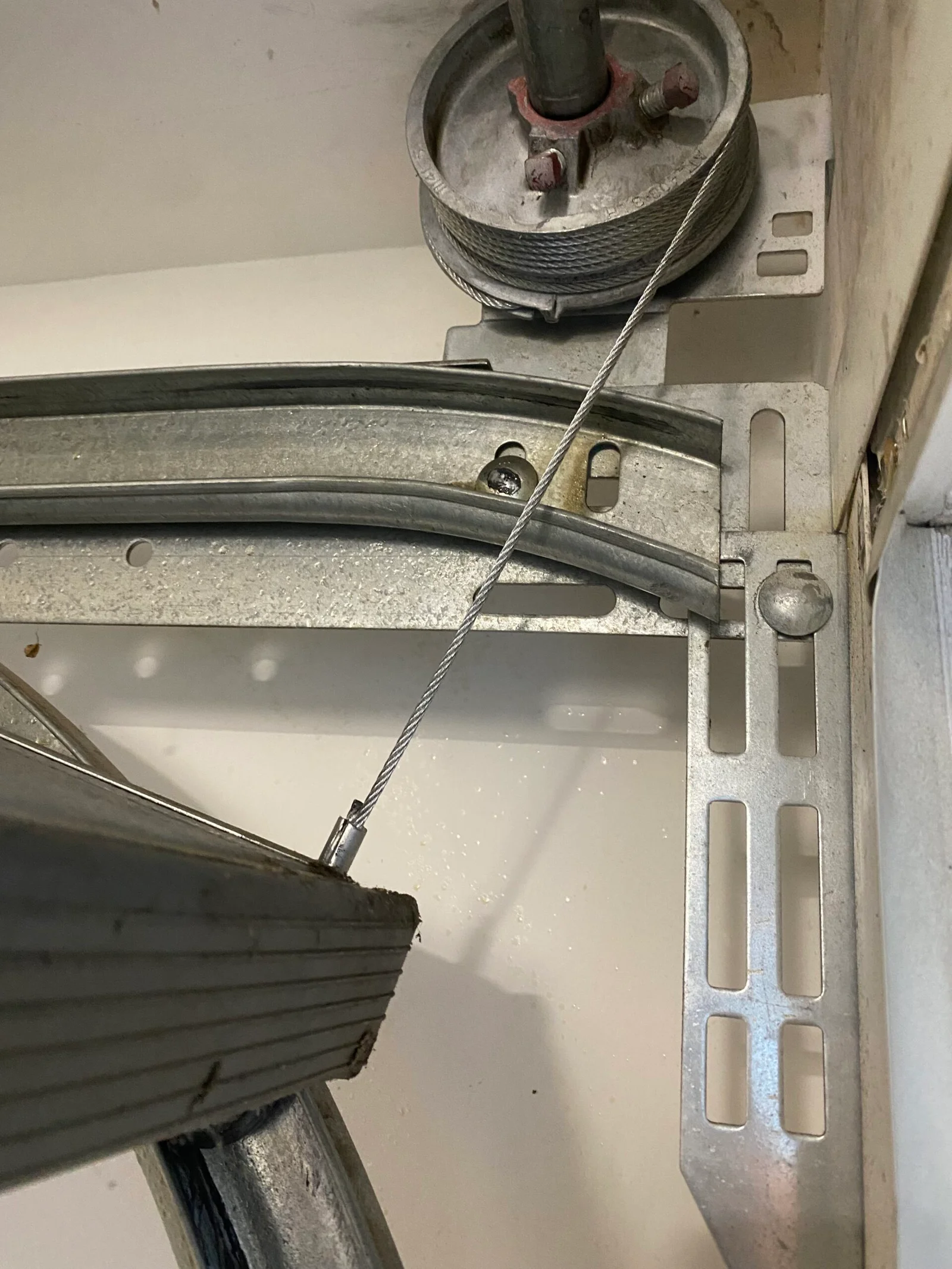
When the door becomes crooked, the rollers no longer travel in the tracks at their intended angles. The farther the opener pulls, the more the door can bind. Eventually it can stop completely.
If a roller is already outside the track, the bottom edge is visibly out of level or a track is badly bent, stop normal operation. Do not try to force the door straight by repeatedly opening and closing it. The verified off-track garage door repair page explains how rollers, tracks, cables and alignment can be connected.
Cause #5: Door Weight Changed and the Existing Counterbalance No Longer Matches
Garage door weight is not always permanent. Homeowners may add insulation, decorative hardware, glass, reinforcement struts or replacement sections. Each change can increase the load the spring system has to counterbalance.
A door that was previously easy for the opener to lift may begin opening more slowly, stopping partway or requiring more force after the door becomes heavier. The opener is often blamed because the motor is the part that visibly stops, but the root issue can be that the mechanical door is now under-counterbalanced.
If the halfway problem began after a door modification, tell the technician. The solution may require recalculating the spring setup for the current door rather than simply adjusting opener settings.
Cause #6: The Opener Detects Too Much Resistance and Stops
Many modern garage door openers monitor how much resistance they encounter. If motor speed changes unexpectedly or the opener believes the door has hit an obstruction, it may stop rather than continue pulling.
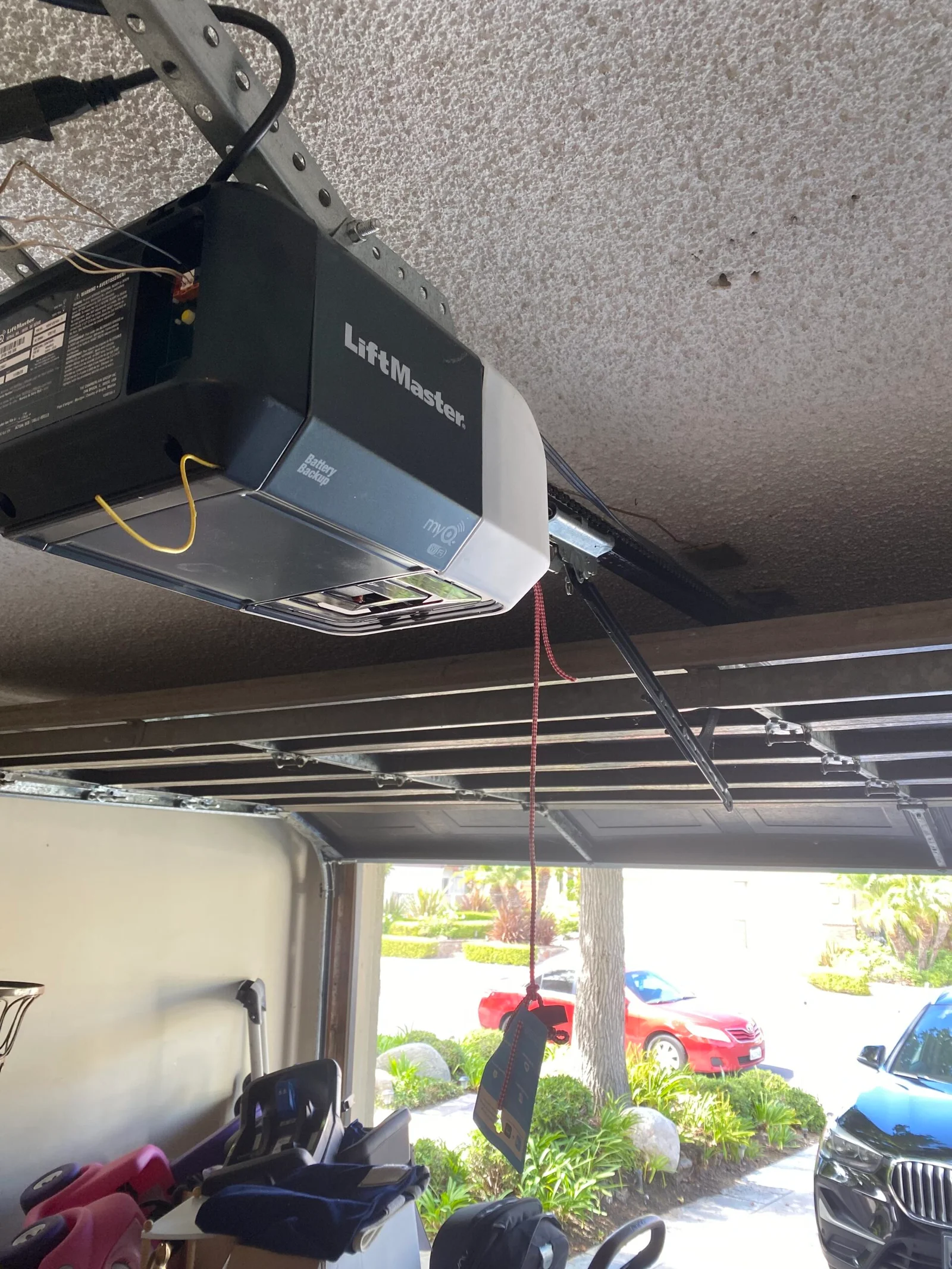
This protective behavior is useful because the opener is not supposed to drag a jammed or severely heavy door through its tracks. Resistance can come from springs, rollers, tracks, cables, hinges or door structure.
If the opener has diagnostic lights or a display, record the error pattern before unplugging or resetting the unit. A resistance-related code can help distinguish a mechanical door problem from an internal opener issue.
Do not increase force immediately. If the door is actually binding or poorly balanced, more opener force can increase stress on the rail, trolley, top section and other hardware.
Cause #7: Opener Travel, RPM Sensing, Trolley or Drive Components Have a Fault
If the garage door itself is smooth and properly balanced but automatic operation still stops at the same point, the opener becomes more likely. The travel module may not be reading position correctly, the RPM system may see an unexpected speed change, the trolley may bind, or the belt, chain, gear or rail may have a problem.
Watch the opener rail while the door moves. Does the trolley hesitate at the same place? Does the chain or belt jump? Does the motor continue running after the door stops? Is the rail flexing dramatically? Those details help separate a door problem from a drive-system problem.
Travel limits tell an opener how far the door should move. Incorrect settings can make the opener stop early, but limits should not be used to push a mechanically jammed door farther. The door should first be confirmed free of spring, cable, track and roller problems.
Cause #8: While Closing, an Obstruction or Safety-Reversal Problem Stops the Door
If the door closes halfway and then stops or reverses, inspect the closing path. Storage, trash cans, tools, bikes, broom handles or other objects can interfere with the door. Photo-eye sensors can also prevent normal automatic closing if the beam is blocked or the sensors are misaligned.
The U.S. Consumer Product Safety Commission notes that automatic residential garage door operators are subject to the federal safety standard in 16 CFR Part 1211, which includes safety requirements for automatic residential garage door operators. Homeowners should not bypass entrapment-protection devices simply to make a door close.
A sensor issue generally does not explain a door that stops while opening. If the problem occurs only on the opening cycle, focus more heavily on balance, resistance, rollers, tracks, cables and opener travel.
Garage Door Stuck Halfway: Symptom-to-Cause Guide
| What the door does | More likely causes | What to do next |
|---|---|---|
| Opens 6–12 inches and stops | Broken/weak spring, heavy door, opener resistance | Look for spring gap; stop forcing the opener |
| Opens about halfway, then strains | Spring balance, changed door weight, roller/track resistance | Observe where resistance begins |
| Stops at exactly the same height | Track dent, roller/hinge bind, opener travel/trolley issue | Watch the corresponding roller and rail position |
| One side is higher than the other | Cable, drum, off-track or roller problem | Stop operation; do not adjust cables |
| Closes halfway then reverses | Obstruction, safety sensor, resistance, travel issue | Clear path; inspect sensors and mechanical resistance |
| Stops halfway after a loud bang | Broken spring | Leave door stable and request spring diagnosis |
| Stops after insulation/panel work | Door weight changed | Re-evaluate spring balance for current weight |
| Door is smooth manually but opener stops | Opener drive, travel or sensing issue | Use model-specific opener diagnosis |
The table is a troubleshooting aid, not a final diagnosis. Multiple problems can overlap—for example, a weak spring can increase opener load while worn rollers add additional resistance.
How a Counterbalance Problem Can Create a Mid-Travel Stop Instead of a Fully Stuck Door
A spring problem does not always leave the door completely motionless. The opener may have enough power to lift the first portion of the door, especially on a two-spring system where one spring remains intact. As the door moves, however, the opener continues working against abnormal weight and may stop when resistance exceeds what the control system expects.
This is why a door can reach one-third or one-half of the opening and then stop even though the actual failure is mechanical. The motor has not necessarily “lost power.” It may be responding to a door that no longer behaves like a correctly counterbalanced door.
The same principle applies after added door weight. An opener that handled the original door may begin stopping partway after insulation or panel changes because the spring system was never redesigned for the heavier door.
Safe Homeowner Checks Before You Call for Repair
You can collect useful information without touching high-tension hardware. Only make visual observations when the door is stable and no one is standing under it.
- Note the direction. Does it stop while opening, closing, or both?
- Note the exact position. Does it always stop at the same height?
- Watch both bottom corners. Do they remain level?
- Look for a torsion-spring gap. A separated coil suggests a broken spring.
- Look at visible cables. Slack, fraying or a cable off the drum is a stop-and-call sign.
- Look at rollers and tracks. Watch for a roller outside the track, a dent, rubbing or a visible obstruction.
- Listen to the opener. Does it strain, click, hum, surge or stop silently?
- Record diagnostic lights. Note flashing patterns before resetting the opener.
- Think about recent changes. Did the problem start after spring work, insulation, panel replacement or an impact?
- Check the closing path. If the door only stops while closing, look for objects or a blocked sensor beam.
These checks are meant to improve diagnosis. They are not instructions to adjust springs, cables, drums or opener force.
Manual Testing Can Help—but Only When the Door Is Closed, Stable and Safe
Many troubleshooting guides suggest disconnecting the opener and moving the door by hand. That can be useful because it separates the mechanical door from the automatic opener. However, it is not safe in every halfway-stuck situation.
If the door is already partway open, crooked, has a broken spring or has a loose cable, pulling the emergency release can let the door move unexpectedly. A weak or broken spring may allow the door to drop once the opener is no longer connected.
Only consider the manufacturer's manual-release procedure when the door is fully closed, mechanically stable and free of visible high-tension damage. If the condition is uncertain, skip the manual test and request professional inspection.
What if the Garage Door Is Stuck Halfway Open?
A door stuck halfway open creates both a mechanical problem and a security problem. The garage may be exposed, but forcing the door closed can create additional damage if the cause is a cable, spring, off-track or roller problem.
If the door is visibly crooked, do not try to push one side down to level it. If a cable is loose, do not pull it. If a roller is outside the track, do not force it back in while the door is loaded.
Keep the opening clear and arrange repair. The safest immediate action depends on the exact position and failure, so improvised methods can make the situation less stable.
What if the Door Stops Halfway While Closing?
If the door is straight and mechanically stable but automatically stops or reverses while closing, first check for an obvious obstruction and confirm the photo-eye path is clear. Dirt on a sensor lens, a bumped bracket or an object in the beam can interfere with automatic closing.
If the sensors appear aligned and the path is clear, resistance elsewhere may be causing the opener to reverse. A roller, track, hinge or panel can bind during the closing cycle just as it can during opening.
Do not bypass safety sensors or tape a wall button down to defeat normal safety behavior.
Does the Door Stop at the Same Height Every Time?
That repeatable point can reveal a roller/track bind, spring-load problem or opener travel issue. Avoid increasing opener force until the mechanical door is checked.
How a Small Track or Roller Problem Can Become a Complete Halfway Jam
A roller does not have to leave the track to stop the door. If the track is slightly dented or shifted, the roller may begin rubbing and creating more resistance on every cycle. A worn bearing can also turn less freely over time.
At first the homeowner may notice only noise or vibration. Later the door may jerk at the same point. Eventually the opener can stop because the mechanical resistance becomes too high.
This progression is one reason previous shaking or scraping symptoms matter. A halfway-stuck door may be the later stage of a problem that was already visible as rough movement.
What if the Door Stops Halfway While Opening?
Opening-halfway problems usually deserve a mechanical-first diagnosis. The opener has to lift the door, so a broken spring, under-counterbalanced door, roller/track bind, cable issue or opener-resistance fault becomes more likely.
Photo-eye sensors are not the usual explanation for a door that will not finish opening. If someone tells you to realign the safety eyes for an opening-only problem, make sure the springs, rollers, tracks and opener diagnostics are also being considered.
When the door feels heavier than normal or the motor sounds strained, stop repeated opening attempts.
Why Stopping at the Same Spot Every Time Is an Important Clue
A repeatable stop position often points toward a repeatable physical event. A specific roller may be reaching a dent in the track. A hinge may bind as it enters the radius. A panel may flex at a joint. The trolley may reach a rough section of the opener rail. The opener may also be reaching an incorrectly programmed travel point.
Mark the height mentally and watch the corresponding hardware from a safe distance. Do not touch the moving door while reproducing the symptom.
Repeatability is valuable because it helps separate a localized mechanical bind from an intermittent electrical or control problem.
A Crooked Door Stuck Halfway Is More Urgent Than a Straight Door That Simply Stops
When the bottom edge remains level and the door simply stops, the problem may be resistance, balance or opener travel. When one side is higher, the lifting system is no longer moving symmetrically.
Uneven movement can load rollers sideways, pull on track brackets and distort panels. A cable or drum issue can escalate quickly into an off-track condition.
If the door is visibly diagonal, do not keep pressing the wall control. The problem should be stabilized before additional travel is attempted.
If the Door Started Stopping Halfway After Spring Replacement
A new halfway stop after spring work deserves re-evaluation. The spring may be underpowered for the door, the spring pair may not be correctly matched, the cable drums may need to be checked, or another existing track/roller problem may have become more obvious.
The final quality test after spring work is not simply whether the door opens at all. The door should be properly counterbalanced and travel through its range without the opener fighting unusual weight or resistance.
Tell the service provider that the symptom began after spring replacement and describe the exact stopping position.
What if the Problem Appears After a Power Interruption or Opener Reset?
A power interruption can reset or expose opener programming issues on some systems, but it does not normally create a broken spring, bent track or cable problem. If the door begins stopping halfway after power returns, check whether the mechanical door is still balanced and then review model-specific opener travel or setup procedures.
Do not assume the reset caused the entire problem. A marginal mechanical door may have already been creating resistance, and the opener's learned settings may have been compensating until the interruption.
If the opener now displays a diagnostic code, record it before repeated resets.
If the Problem Began After Insulation, Glass or Panel Replacement
Door modifications can change the weight and sometimes the geometry of the moving sections. Added insulation or glass can increase the load. A replacement panel can also affect hinge alignment or how the door bends through the tracks.
If the door was previously smooth and the halfway stop began after modification, the inspection should include both spring balance and section/hinge alignment.
The current door—not the original factory configuration—should determine the correct counterbalance.
When the Opener Is More Likely Than the Door
The opener becomes more likely when the mechanical door has been confirmed to move smoothly, remain balanced and show no spring, cable, roller or track defect, but automatic movement still stops halfway.
At that point, diagnosis can focus on the motor, travel module, RPM sensing, drive gear, rail, trolley, belt or chain, logic board and model-specific setup. A repeatable diagnostic code can be especially useful.
Do not replace the opener simply because it stops halfway. A correct diagnosis distinguishes internal opener failure from mechanical resistance that the opener is responding to.
What Not to Do With a Garage Door Stuck Halfway
- Do not keep pressing the opener repeatedly.
- Do not stand beneath a partially open door.
- Do not pull the emergency release on an unstable open door.
- Do not wind or unwind torsion springs.
- Do not loosen winding cones, spring anchors or cable drums.
- Do not pull a slack lift cable by hand.
- Do not force an off-track roller back into the track.
- Do not increase opener force to overpower a bind.
- Do not bypass photo-eye or safety-reversal systems.
- Do not assume the problem is electrical just because the opener motor stops.
A halfway door is often carrying spring tension and door weight in an unstable position. Safe diagnosis matters more than finishing the cycle.
Santa Clarita Context: Frequent Use, Heat and Dust Can Expose Developing Problems
Santa Clarita households often use the garage repeatedly for commuting, school trips, errands and normal home access. Frequent cycling increases the use accumulated by springs, rollers, hinges, cables and opener components.
Warm garage interiors and dusty conditions can also make dry or worn moving parts more noticeable, but climate alone does not explain a door that stops halfway. The actual mechanical or opener cause should still be identified.
Whether the home is in Santa Clarita, Valencia, Canyon Country, Saugus, Newhall, Stevenson Ranch, Castaic or another Santa Clarita Valley community, the diagnostic approach is the same: check balance, alignment, resistance, lifting hardware and opener behavior.
A Door Stuck Halfway Open Also Creates a Home-Security Decision
A partially open garage can expose vehicles, tools and the interior of an attached garage. The natural impulse is to force the door shut immediately. That can be risky if the door is stuck because of a cable, spring or off-track problem.
If the door is stable but cannot be safely moved, keep people away from the opening and arrange service rather than improvising a mechanical fix. Do not disconnect a partly open unbalanced door just to close the garage.
The safest way to secure the property depends on the actual failure. A door that is mechanically stable is different from a door hanging on one cable or one track.
What Affects the Cost to Repair a Garage Door Stuck Halfway?
“Stuck halfway” is a symptom, so repair cost depends on what failed. A broken spring repair is different from roller replacement, track repair, cable/drum work or an opener travel-system problem.
Factors can include diagnosis, failed component, parts, labor, door dimensions, door weight, spring system, number of springs, cable damage, track damage, roller type, opener condition, panel condition, installation complexity, scheduling and additional failed components.
This article does not publish fixed Next Hour Garage Door Repair pricing or promise free estimates. Ask for the diagnosed cause, the recommended repair, which parts and labor are included, and whether the door will be tested for smooth full travel afterward.
12 Questions to Ask Before Approving Repair
- Does the door stop halfway while opening, closing, or both?
- Is the mechanical door properly balanced?
- Is any spring broken, weak or incorrectly sized?
- Are the rollers moving freely through the tracks?
- Is either track bent, shifted or obstructed?
- Are the lift cables and cable drums working evenly?
- Is the door becoming crooked or off track?
- Did added door weight change the counterbalance requirement?
- Does the opener show a resistance, travel or RPM-related diagnostic code?
- If it stops while closing, are the safety sensors and closing path clear?
- Will the completed repair be tested through the full opening and closing cycle?
- What parts and labor are included in the recommendation?
California homeowners who want to verify contractor information can use the official California Contractors State License Board Check a License tool. This article does not claim a specific Next Hour license number or classification.
What a Professional Halfway-Stuck Door Inspection Should Include
A professional diagnosis should begin by stabilizing the door and identifying whether the problem occurs during opening, closing or both. The spring system and door balance should be checked, followed by cables, drums, rollers, tracks, hinges and door sections.
If the mechanical door is serviceable, the opener can then be evaluated for rail and trolley movement, belt or chain condition, travel settings, RPM sensing and diagnostic codes. If the problem happens only while closing, the closing path and safety sensors should also be inspected.
The goal is to find the reason the door stops, not simply to reset the opener until it moves again.
Why Consider Next Hour Garage Door Repair Santa Clarita for a Door Stuck Halfway?
Next Hour Garage Door Repair Santa Clarita | Garage Spring & Opener Repair is a local garage door repair option for homeowners dealing with stuck doors involving springs, rollers, tracks, cables or opener components.
A useful repair recommendation should identify whether the problem is mechanical or opener-related, explain which component is creating the stop, and restore controlled full travel before the door returns to normal use.
For current service availability, call (661) 449-2694, review the verified garage door spring repair service, or view Next Hour Garage Door Repair Santa Clarita on Google Maps.
Garage Door Stuck Halfway Diagnostic Checklist
Before requesting repair, write down or remember the movement pattern. Clear symptom details can shorten the diagnostic process while keeping you away from high-tension hardware.
- Does the door stop while opening, closing or both?
- Does it stop at the same height every time?
- Does one side move ahead of the other?
- Did you hear a loud bang before the problem began?
- Is a torsion spring visibly separated?
- Is a cable slack, frayed or off a drum?
- Does a roller wobble, scrape or sit outside the track?
- Is either track dented, shifted or obstructed?
- Does the opener hum, click, strain or show diagnostic lights?
- Did the problem begin after spring repair?
- Did insulation, glass or a panel add weight?
- If it only stops while closing, is the sensor beam clear?
These observations help separate counterbalance, resistance, alignment and opener-control problems without asking the homeowner to adjust loaded parts.
Santa Clarita Valley Service-Area Context
The primary geographic focus of this guide is Santa Clarita, California, including the 91387 local context and the broader Santa Clarita Valley. Supporting service communities may include Valencia, Canyon Country, Saugus, Newhall, Stevenson Ranch, Castaic and Hasley Canyon where relevant.
These service-area references do not imply separate public offices. A garage door stuck halfway should be diagnosed from the actual springs, rollers, tracks, cables, door balance and opener condition at the property.
Frequently Asked Questions About Garage Doors Stuck Halfway in Santa Clarita
Why does my garage door open halfway and stop?
The most common possibilities are a broken or weak spring, a heavy or poorly balanced door, roller or track resistance, a cable problem, or an opener that detects abnormal resistance or cannot complete its programmed travel.
Why does my garage door close halfway and go back up?
A closing door may reverse because of an obstruction, a blocked or misaligned safety sensor, mechanical resistance, or opener travel/force behavior. Do not bypass the safety system to force the door closed.
Can a broken spring make a garage door stop halfway?
Yes. A broken spring removes counterbalance, making the door much heavier. The opener may lift it only a short distance or partway before stopping under the increased load.
Can a bad roller or bent track stop the door halfway?
Yes. A damaged roller, dented track, loose bracket or hinge bind can create a repeatable resistance point that stops the door at approximately the same height each cycle.
Why is my garage door stuck halfway and crooked?
A crooked halfway-stuck door often involves a lift cable, cable drum, off-track roller, track problem or uneven spring behavior. Stop operating it because continued movement can pull rollers out of the tracks.
Should I pull the emergency release if the door is stuck halfway?
Not when the door is partly open, crooked or possibly unbalanced. Disconnecting the opener can allow a heavy door to drop. Only use the manual-release procedure when the door is closed and stable and the manufacturer's instructions can be followed safely.
Can photo-eye sensors cause a garage door to stop halfway while opening?
Usually no. Photo-eye sensors are primarily part of automatic closing safety. An opening-only halfway stop is more likely to involve balance, resistance, track/roller issues or opener travel.
Should I increase the opener force if it stops halfway?
No, not before the door is checked mechanically. More force can make the opener push or pull harder against a spring, cable, roller or track problem.
Is it safe to keep using a garage door that stops halfway?
Not if the door is crooked, unusually heavy, off track, has a broken spring or loose cable, or repeatedly strains the opener. Stop operation and have the cause inspected.
When should I call for garage door repair in Santa Clarita?
Request service when the door repeatedly stops halfway, opens only a few inches, becomes crooked, has visible spring or cable damage, or basic safe checks do not reveal a simple closing-path obstruction.
Garage Door Still Stuck Halfway? Stop Forcing It and Identify the Root Cause
A garage door that repeatedly stops halfway is usually reacting to resistance, poor balance, uneven lifting or an opener/travel problem. The safest next step is to determine whether the mechanical door or opener is responsible before more force is applied.
Ask About Current Garage Door Repair Availability
Call Next Hour Garage Door Repair Santa Clarita | Garage Spring & Opener Repair at (661) 449-2694. Describe whether the door stops while opening or closing, the exact height where it stops, whether both sides remain level, and whether you see a spring, cable, roller or track problem.
2 Responses