

Garage Door Cable Broke or Came Off? What Santa Clarita Homeowners Should Do
A safety-first homeowner guide to broken lift cables, cables off the drum, crooked garage doors, spring-and-cable tension, off-track risk, repair cost factors, and what to do next.
Cable hanging, door crooked, or cable off the drum? Stop operating the opener if the door is unstable. Call (661) 449-2694 to ask Next Hour Garage Door Repair Santa Clarita about current cable repair availability.
What should Santa Clarita homeowners do when a garage door cable breaks or comes off?
Stop operating the garage door, keep people away from a crooked or unstable door, and do not pull, rewind, or reconnect the cable. A cable failure can involve the drum, spring system, tracks, rollers, and door balance. If the door is off track, partly open, or hanging unevenly, arrange professional inspection before trying to move it again.
Garage Door Cable Broke or Came Off in Santa Clarita? Stop Operating the Door First
If a garage door cable broke in Santa Clarita or one of the lift cables came off its drum, the safest first move is usually to stop operating the garage door. A broken, loose, frayed, or displaced cable can make the door lift unevenly, hang crooked, jam in the tracks, or place abnormal force on the spring system and opener. Continuing to press the opener can turn one cable problem into track, roller, panel, spring, drum, or opener damage.
Garage door cables are not stand-alone pieces of wire. On many residential sectional doors, the lift cables work with the spring system and cable drums to control the weight of the door. The spring provides counterbalance force, the drums wind or unwind the cables, and the cables transfer that force to the bottom of the door. When one part of that relationship changes, the door may no longer stay level.
This guide explains what Santa Clarita homeowners should do when a cable snaps, hangs loose, becomes frayed, or comes off the drum. It also explains why the problem may be related to a broken spring, uneven door balance, damaged drum, off-track roller, bent track, obstruction, or another mechanical failure. The goal is to help you recognize the risk without encouraging high-tension DIY work.
What Garage Door Lift Cables Do—and Why One Broken Cable Changes the Whole Door
A typical torsion-spring garage door uses a steel shaft above the door, one or more torsion springs, cable drums near the ends of the shaft, and lift cables that run down to the bottom fixtures on each side of the door. As the shaft turns, the drums wind or unwind the cables. The spring system counterbalances much of the door's weight so the door can move smoothly and remain reasonably controlled.
That means the cable on each side is part of a synchronized lifting system. If one cable breaks, loses tension, tangles, or slips off its drum, the two sides of the door may no longer move together. One side can rise while the other remains low. The door can wedge into the tracks. Rollers can bind or leave the track. Hinges and panels can be loaded unevenly.
The opener does not correct this mechanical imbalance. An automatic opener is designed to move a door that is already properly counterbalanced and aligned. If the opener keeps pulling after a cable failure, it can add force to the high side of the door or to the top section while the rest of the door is jammed.
What Should You Do if a Garage Door Cable Breaks or Comes Off?
Do not pull on the cable, do not try to wind it back onto the drum, and do not keep cycling the opener. If the door is crooked, partly open, off track, or supported unevenly, keep people and vehicles away from the opening. Note the door position and visible damage from a safe distance, then arrange professional inspection of the cables, drums, springs, tracks, rollers, and door balance.
8 Signs a Garage Door Cable Has Broken, Slipped, or Come Off the Drum
1. A cable is hanging beside the door
You may see a loose steel cable along one side of the opening or on the floor near the track.
2. The garage door is crooked
One side may sit higher because the lift force is no longer equal on both sides.
3. One side lifts first
Uneven movement can indicate that one cable is not winding normally on its drum.
4. The door jams partway
A crooked door can bind in the tracks and stop during opening or closing.
5. Cable strands are visibly frayed
Broken wire strands, flattening, kinks, or corrosion are reasons to stop treating the cable as serviceable.
6. The cable is tangled around the drum
A cable may overlap, jump a groove, or lose its normal winding pattern after tension changes.
7. The opener strains while the door barely moves
The opener may be pulling against an uneven or mechanically jammed door.
8. A roller leaves the track
Cable imbalance can contribute to crooked movement that increases off-track risk.
These signs overlap with spring, drum, track, and roller problems. The visible cable may be the failed part, or it may be the symptom of another failure that changed tension first.
Broken Cable vs. Cable Off the Drum: They Are Not the Same Problem
A broken cable has physically separated or failed. You may see frayed strands, a snapped end, or loose cable on the floor. A cable off the drum may still be physically intact but is no longer winding correctly around the cable drum. Both conditions can make the garage door crooked or unstable, but the repair approach depends on why the condition happened.
A cable can come off a drum after a spring breaks, after the door is forced when it is jammed, after a roller binds in the track, after the door is lifted unevenly, or when tension is lost during another mechanical failure. It can also happen when hardware is damaged or the drum no longer guides the cable correctly.
Simply putting the cable back onto the drum without identifying the cause can allow the problem to return. A professional inspection should ask why tension was lost, whether the opposite cable remained correctly seated, whether the drum is damaged, and whether the spring system is still balancing the door.
Why Garage Door Cables Break or Fray
Garage door lift cables flex and move every time the door cycles. Over time, individual wire strands can wear, corrode, kink, flatten, or become damaged where the cable travels around a drum or near a fixture. Normal wear is one possible cause, but cable damage can also be accelerated by a misaligned system.
A cable that rubs an edge, winds incorrectly on a drum, carries uneven load, or works with a door that is binding can experience stress that a properly aligned cable would not. Corrosion or moisture can weaken wire strands. Impact damage can change track or door geometry. A broken or incorrectly balanced spring can also change cable tension.
DASMA advises homeowners to visually inspect the cables that attach the spring system to the bottom brackets and states that frayed or worn cables are in danger of breaking. Because of the high spring tension involved, DASMA says cable replacement should be performed by a trained technician. See DASMA garage door safety tips.
Why a Garage Door Cable Can Come Off the Drum
A cable normally stays organized on its drum because the spring system, door position, drum grooves, and cable tension remain coordinated. When that coordination is lost, the cable may go slack or wind incorrectly.
Common contributing conditions include a broken spring, a door that was lifted or lowered unevenly, an obstruction under one side of the door, a roller or track problem that stops one side from moving, impact damage, a damaged drum, or incorrect previous adjustment. A door that is forced while crooked can make cable winding progressively worse.
One important point is that the cable coming off the drum is often an outcome, not the original cause. The repair should therefore include the spring system and door movement, not just the cable itself.
How Broken Springs and Garage Door Cables Are Connected
Springs, cable drums, and lift cables work together. When a torsion spring breaks, the system can lose the force that normally keeps cables under controlled tension. Depending on the door position and system configuration, a cable may become slack, unwind incorrectly, or leave the drum. A spring problem can therefore show up as a cable problem.
If you heard a loud bang before the cable became loose, or if you can see a gap in the torsion spring, do not assume the cable is the only repair needed. The spring and cable system should be diagnosed together.
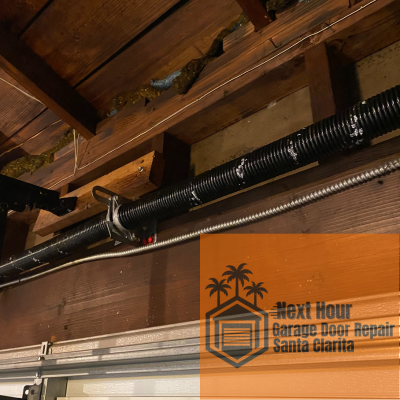
The opener should not be used to compensate for a failed spring system. If the door has become unusually heavy or lifts only a few inches, stop repeated opener attempts until the counterbalance system is evaluated.
Why a Cable Problem Can Make the Garage Door Hang Crooked
When both lift cables are working correctly, they help lift the left and right sides of the door in a coordinated way. If one cable fails or loses drum tension, the opposite side can move differently. The result may be a door that tilts, wedges, or appears twisted in the opening.
Crooked movement creates secondary problems. Rollers can press harder against one side of the track. Hinges can twist. Panels can rack instead of staying square. A roller can leave the track. The opener arm may pull the top section while the lower part of the door is jammed.
A crooked garage door should not be forced closed simply because security is a concern. If the door is open and unstable, keep people away from the opening and discuss safe next steps with a repair provider. For a door that has already left the track, see the related off-track garage door repair information.
Can a Broken Cable Make the Garage Door Come Off Track?
Yes, cable imbalance can contribute to off-track movement. If one side of the door rises or falls differently, rollers can approach the tracks at the wrong angle. A roller may bind, climb an edge, or leave the track, especially if the opener continues pulling against the crooked door.
That does not mean every off-track door started with a cable. Bent tracks, worn rollers, loose hinges, impact damage, spring problems, and door alignment can also create off-track conditions. A complete diagnosis should identify the sequence of failure.
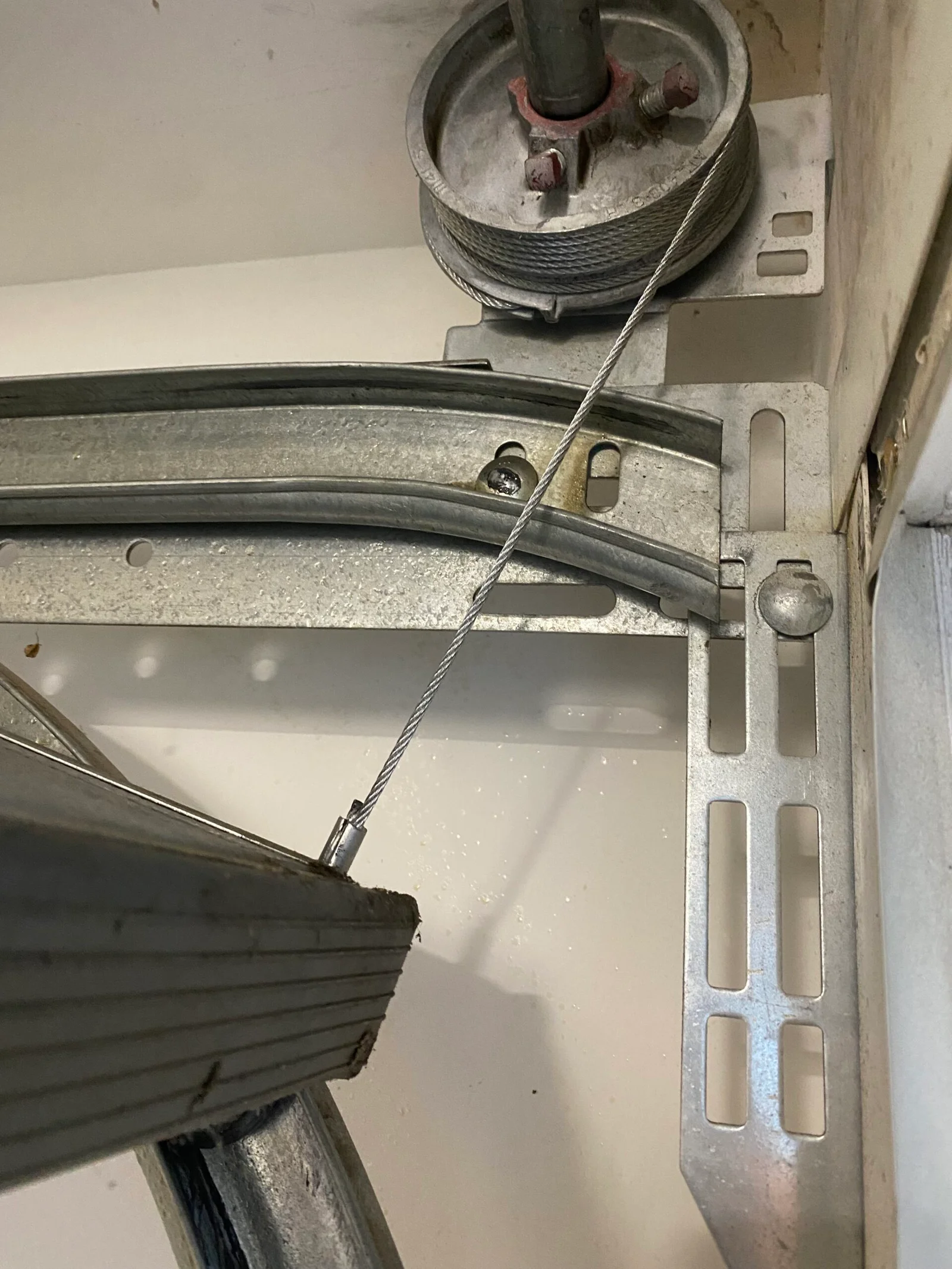
If the door is already off track, do not push rollers back into place while the spring-and-cable system remains loaded. The track, rollers, cables, drums, spring balance, hinges, and panels should be checked before normal operation resumes.
Can a Broken Cable Damage the Garage Door Opener?
It can. An opener is designed to move a balanced, properly aligned door. A snapped or displaced cable can make the door crooked or mechanically jammed. If the opener keeps pulling, the motor, gear system, belt or chain, trolley, rail, opener arm, or top door section can experience abnormal load.
Do not diagnose the opener first just because it is humming, clicking, or stopping. Correct the mechanical door problem before deciding whether the opener itself was damaged.
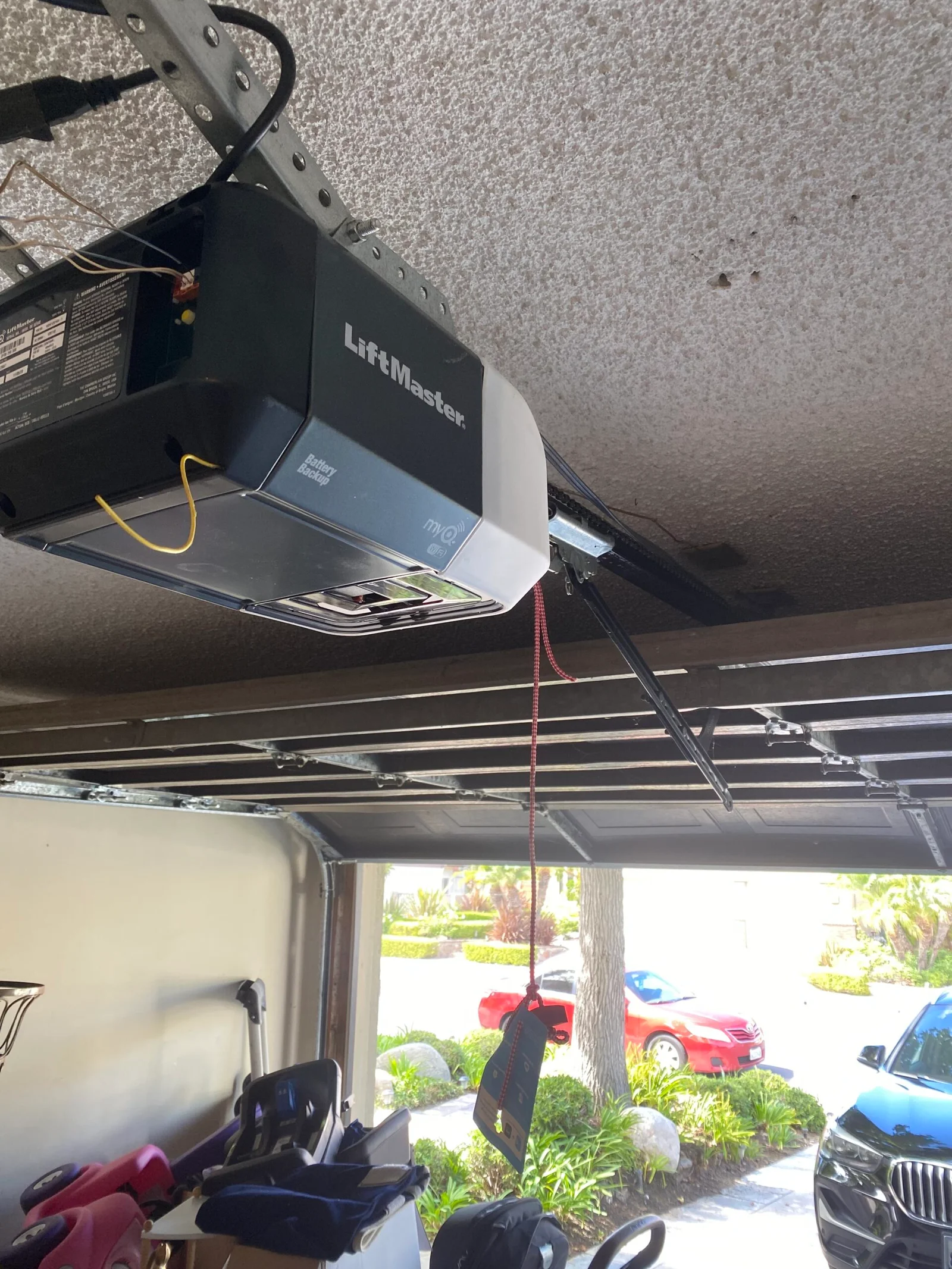
After cable repair, the technician can test whether the opener moves the balanced door smoothly and whether travel and safety functions remain appropriate. Opener adjustments should not be used to hide an unresolved cable or balance problem.
What Santa Clarita Homeowners Should Do Right Now
- Stop operating the opener. Repeated cycles can make a crooked or jammed door worse.
- Keep people and pets away from the door path. This is especially important if the door is open, tilted, or off track.
- Do not touch the loose cable. A cable can look slack while other parts of the system remain under significant spring tension.
- Observe the spring from a safe distance. Note whether a torsion spring has a visible gap or whether you heard a loud bang before the cable issue appeared.
- Look at the tracks and rollers. Do not attempt to reposition them; simply note whether a roller has left the track or the track appears bent.
- Note the door position. Tell the repair company whether it is fully closed, partly open, fully open, or hanging crooked.
- Explain whether a vehicle is trapped. Access can change the practical urgency of the service call.
- Explain whether the garage can be secured. A door stuck open creates a different problem than a closed door with a broken cable.
- Take a photo only from a safe position. Do not climb under the door or onto a ladder beside high-tension hardware.
- Ask for a complete cable-and-balance diagnosis. The goal is to find why the cable failed or came off, not just make the door move once.
Should You Pull the Emergency Release if the Cable Broke?
Not automatically. The emergency release disconnects the opener trolley from the garage door. It does not repair a broken cable, restore spring tension, or stabilize a crooked door. If the door is open or partly open, disconnecting the opener can change how the door is supported and may allow unexpected movement.
If one cable has failed, the door may be supported unevenly. If a spring is also broken, the door may be much heavier than expected. If a roller is off track, manual movement may make the situation worse.
When the door is mechanically damaged or its stability is uncertain, leave the release alone and ask a trained technician for guidance. Emergency-release procedures are more appropriate for a mechanically sound, balanced door when the opener itself or electrical power is unavailable.
Can You Open or Close a Garage Door With a Broken Cable?
A door with a broken cable should not be treated as safe for normal operation. Even if the opener can move it, the door may be lifting unevenly and placing abnormal force on tracks, rollers, panels, and the opener. A door that appears to move can still be mechanically unstable.
If the door is fully closed, leaving it closed is often the safer choice until it can be inspected. If it is open or partly open, do not stand under it or attempt to muscle it down. If a vehicle is trapped, tell the service provider; do not convert an access problem into a high-tension DIY repair.
There is no universal manual-lifting instruction that is safe for every cable failure because spring condition, door weight, track alignment, and which cable failed all matter.
Garage Door Cable Symptom Matrix: What the Pattern May Suggest
| Symptom | Possible cable-related explanation | Other conditions to rule out |
|---|---|---|
| Cable hanging loose on one side | Cable off drum, broken cable, lost tension | Broken spring, damaged drum, uneven door position |
| Door rises higher on one side | One cable not carrying normal lift force | Track binding, roller damage, spring imbalance |
| Cable tangled around drum | Improper winding after tension loss | Drum damage, spring failure, forced movement |
| Door stuck halfway and crooked | Uneven cable tension can rack the door | Off-track roller, bent track, panel damage |
| Frayed strands near bottom fixture | Wear or rubbing at cable attachment/travel area | Fixture damage or misalignment |
| Frayed strands near drum | Drum winding or rubbing problem may be involved | Incorrect cable, damaged drum, alignment issue |
| Opener hums while door barely moves | Door may be jammed from cable imbalance | Broken spring, opener drive failure, track obstruction |
| Door was normal, then loud bang and cable slack | Cable tension may have changed after spring failure | Confirm spring break and inspect both sides |
The matrix is not a substitute for inspection. Its purpose is to show why a visible cable problem should be diagnosed as part of the complete lifting and balance system.
Broken Cable or a Bigger Balance Problem?
A cable can fail by itself, but it can also come off after a spring, drum, track, or roller problem changes door tension. The diagnosis should identify the sequence of failure before parts are replaced.
Why Garage Door Cable Repair Is Not a Good DIY Project
Garage door cables connect to a system that can store substantial mechanical energy. On torsion systems, the cable drums are mounted on the spring shaft. Bottom fixtures can be connected to cable tension. Adjusting a drum or loosening hardware can release force unexpectedly.
DASMA warns that bottom brackets are under extreme tension because they are connected to the spring system and states that they should be adjusted or loosened only by trained door-system technicians. The association also advises that worn or frayed cables should be replaced by trained technicians because of the high spring tension involved.
Homeowners should not wind or unwind torsion springs, loosen winding cones, remove spring brackets, adjust cable drums, reconnect lift cables under tension, or loosen bottom fixtures in an attempt to save a service call.
What a Professional Cable Repair Diagnosis Should Include
A useful cable repair visit should identify the failed cable and then inspect the system that controls cable tension. That may include both lift cables, cable drums, torsion shaft, springs, center and end bearings, bottom fixtures, rollers, tracks, hinges, panels, and the opener connection.
The technician should determine whether the cable broke from wear, became damaged because of rubbing or misalignment, or came off the drum after another failure. If the door is crooked, the tracks and rollers should be checked for damage created during the event. If a spring is broken, spring repair must be addressed before the door can be properly balanced.
After repair, both sides of the door should move in coordination. Cable winding should remain orderly on the drums. The door should be level, travel smoothly, and remain mechanically balanced before the opener is relied on for normal operation.
Lift Cables, Retaining Cables, and Why Terminology Matters
Homeowners sometimes use the word “cable” for several different components. On a torsion-spring door, the lift cables run from the bottom fixtures to the cable drums and help raise the door. On some extension-spring systems, separate safety or retaining cables run through the extension springs to help contain a spring if it breaks.
Those cables serve different purposes. A broken lift cable directly affects how the door is raised and balanced. A missing or damaged extension-spring safety cable is primarily a containment and safety concern. DASMA advises that extension-spring systems use safety cables because extension springs are under high tension when the door is down.
When calling for service, a photo from a safe distance can help the technician understand which cable you are referring to. Avoid touching either type while trying to identify it.
If One Lift Cable Broke, Does the Other Cable Need Replacement Too?
There is no responsible one-sentence answer for every garage door. The remaining cable should be inspected for fraying, corrosion, flattening, kinks, damaged end fittings, and similar wear. If both cables were installed together and have experienced the same number of cycles, the second cable may show comparable aging, but condition and system requirements should guide the recommendation.
Ask the technician why one cable or both cables are being recommended. The answer should be tied to visible condition, compatibility, matching length and construction, and the goal of keeping the two sides of the door lifting evenly.
Do not approve an automatic “both sides every time” rule without explanation, and do not insist on keeping a visibly deteriorated opposite cable merely to reduce the immediate price.
What if the Cable Drum Is Damaged or the Cable Keeps Coming Off?
A cable that repeatedly comes off the drum suggests that the cause may not have been fully corrected. The drum can be worn or damaged, the cable may be winding incorrectly, the shaft or spring system may not be set properly, or the door may be moving unevenly because of track, roller, or balance problems.
The technician should inspect drum grooves and cable seating, confirm that the drum is compatible with the door and cable, and determine whether the shaft and spring system are operating correctly. A recurring cable-off-drum problem should not be handled as a simple reset every time.
Repeated failure is also a reason to inspect the door for racking or structural movement. A cable can be perfectly new and still have trouble if the door does not travel squarely through the opening.
What Affects Garage Door Cable Repair Cost in Santa Clarita?
Garage door cable repair cost varies with the actual diagnosis. The price can depend on whether the cable is frayed, broken, or simply off the drum; the type and size of cable; door dimensions and weight; spring configuration; drum condition; track or roller damage; door alignment; labor; scheduling; and whether additional components failed during the event.
A cable-only repair is different from a cable failure that also leaves the door off track or damages a drum. A broken spring with loose cables is also a different scope from a cable that frayed while the rest of the counterbalance system remained intact.
This article does not publish a fixed Next Hour Garage Door Repair cable price, promise a free estimate, or state that special scheduling has no additional charge. Ask how diagnosis and service-call charges are handled and request the final repair price before authorizing work.
Does a Broken Cable Mean You Need to Replace the Garage Door?
Usually, a broken lift cable by itself does not mean the entire garage door must be replaced. If the sections, tracks, rollers, hinges, spring system, and structural attachment points remain serviceable, cable repair can restore the lifting system.
The decision changes when the cable failure happened during a severe off-track event, vehicle impact, or structural failure that bent multiple panels and tracks. In that situation, homeowners may need to compare component repair, panel repair, and full door replacement.
If cable failure exposed broader structural damage, our guide to garage door repair versus replacement explains how to compare those options without assuming that every major-looking failure requires a new door.
What Should Be Checked After Garage Door Cable Repair?
After cable repair, the door should be evaluated through its complete mechanical travel before normal opener use resumes. The repaired cable should remain correctly seated on the drum. The opposite cable should maintain compatible tension. The door should remain level rather than rising on one side.
Rollers should stay inside the tracks without scraping or binding. Tracks should remain secure and aligned. Hinges and panels should not show twisting created by the earlier crooked movement. If the door went off track during the cable failure, the repaired system should be checked for damage that could cause another derailment.
Door balance is also important. A cable repair cannot compensate for a spring system that is still incorrect or damaged. The door should move in a controlled way with the counterbalance system functioning properly.
Only after the mechanical system is restored should the opener be relied on for normal operation. The technician can then check full opening and closing travel, listen for strain, and verify that the opener is not masking a balance or track problem.
When a Cable Problem Becomes an Urgent Garage Door Situation
A cable problem deserves greater urgency when the door is hanging crooked, a roller is off track, the door is stuck open and the garage cannot be secured, the door is partly open and unstable, or a vehicle is trapped behind a door that cannot be moved safely.
Urgency does not change the safety rules. Do not force the opener, do not pull the cable, do not stand beneath the door, and do not attempt to unwind spring tension. Describe the practical problem when you call: “the door is stuck open,” “one cable is hanging,” “one side is higher,” or “the vehicle is trapped.”
A closed, stable door with a frayed cable that has not yet failed still deserves prompt professional attention because visible cable wear can progress. DASMA specifically recommends visual cable inspection and professional replacement when cables are frayed or worn.
Santa Clarita Conditions and Cable Wear: Useful Context Without Guessing the Cause
Santa Clarita garages operate in a warm, dry Southern California environment where dust, direct sun, garage heat, and frequent daily use can affect a range of garage door components. Those conditions can be relevant to inspection and maintenance, but they should not be used to claim that local heat or canyon conditions caused a particular cable to snap without evidence.
Daily usage can matter more directly because every opening and closing cycle moves the cables around the drums and loads the spring system. A garage used as the primary household vehicle entrance may accumulate more cycles than a garage opened only occasionally.
For homeowners in Santa Clarita, Valencia, Canyon Country, Saugus, Newhall, Stevenson Ranch, Castaic, and Hasley Canyon, the same rule applies: inspect visible cable condition from a safe distance and address fraying, crooked movement, or repeated cable problems before forcing the door through another cycle.
Can Maintenance Help Catch Cable Problems Before They Snap?
Routine visual inspection can help identify frayed strands, corrosion, unusual slack, cable rubbing, or changes in door alignment before a complete cable failure occurs. Homeowners can also pay attention to new scraping, jerking, popping, or uneven travel.
Maintenance does not mean adjusting the cable drums or spring tension. Those tasks involve the counterbalance system and should be handled by trained professionals. A homeowner maintenance routine is better focused on observation, keeping the door path clear, following manufacturer lubrication instructions for appropriate components, and arranging service when something changes.
DASMA recommends regular safety checks and notes that garage door parts wear over time. A cable inspection can be part of a broader review that also looks at springs, rollers, tracks, hinges, and opener safety functions.
12 Questions to Ask Before Approving Garage Door Cable Repair
- Did the cable break, fray, or simply come off the drum?
- What caused the cable to lose tension?
- Is the spring system still functioning correctly?
- Is the opposite lift cable in serviceable condition?
- Are the cable drums damaged or worn?
- Did the cable problem bend a track or push a roller out?
- Is the garage door still square and structurally sound?
- Will door balance be checked after the cable repair?
- Will the opener be tested only after the mechanical door is restored?
- What parts and labor are included in the quoted repair?
- Will I approve additional work before it is performed?
- What final safety and full-travel checks will be completed?
California homeowners who want to verify contractor information can use the official California Contractors State License Board Check a License tool. CSLB describes a D-28 Doors, Gates and Activating Devices classification covering installation, modification, and repair of door systems. This article does not claim a specific Next Hour license number.
Why Consider Next Hour Garage Door Repair Santa Clarita for a Cable Problem?
Next Hour Garage Door Repair Santa Clarita | Garage Spring & Opener Repair is a local option for homeowners dealing with loose, frayed, broken, or displaced garage door cables and related crooked-door or off-track problems.
A strong cable diagnosis should focus on more than replacing wire. It should evaluate why tension changed, whether the spring system is working correctly, whether the drums and tracks were damaged, whether the door remains square, and whether the opener was strained during the failure.
For current service availability, call (661) 449-2694, review the dedicated garage door cable repair service page, or view Next Hour Garage Door Repair Santa Clarita on Google Maps.
Santa Clarita Valley Service-Area Context
The primary geographic focus for this guide is Santa Clarita, California, including the 91387 local context. Next Hour Garage Door Repair Santa Clarita also serves relevant Santa Clarita Valley communities when current scheduling allows, including Valencia, Canyon Country, Saugus, Newhall, Stevenson Ranch, Castaic, and Hasley Canyon.
These community names describe service geography; they do not mean the company maintains a separate physical office in every community. When calling, provide the city or ZIP code and explain the cable symptom so current service coverage can be confirmed.
Frequently Asked Questions About Broken or Loose Garage Door Cables in Santa Clarita
What should I do if my garage door cable breaks?
Stop operating the opener, keep people away from the door, and do not pull or reconnect the cable. Note whether the door is crooked, off track, partly open, or showing a broken spring, then arrange professional inspection of the cable, drums, spring system, tracks, and door balance.
Why did my garage door cable come off the drum?
A cable can come off the drum after tension changes caused by a broken spring, crooked door movement, track or roller binding, an obstruction, a damaged drum, impact, or incorrect previous adjustment. The cause should be identified before the cable is reset.
Is it safe to use a garage door with one broken cable?
No. One broken lift cable can make the door move unevenly, bind in the tracks, or become unstable. Even if the opener can move the door, continued operation can create additional damage.
Can I put a garage door cable back on the drum myself?
It is not recommended. Cable drums work with the high-tension spring system. Adjusting drums, springs, bottom fixtures, or lift cables can release stored mechanical force unexpectedly.
Why is my garage door crooked after a cable broke?
The two sides are no longer receiving equal lift support. One side can rise or fall differently, causing the door to rack, bind, or push rollers against the tracks.
Can a broken cable make the garage door come off track?
Yes. Uneven cable tension can make the door travel crooked, increasing the chance that rollers bind or leave the track. Other track, roller, spring, or impact problems can also contribute.
Can a broken garage door spring cause the cable to come off?
Yes. The spring, drums, and lift cables work together. When spring tension is lost, a cable may go slack or wind incorrectly. A visible spring gap or recent loud bang should be reported during the cable diagnosis.
How much does garage door cable repair cost in Santa Clarita?
Cost depends on the diagnosis, cable type, door weight and size, spring and drum condition, track or roller damage, labor, scheduling, and whether additional components failed. Ask for the final repair price before authorizing work.
Does one broken cable mean the whole garage door needs replacement?
Usually not. Cable repair may be enough when the door sections, tracks, rollers, springs, and structure remain serviceable. Replacement becomes a separate decision when severe structural or multi-component damage is also present.
When is a garage door cable problem urgent?
Treat it with greater urgency when the door is hanging crooked, off track, partly open and unstable, stuck open so the garage cannot be secured, or trapping a vehicle. Do not force the door while waiting for professional help.
Need Help With a Broken, Loose, or Off-Drum Garage Door Cable?
If a cable is hanging, frayed, snapped, tangled on the drum, or making the garage door sit crooked, stop using the opener when continued operation could worsen the condition. Do not touch spring, drum, bottom-bracket, or cable hardware under tension.
Ask About Current Garage Door Cable Repair Availability
Call Next Hour Garage Door Repair Santa Clarita | Garage Spring & Opener Repair at (661) 449-2694. Describe whether the cable broke or came off, the door position, whether the door is crooked or off track, and whether a spring appears damaged.
One Response