Residential Garage Door Repair Santa Clarita
A complete homeowner guide to residential garage door repair in Santa Clarita, including broken springs, opener problems, cables, rollers, tracks, safety sensors, doors that will not open or close, repair-versus-replacement decisions, safety concerns, maintenance, and professional garage door service.
What Does Residential Garage Door Repair in Santa Clarita Include?
Short answer: residential garage door repair in Santa Clarita can involve diagnosing and correcting problems with springs, garage door openers, cables, rollers, tracks, hinges, safety sensors, panels, weather seals, and other components that allow a residential garage door to lift, lower, balance, close, and secure properly.
The correct repair depends on the symptom. A garage door that suddenly feels extremely heavy may have a broken spring or counterbalance problem. An opener that runs while the door does not move may involve the trolley, drive system, spring system, or another mechanical failure. A garage door that closes and immediately reverses may involve safety sensors, an obstruction, travel settings, or excessive resistance.
Because a residential garage door functions as one connected system, the visible symptom does not always identify the failed component. A professional inspection should consider door balance, springs, cables, rollers, tracks, opener operation, sensors, attachment hardware, and overall door movement before determining whether repair or replacement makes sense.
Garage door springs, cables, and heavy moving door sections can present serious safety risks. Homeowners can observe symptoms and keep the area clear, but repairs involving loaded springs, lifting cables, or structural hardware are generally better handled by a garage door professional.
Why Residential Garage Door Problems Should Be Diagnosed Early
A residential garage door is one of the largest moving systems attached to many Santa Clarita homes. Springs, cables, rollers, tracks, hinges, safety equipment, and the automatic opener all work together every time the door opens or closes.
When everything is functioning correctly, homeowners may barely notice these components. When one begins wearing out or fails, however, the symptoms can quickly affect convenience, access, security, and safe operation.
A garage door may begin making an unusual grinding or squeaking noise several weeks before a roller or hinge becomes severely worn. A spring may gradually lose effective tension before it eventually breaks. A lift cable can begin fraying before the garage door becomes visibly uneven. An automatic opener may begin struggling because the garage door itself is becoming difficult to lift rather than because the opener motor has failed.
This interaction between components is why professional residential garage door repair should start with diagnosis rather than automatically replacing the part that appears most obvious.
For example, a Santa Clarita homeowner may notice that the garage door stops halfway while opening. Possible causes can include a garage door opener travel problem, track resistance, worn rollers, spring imbalance, a cable problem, or more than one condition occurring together.
Replacing an opener without first evaluating the door's balance could leave the underlying mechanical problem unresolved. Likewise, replacing springs would not correct an electronic opener problem if the garage door itself is properly balanced.
A useful garage door service visit should therefore answer several important questions: What actually failed? Why did it fail? Are related components contributing to the problem? Is the garage door safe to operate? Is a repair appropriate, or is replacement worth considering?
What Residential Garage Door Problems Are Common in Santa Clarita?
Most residential garage door repair calls begin with a symptom rather than a confirmed diagnosis. Homeowners usually notice that the door will not open, refuses to close, becomes noisy, moves unevenly, feels unusually heavy, or behaves differently when the opener is activated.
Garage Door Will Not Open
Possible causes include a broken garage door spring, opener malfunction, disconnected trolley, damaged cable, track obstruction, electrical issue, or an excessively heavy and unbalanced garage door.
Garage Door Will Not Close
Safety sensors, track resistance, travel settings, obstructions, opener problems, or damaged garage door hardware may prevent normal closing.
Garage Door Becomes Heavy
A door that suddenly becomes difficult to lift can indicate a spring or counterbalance problem. Continuing to operate the automatic opener can place additional stress on the system.
Garage Door Moves Unevenly
Uneven movement can involve cables, cable drums, rollers, tracks, spring balance, or impact damage. A visibly crooked garage door should not be repeatedly operated.
Garage Door Is Noisy
Squeaking, popping, grinding, and scraping sounds may come from rollers, hinges, tracks, springs, or garage door opener components.
Garage Door Reverses
A closing garage door that immediately reverses may involve safety sensors, an obstruction, incorrect travel settings, or abnormal resistance during movement.
Some residential garage door problems are inconvenient but relatively contained. Others may indicate a more immediate safety issue.
A damaged decorative component is very different from a broken spring, hanging cable, roller that has left the track, or a garage door that appears at risk of falling.
If movement becomes visibly unstable, homeowners should avoid repeatedly cycling the garage door simply to see whether the problem corrects itself.
How Is a Residential Garage Door Problem Diagnosed?
A garage door repair diagnosis should determine whether the failure is primarily mechanical, electrical, alignment-related, or a combination of several conditions.
A technician may begin by asking when the problem started, whether it happened suddenly or gradually, whether an impact occurred, what sounds were heard, and how the automatic opener responds.
The garage door system can then be evaluated as a whole. Important components include the torsion or extension springs, lifting cables, cable drums, tracks, rollers, hinges, opener rail, trolley, drive system, safety sensors, wall control, and attachment points.
Garage door panels and the bottom section may also provide evidence of physical damage or alignment problems.
Garage Door Balance Matters
An automatic garage door opener is not intended to compensate for a garage door that has become excessively heavy because its counterbalance system is no longer working correctly.
When spring tension is inadequate or a spring has broken, the opener may struggle, stop, or make sounds that initially appear to be an opener failure.
This distinction is important because installing a new garage door opener would not solve a broken spring or severe balance problem.
Related Garage Door Components Should Be Inspected Together
Garage door components wear at different rates, but their performance is connected.
A worn roller can create additional resistance in the track. A cable problem can cause one side of the garage door to rise differently than the other. Loose hinges may contribute to noise or unusual movement. Sensor problems can prevent closing even though the mechanical garage door itself remains functional.
The goal of diagnosis is not to replace every older component. It is to identify the actual problem, determine whether related parts have been affected, and separate necessary repair from optional maintenance.
Residential Garage Door Spring Repair in Santa Clarita
Springs are a critical part of the counterbalance system on many residential garage doors. Their job is to offset much of the garage door's weight so the door can move in a controlled manner.
Depending on the garage door system, a home may use torsion springs mounted above the garage door opening or extension springs positioned near the horizontal tracks.
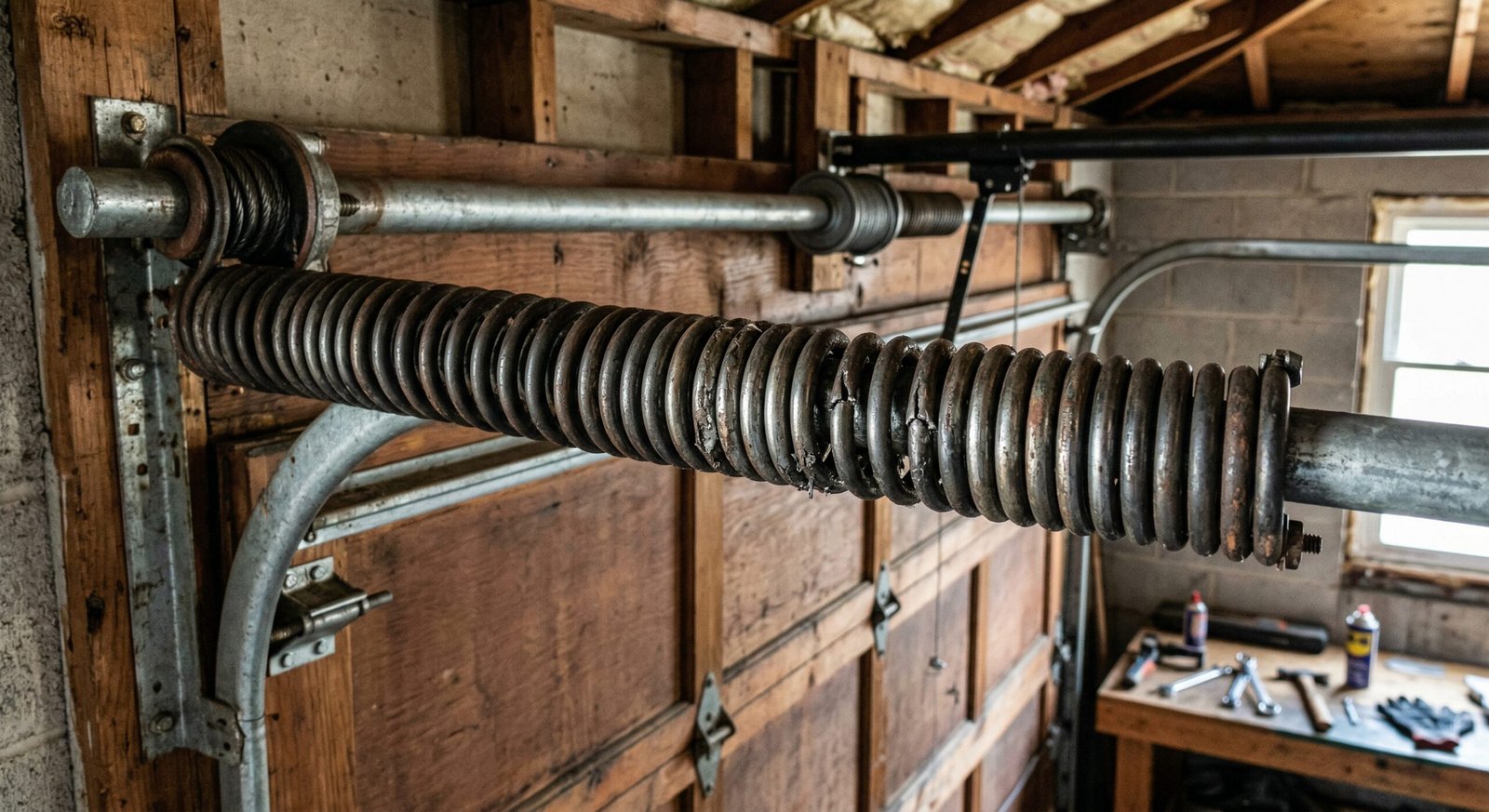
A broken torsion spring may sometimes be identified by a visible separation in the spring coil. Other symptoms may include a garage door that suddenly becomes extremely heavy, an opener that can no longer raise the door, or a loud sound when the spring fails.
Why a Broken Spring Can Look Like an Opener Problem
When a garage door spring fails, the automatic opener may still make noise or attempt to operate. Homeowners may therefore assume that the opener itself is defective.
However, an opener is designed to move a properly balanced garage door—not lift the entire weight of a garage door whose spring system is no longer providing counterbalance.
A spring-related service visit may therefore include inspection of the spring system, door balance, cables, drums, and related hardware before the repair recommendation is finalized.
Garage Door Spring Safety Warning
Garage door springs can store significant mechanical energy. Winding, unwinding, removing, or replacing a high-tension spring should not be treated as a trial-and-error homeowner repair.
Cables connected to a loaded spring system should also not be loosened casually. If a spring is broken or the garage door is visibly unstable, avoid operating the system until it can be evaluated.
Garage Door Opener Repair for Santa Clarita Homes
Automatic garage door openers provide convenient access, but not every opening or closing problem begins inside the opener motor.
Before replacing an opener, the mechanical garage door should be evaluated to determine whether it moves correctly and whether the counterbalance system is functioning.
Common garage door opener problems may involve the motor, internal drive system, trolley or carriage, rail, wall control, remote control, power supply, safety sensors, travel settings, or electronic controls.
Depending on the failure, the opener may run but fail to move the garage door, stop before reaching the desired position, reverse unexpectedly, or fail to respond to one or more controls.
Garage Door Safety Reversal Systems
Modern residential garage door opener systems include safety features intended to reduce the risk of entrapment.
Homeowners can review automatic residential garage door operator information from the U.S. Consumer Product Safety Commission for additional information about applicable residential garage door operator safety requirements.
UL also provides information about UL 325 garage door operator safety considerations .
If a garage door no longer reverses appropriately or its safety sensors are not functioning as intended, the condition should not be ignored merely because the garage door can still be forced to operate.
Repair or Replace the Garage Door Opener?
Opener repair may make sense when the failure is isolated and the current system remains otherwise serviceable.
Replacement may deserve consideration when a major internal component has failed, compatible replacement parts are difficult to obtain, the opener is significantly outdated, or the homeowner wants newer control, connectivity, or safety features.
The age of an opener alone should not determine the decision. Condition, compatibility, repairability, availability of parts, and the difference between repair and replacement should all be considered.
Garage Door Cable, Track, and Roller Problems
Springs provide counterbalance, while cables, drums, rollers, tracks, and hinges help translate that force into controlled garage door movement.
When one of these components becomes damaged or severely worn, the garage door may rise unevenly, bind, scrape, lean, shake, or move out of its intended track.
Garage Door Cable Problems
Lift cables operate under load. Fraying, corrosion, improper winding on a cable drum, slack, or a completely broken garage door cable can affect the position and stability of the garage door.
A garage door that rises noticeably higher on one side should not be repeatedly operated in hopes that it will straighten itself.
Garage Door Track Problems
Tracks guide the rollers as the garage door moves. A track can become bent because of impact, loosen at its attachment points, or develop alignment problems.
Minor cosmetic irregularities are different from structural track displacement. The severity of the damage should be evaluated before deciding whether adjustment, reinforcement, or track replacement is appropriate.
Worn Garage Door Rollers
Worn or damaged rollers can contribute to rough or noisy movement. Depending on their construction and condition, rollers may develop excessive play, damaged bearings, or difficulty moving smoothly through the track.
Tracks and hinges should be considered at the same time because installing a new roller into a significantly damaged track does not correct the entire problem.
When Should You Stop Operating the Garage Door?
Avoid repeatedly operating the garage door if a cable is hanging loose, the door is severely crooked, multiple rollers are outside the track, a track is separating from its mounting point, or the garage door appears at risk of falling.
Why Does a Residential Garage Door Refuse to Close?
Safety sensor problems are one common reason an automatic garage door refuses to close normally.
Many opener systems use photoelectric sensors positioned near the bottom of the garage door opening. When the opener detects a problem with the safety circuit or perceives an obstruction, normal closing may be interrupted.
Homeowners can visually check whether an object is obviously blocking the doorway or whether a sensor appears to have been bumped out of position. Dust and debris may also interfere with some sensor systems.
However, repeatedly bypassing a safety behavior without understanding why it is occurring defeats the purpose of the protection.
Sensor symptoms can also resemble other garage door problems. A closing garage door may reverse because it encounters unusual resistance or because opener travel settings are incorrect.
That is why the complete movement of the garage door should be considered instead of assuming that every reversal is caused by dirty or misaligned sensors.
Should You Repair or Replace a Residential Garage Door?
Many residential garage door problems can be repaired without replacing the entire garage door.
A broken spring, damaged cable, worn roller, safety sensor problem, or repairable garage door opener fault does not automatically mean the garage door itself needs replacement.
Garage Door Repair May Make Sense When
- The failure is isolated to a specific repairable component.
- The garage door panels remain structurally suitable.
- Compatible repair parts remain available.
- The garage door can be restored to normal movement without disproportionate repair expense.
- The system does not have widespread structural deterioration.
Full Garage Door Replacement May Make Sense When
- Several garage door sections are severely damaged.
- The door structure is significantly compromised.
- Multiple major components require substantial work at the same time.
- The homeowner wants a significant design, insulation, material, or functionality change.
- Repair would not restore safe or appropriate operation.
Garage Door Panel Replacement Can Be a Middle Option
In some cases, physical damage affects only one garage door section. If a compatible matching panel is available and the remainder of the garage door is in suitable condition, panel replacement may be worth considering.
Matching depends on garage door manufacturer, model, dimensions, design, color, age, and availability.
Homeowners considering larger garage alterations can also review information from the City of Santa Clarita Building & Safety Permit Center when determining whether a project may involve local permit requirements.
Residential Garage Door Symptom Comparison
| Garage Door Symptom | Possible Causes | Recommended Next Step | Urgency |
|---|---|---|---|
| Garage door suddenly becomes extremely heavy | Broken spring or counterbalance problem | Stop forcing the opener and inspect spring/balance system | High |
| Garage door opener runs but door does not move | Disconnected trolley, drive problem, broken spring, mechanical issue | Evaluate opener connection and garage door balance | Moderate to High |
| Garage door closes and immediately reverses | Safety sensor, obstruction, travel setting, excessive resistance | Clear obvious obstruction and diagnose persistent reversal | Moderate |
| Garage door becomes visibly crooked | Cable, drum, spring, roller, or track problem | Stop operation and inspect lifting/alignment system | High |
| Grinding or scraping sounds | Roller, track, hinge, spring, or opener component | Identify the location and cause before replacing parts | Moderate |
| Garage door remote works inconsistently | Battery, receiver, interference, control issue | Compare wall control and remote operation | Low to Moderate |
| Garage door cable is hanging or loose | Cable/drum problem, spring failure, loss of tension | Do not pull or reconnect loaded cable; schedule inspection | High |
| Garage door will not stay in normal position | Balance, spring, structural, or hardware problem | Avoid unsupported movement and arrange evaluation | High |
This comparison is intended as a troubleshooting guide rather than a final diagnosis. Several different garage door failures can create similar symptoms.
What Affects Residential Garage Door Repair Cost?
Residential garage door repair pricing varies because the phrase "garage door repair" describes many different types of work.
Replacing a worn roller is different from repairing an off-track garage door, replacing a spring system, correcting cable damage, installing a garage door opener, or repairing impact damage.
Main Garage Door Repair Cost Factors
- Which garage door component failed
- Garage door size and weight
- Spring type and configuration
- Extent of track or cable damage
- Garage door opener type
- Number of damaged components
- Accessibility
- Replacement-part availability
- Whether additional damage occurred after the original failure
- Whether urgent or same-day scheduling is requested
Why an Exact Online Price Is Often Difficult
Two garage doors showing the same symptom can require completely different repairs.
A garage door that "will not open" could have a broken spring, an opener problem, a damaged cable, a track problem, or even a control issue.
Quoting a single repair price before identifying which component has failed may therefore be misleading.
Compare the Scope of Work, Not Only the Price
When comparing garage door repair estimates, homeowners should look at exactly what is included.
One estimate may include only replacement of the failed component, while another may include related hardware, adjustments, or a different repair approach.
The scope should be understandable enough that the homeowner knows what is being repaired and why.
Why Santa Clarita Conditions Can Matter for Residential Garage Doors
Residential garage doors in the Santa Clarita Valley operate in an environment that can include extended heat, strong sunlight, dry conditions, wind, and airborne dust.
These conditions do not automatically cause a particular garage door component to fail, but they can influence how garage door systems age and how frequently certain maintenance issues appear.
Heat and Sun Exposure
Garage doors that receive prolonged afternoon sun can become very warm. Exterior weather seals, finishes, and some components may experience more sustained heat than systems installed in cooler coastal environments.
Dust Around Tracks and Safety Sensors
Dust can accumulate around tracks, rollers, garage door opener rails, and photo-eye sensors. Dust itself is not proof of a mechanical failure, but keeping the area clean can make inspection easier and help prevent simple obstructions.
Frequent Daily Garage Use
For many homeowners in Valencia, Saugus, Canyon Country, Newhall, Stevenson Ranch, and nearby Santa Clarita Valley communities, the garage is a primary daily entry point.
A garage door that cycles several times each day naturally accumulates more movement than a lightly used secondary garage.
Large Residential Garage Doors
Larger two-car garage doors can involve substantial weight, making proper spring balance especially important.
When the counterbalance system is no longer operating correctly, the automatic opener should not be expected to compensate for the full weight of the garage door indefinitely.
Older and Newer Santa Clarita Homes
Older homes may have aging hardware, replacement components, or garage door opener systems installed many years ago.
Newer master-planned communities may use insulated garage doors, newer opener technology, and connected access systems.
Neither older nor newer equipment should automatically be considered problematic. The correct repair should match the garage door system actually installed at the home.
Can Maintenance Reduce Residential Garage Door Problems?
Preventive garage door maintenance cannot eliminate every future failure. Springs eventually wear, electronic components can fail, and accidental impact damage may occur unexpectedly.
Maintenance can, however, help identify developing problems before they become more disruptive.
Changes Worth Paying Attention To
- New squeaking or grinding noises
- Garage door movement becoming jerky
- Door slowing down during travel
- Visible cable wear
- Garage door beginning to sit unevenly
- Repeated safety sensor problems
- Opener struggling to raise the garage door
- Rollers becoming noisy or unstable
- Weather seal becoming damaged
What a Professional Garage Door Inspection May Include
Depending on the system and problem, inspection may include garage door balance, spring condition, roller condition, track alignment, hinge condition, cable condition, opener attachment, safety sensors, weather seals, and related hardware.
Lubrication Does Not Replace Repair
Appropriate lubrication can be part of garage door maintenance for certain moving components, but it cannot repair a broken spring, straighten a severely damaged track, restore a frayed cable, or correct a failed garage door opener circuit.
If the garage door has an actual mechanical defect, covering up a noise without correcting the underlying problem can delay proper diagnosis.
Questions to Ask Before Hiring for Residential Garage Door Repair
Santa Clarita homeowners do not need to become garage door technicians to make an informed service decision.
A few focused questions can help clarify the diagnosis, repair scope, and whether the recommendation matches the actual condition of the garage door.
Questions Worth Asking
- What do you believe caused the garage door problem?
- Which garage door component has actually failed?
- Is the garage door safe to operate right now?
- Which parts need to be repaired or replaced?
- Did you inspect related garage door components?
- Is this a repair recommendation or replacement recommendation?
- If replacement is recommended, why is repair not practical?
- What exactly is included in the written estimate?
- Are labor and parts both included?
- What replacement parts are being installed?
- Are multiple repair options available?
- What maintenance may help reduce repeat problems?
The goal is not to challenge every recommendation. It is to understand what is being repaired and why.
Residential Garage Door Repair Red Flags
Be Careful When the Repair Recommendation Is Not Clearly Explained
- A vague verbal price without a clear repair scope
- Pressure to replace the entire garage door before inspection
- No explanation of what caused the garage door failure
- Parts being added without a clear reason
- A major price change that is not explained
- No distinction between necessary repair and optional maintenance
- No explanation of repair versus replacement
- A safety issue being dismissed without inspection
- The technician cannot identify the failed component
- Every garage door symptom is treated as requiring the same package
Residential garage door systems differ from home to home. A repair recommendation should relate to the condition of the specific garage door rather than relying on a generic repair package.
Why Consider Next Hour Garage Door Repair Santa Clarita?
Next Hour Garage Door Repair Santa Clarita | Garage Spring & Opener Repair is a residential garage door service option for homeowners throughout Santa Clarita and surrounding Santa Clarita Valley communities.
Services related to residential garage doors include garage door troubleshooting, broken spring repair, garage door opener repair, cable problems, safety sensor problems, roller and track problems, off-track garage doors, maintenance, and garage door installation.
For homeowners dealing with a garage door that will not open, refuses to close, has become unusually heavy, operates unevenly, or is producing abnormal sounds, the first objective should be identifying the cause before determining which components need repair or replacement.
Business Information
Next Hour Garage Door Repair Santa Clarita | Garage Spring
& Opener Repair
19410 Golden Valley Rd
Santa Clarita, CA 91387
Phone:
(661) 449-2694
Homeowners can also review garage door repair services in Santa Clarita through the company website.
Residential Garage Door Repair Across Santa Clarita
Residential garage door service may be relevant for homeowners throughout Santa Clarita and nearby Santa Clarita Valley communities.
Find Next Hour Garage Door Repair Santa Clarita
View the Google Business Profile and local business location for Next Hour Garage Door Repair Santa Clarita.
Residential Garage Door Repair Santa Clarita FAQs
What are the most common residential garage door repairs?
Common residential garage door repairs can involve broken springs, worn rollers, garage door opener problems, damaged or loose cables, safety sensor problems, off-track doors, noisy hinges, track issues, and garage doors that will not open or close correctly. Because several failures can produce similar symptoms, diagnosis should consider how the springs, cables, rollers, tracks, and opener interact.
When should I stop using a damaged garage door?
Stop operating the garage door when it is severely crooked, has a hanging cable, has rollers outside the track, appears at risk of falling, or suddenly becomes extremely heavy after a spring failure. Continued operation can cause additional damage. High-tension springs and loaded garage door cables should not be loosened or repositioned casually by a homeowner.
How can I tell if a garage door spring is broken?
Common signs can include a visible separation in a torsion spring, a loud noise when the spring fails, a garage door that suddenly becomes unusually heavy, or an opener that can no longer raise the door normally. Because other garage door problems can create similar symptoms, the spring system, cables, drums, and overall door balance should be evaluated.
Why does my garage door opener run but the door does not move?
Possible causes include a disconnected garage door opener trolley, a drive-system problem, a broken spring, or another mechanical condition preventing the garage door from moving. The opener should not automatically be replaced until the mechanical garage door and its balance have been evaluated.
Should I repair or replace my residential garage door?
Repair may make sense when the problem is isolated to a spring, cable, roller, sensor, opener component, or another repairable part and the garage door remains structurally suitable. Replacement may deserve consideration when structural damage is severe, multiple panels are compromised, or several major components require extensive repair at the same time.
How much does residential garage door repair in Santa Clarita cost?
Residential garage door repair cost depends on the failed component, garage door size and weight, spring configuration, opener type, extent of damage, replacement-part availability, and whether additional components were affected. An accurate estimate usually requires identifying the actual failure before determining the repair scope.
Why does my garage door close and then reverse?
A reversing garage door may be reacting to a safety sensor problem, obstruction, incorrect opener travel setting, or excessive resistance in the garage door's movement. Homeowners can remove obvious obstructions, but persistent reversal should be evaluated so the safety system and mechanical door movement can both be checked.
Can I get same-day residential garage door repair in Santa Clarita?
Same-day garage door service may be available depending on scheduling, the repair required, and replacement-part availability. When calling, clearly describe the symptom—such as a broken spring, stuck garage door, hanging cable, or opener failure—so the service provider can better understand the urgency and likely repair category.
Need Residential Garage Door Repair in Santa Clarita?
If your residential garage door will not open or close, has a broken spring, operates unevenly, has a garage door opener problem, or needs professional troubleshooting, identifying the cause is the first step toward deciding which components should be repaired or replaced.
Call (661) 449-2694Call Next Hour Garage Door Repair Santa Clarita at (661) 449-2694 for residential garage door repair in Santa Clarita and nearby areas.